Recent Articles
Popular Makes
Body Types
2007 Toyota Yaris Review
A respectable little car that could use a little more power
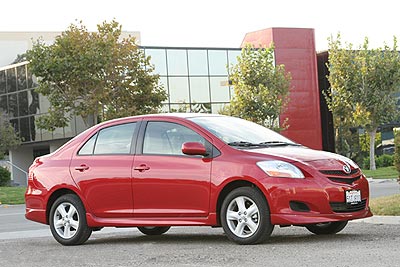
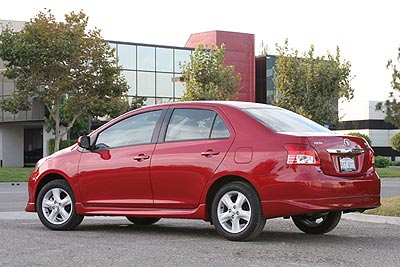
Toyota Yaris – Driving Impressions: Used to be that opting for an economy car required sacrificing most every automotive accoutrement in exchange for a cheap price and impressive fuel economy. Power steering? Don’t fret – you need to work on your upper body strength anyway. Rear defroster? That’s what ice scrapers are for. Cloth seats? Everyone should experience skin melding to vinyl on a steamy summer’s day. Air conditioning? You can’t be serious. In the end, you walk away with bulging biceps, blistered thighs, and a wallet full of cash that otherwise would have been spent on “unnecessary” features and gas. Fast forward to the 2007 model year, where inexpensive, efficient econoboxes are still available, and thanks to pricey petrol, increasingly popular. However, today’s buyer benefits from a bit more luxury and a lot less sacrifice. Take the 2007 Toyota Yaris, for example. With a base price under $11,000 and EPA-rated fuel economy as high as 40 mpg on the highway, this little import is all about saving money, yet at the same time it comes equipped with air conditioning and power steering. Finally, the public can determine that the bulky, sweaty guys crowding the room are steroid users and not economy car drivers. In addition, the Yaris can comfortably seat five, offers a touch of style, can be equipped with desirable options, and ponies up enough power to move along with (slow) traffic. Subcompact cars are known for not only their small size but also efficiency. In the case of the 2007 Toyota Yaris, this equates to a ride weighing in between 2,293 and 2,336 pounds with EPA estimates of 34 mpg city/40 mpg highway with a standard five-speed manual transmission, or 34 mpg/39 mpg when equipped with an optional four-speed automatic. Either way, you’re promised the mileage of a hybrid without the fancy technology – or high price. Unfortunately, our week long test of a Yaris S sedan with the standard manual transmission yielded only 27.5 mpg in mixed driving. But that figure needs to be taken with a grain of salt – Southern California was experiencing one of its hottest summers on record, thus necessitating the constant use of max air conditioning, and our right feet were often hard on the throttle, doing our darnedest to extract every drop of power from the 1.5-liter, dual overhead cam, 16-valve, four-cylinder engine using VVT-i (variable valve timing with intelligence). With 106 ponies running free at 6,000 rpm and only 103 lb.-ft. of torque available at 4,200 rpm, the Yaris is most definitely about economy, regardless that the S model’s decorative body kit suggests otherwise. The all-new Toyota Yaris rides on a rather basic suspension system utilizing MacPherson struts fore and a torsion beam axle aft, with a stabilizer bar bolted on up front with the driven wheels, which are in turn connected to a power rack-and-pinion steering system. Braking is accomplished through ventilated front discs coupled with rear drums. Antilock brakes are a $300 option. Three Yaris models are available: a three-door liftback, a four-door sedan, and an S sedan. The liftback, priced at $10,530 including a $530 destination charge, can be considered inexpensive transportation with just enough standard equipment to keep it off the bare-bones list. Included with the base sticker price is air conditioning, 175/65 tires rolling on 14-inch steel wheels, tilt steering, cloth upholstery, a cargo cover, a tachometer, and, well, that’s about it. However, you can plunk down $630 for the Convenience Package to get a sound system that plays CDs and MP3s, a rear defroster and wiper, 15-inch steel wheels, and a rear 60/40 split bench; $900 for the four-speed automatic transmission; $1,680 for a Power Package with alloy wheels ($1,290 without the alloys) that buys the Convenience Package as well as power door locks, power windows, power mirrors, ABS, and cruise control; side-curtain and front-side airbags for $650; $200 for a rear spoiler; and a whole host of other items like the stand-alone ABS package for $300, front fog lights, and keyless entry. Needless to say, you can make that $10,530 base price a distant memory if you check every box on the order sheet. Moving up to the sedan requires an outlay of at least $12,405 yet offers in return standard equipment such as a height-adjustable driver’s seat, an interior trunk lid release button, a rear three-point center seatbelt, and an in-glass radio antenna. But, sorry, the actual radio is still limited to the options list. However, for the ultimate Yaris experience, it has to be the S sedan that sells for $13,900. Included on this model is the rear 60/40 split bench seat, 15-inch steel wheels with 185/60 tires, the sound system that’s optional on lesser models, a body kit with “S” badges, and a rear center armrest. This is the example we utilized for testing, though ours came equipped with various add-ons including front-side and side-curtain airbags, keyless entry, and the Power Package with alloy wheels, bringing the total price to $16,355.
Performance
With 106 horses and 103 lb.-ft. of torque on tap, the 2007 Toyota Yaris is hardly a performance machine, but once its driver gets used to where the meat of the motor is and learns how best to extract the power, this littlest of Toyotas offers acceptable gusto considering its place in the subcompact segment. Off-the-line acceleration is less than thrilling, though once the revs climb a bit the engine starts to stir, making sure that the Yaris will at least get out of its own way. But to be sure, you’ve got to wring the little four-banger out in every gear to get decent acceleration. Provided there’s plenty of highway, cruising at 80-90 mph takes little effort, though don’t expect to tap into reserves for any multi-car passes. The five-speed manual transmission is a bit vague, and we felt a grind a few times when engaging reverse. Our average gas mileage reached only 27.5 mpg, which no doubt reflected a staff of heavy-footed editors. Those with more patience will surely see better results.
Handling
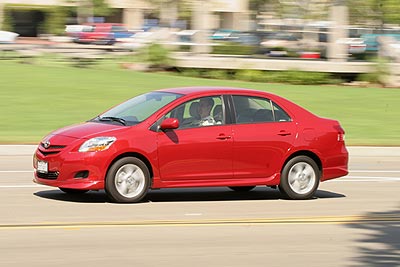
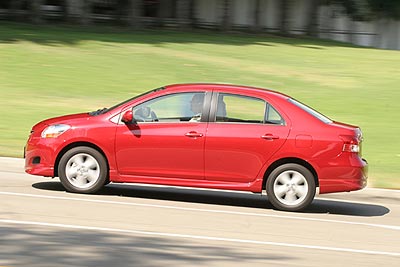
Don’t confuse the S treatment with any type of handling enhancements. Aside from some body add-ons and a few other changes, the Yaris S will offer the same ride as the Liftback and Sedan versions, body roll and all. The suspension is on the soft side and the front end plows when pushed hard into corners, but the 2007 Toyota Yaris is marketed as an efficient subcompact, so these traits are acceptable and not the least bit unexpected. Steering is moderately responsive with a touch of road feel thrown in, but the wheel feels a touch floaty at higher speeds. Nevertheless, one of our editors reported having a good time tossing the Yaris S through the gentle curves of Santa Monica’s Sunset Boulevard, despite never topping 60 mph and the ever-present body roll.
Visibility
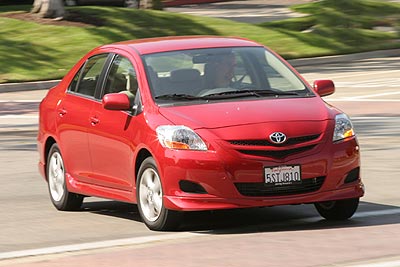
Though it looks small from the outside, the 2007 Toyota Yaris offers a big view of its surroundings from the inside. Aiding outward visibility are ample side mirrors, generous use of side glass, and rear pillars that are narrow enough to prevent any troublesome blind spots. If there’s a weak point, it would be the rear window – of the limited glass area available, too much of it is absorbed by the rear headrests.
Fun to Drive
For a car to be fun to drive, there has to be something that gets the blood pumping, something that puts a smile on your face, something that makes battling through traffic to reach your destination almost worth the hassle. All kinds of vehicles of various styles and sizes fill the bill, though not one of them carries a Yaris badge. It can be wrung out, the styling can be considered cute, and it offers a decent list of desired features, but at the end of the day the Yaris is a repackaged subcompact commuter car serving as A to B transportation and swilling as little fuel as possible. Fun is absent from the equation.
Front Comfort
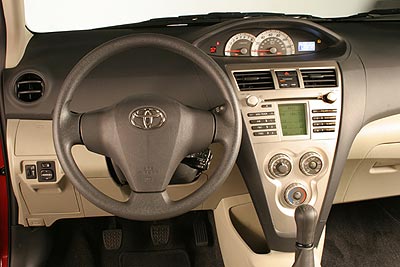
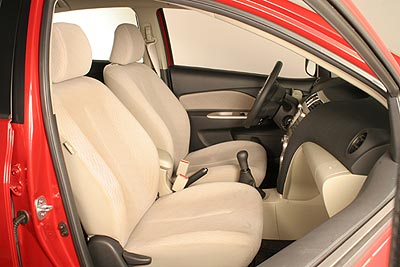
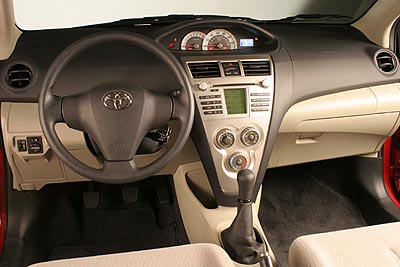
If used as a daily commuter, the Toyota Yaris offers front passengers acceptable accommodations in terms of comfort. The driver gets a tilt steering wheel for a suitable driving position, the side bolsters are a little lean but they’re in line with the car’s limited handling abilities, and there’s generous overall room. On the other hand, the Yaris is a low-priced economy car, a point made obvious by the hard plastic on the door sills and armrests, hard plastic on the lower dash upon which the unfortunate knee will occasionally brush, and the stiff seats that feel more like one big piece of rigid foam rather than traditional, somewhat soft cushions. Over the long haul, the hard surfaces and unforgiving seats become increasingly inhospitable.
Rear Comfort
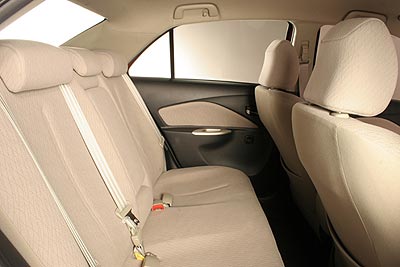
Rear seat passengers in the 2007 Toyota Yaris get the same stiff cushions as their fellow passengers up front, yet they’re offset by soft front seatbacks that are easy on the knees, a fold-down padded armrest (S model only), and wide-opening doors that allow for easy ingress/egress. For a subcompact car, the Yaris sedan offers a surprising amount of rear leg and foot room, however, head room is a bit tight. Adjustable headrests are provided for up to three passengers.
Interior Noise
There’s only so much one can ask of a car starting at less than $11,000, especially one that comes with a Toyota badge and standard features such as air conditioning and power steering. A quiet ride, while nice, fails to compare to the comfort of keeping cool on a baking summer day. To keep that introductory price so low, Toyota had to scrap items, like a basic radio, which is all that’s needed to drown out moderate levels of road and engine noise in the Yaris. Sound intrusion is far from what’s required to cause a loss of hearing, but it’s there and pronounced on the grooved concrete highways passing our Southern California offices. Wind noise is kept to a minimum, while our Yaris S was free of any squeaks or rattles.
Loading Cargo
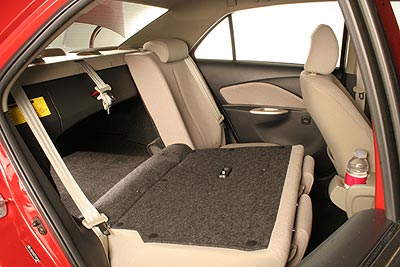
Our Yaris S sedan offered 13.7 cubic feet of trunk space, up from the base sedan (12.9) and the liftback (12.8) primarily because it’s the only model with a folding rear seat that splits. To release the seat backs, one needs to reach in and pull the handles – a better design would have put the handles on the outboard sides of the seats, closer to the doors. The folded seatbacks don’t lie flat, thereby limiting overall cargo room. A center pass-through is not available. Sedan models include an interior release for the trunk, which, when opened, provides a low load height and fairly wide opening for easy loading. The lid lacks a liner or a grab handle, though it’s low enough so as to not really require one – just prepare to be OK with palm prints on the paint.
Build Quality
We’ve honestly been surprised by the questionable build quality of recent Toyota test cars. Our 2007 Yaris S showed improvement, yet there were still more issues than one expects from this brand. Among them were irregular gaps around the dash panels and glovebox, wide gaps where the dash met the A-pillar and the plastic sills joined the door frame, slight gap inconsistencies along the hood seams, and cupholder covers that didn’t sit flush when closed.

Materials Quality
For those unfamiliar with the current new car market, the first thing to know is that well- or even decently-equipped vehicles under $20,000 are a rarity. Among the few available is the 2007 Toyota Yaris, and in order to provide an inexpensive ride with at least a few must-have features, corners had to cut somewhere. That’s where the headliner, hard as cardboard and finished in a fuzzy material, and the liberal use of hard plastics come in to play. Look all you like – aside from the seats, you will go crazy trying to find a soft-touch surface within the Yaris’ interior. The fabric on the seats and door panels has a very low-rent feel, and with our tester we unwittingly proved that it was easy to stain.