Recent Articles
Popular Makes
Body Types
2007 Saturn Sky Review
Today, skies are bright for Saturn, but the forecast might call for clouds

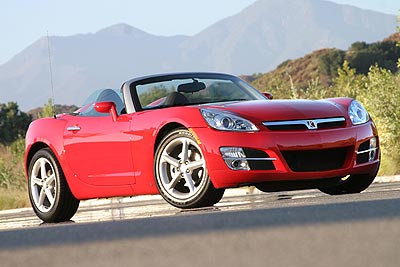
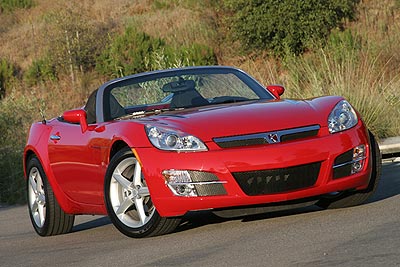
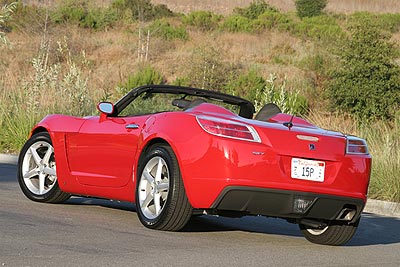
Saturn Sky – Driving Impressions: Now that Americans have forgotten all about no-haggle prices, dent-resistant body panels, and feel-good homecomings in the heart of Dixie, Saturn needs CPR. More than a decade of product development starvation and design by committee has left the once shining brand weak and gasping for breath, and the time is now for its parent, General Motors, to resuscitate the brand or Kevork it like Oldsmobile. The debut of the 2007 Sky roadster sends a clear message from the emergency room in Detroit: save the patient. Think of the Sky as an ultra-hot nurse arriving with a defibrillator. Too bad brains didn't arrive with this beauty. Based as it is on the same platform as the gorgeous but dynamically stunted Pontiac Solstice, the Saturn Sky is all looks, no action. Roadsters demand to be driven rapidly on beautiful roads, allowing occupants to revel in speed and scenery. In the Saturn Sky, however, a priority on form over function and an obvious emphasis on cost reduction results in an ultimately dissatisfying wind-in-the-hair experience. And though it suffers many of the same problems as the standard model, the turbocharged Sky Red Line variant's extra power goes a long way toward making the Sky a worthy competitor against the likes of the Honda S2000 and Mazda MX-5 Miata. In standard format, however, the Sky amounts to little more than a terrific styling exercise that sticks in a turn. Nevertheless, Saturn needs something approximating an image vehicle upon which to build its renaissance as an alternative to the Honda, Nissan, and Toyota status quo, and the flashy Sky should do the trick, which is to drive traffic to dealer showrooms. Under the Sky's lovely body work is a fundamentally sound foundation. The chassis is stiff, lending the roadster a solid, planted feel on the road. Equipped with 18-inch wheels wearing 45-series rubber mounted to a four-wheel-independent, double-wishbone suspension with Bilstein shocks, the Sky manages to couple a compliant ride with capable grip. A 2.4-liter four-cylinder engine with variable valve timing works up a sweat moving the Sky's near 3,000-pound curb weight despite Saturn's claim of 7.2 seconds to 60 mph, and though the manual transmission is massaged to add refinement and isolation from the mechanicals this powertrain is about as graceful as Homer Simpson. Power is driven to the rear wheels, and a five-speed automatic is optional. Brake pedal feel could be improved, allowing the driver to take better advantage of the four-wheel-disc antilock brakes, and though the steering is a hydraulically-assisted rack-and-pinion system with quick response, it filters too much road feel. If you're still falling in love at first sight, take comfort in the fact that the Saturn Sky we drove stickered for less than $25,000 (prices have been jacked a grand and a half since our test car was built), and that the powertrain is covered by GM's new five-year/100,000-mile warranty program. And here's a little known fact: Saturn offers a 30-day/1,500-mile exchange program, so if the Sky doesn't work for you just swap it for a new Aura sedan. Additionally, the Saturn comes better equipped than its sibling, the Solstice, right out of the box. Standard features include air conditioning, power windows, power mirrors, power door locks, remote keyless entry, cruise control, and a stereo with six speakers and a CD player. The Sky has no spare tire; instead, there's a sealant kit and an inflator, so try not to slice the sidewalls open. Other goodies include dual-stage front airbags, projector beam headlights and fog lights, and a cloth top with a glass rear window and defogger. Stability control is available only on the Saturn Sky Red Line. Key options include an automatic transmission ($850), leather upholstery ($750), a Monsoon audio system with a six-disc CD changer and MP3 player ($890), chrome wheels ($795), a limited-slip rear differential ($195), and XM satellite radio ($199). You can also plop a spoiler on the back ($275), but it ruins the Sky's lines. Saturn dealers can also add overpriced items like unique chrome wheels ($2,027), an unnecessary performance suspension kit ($1,584), and a presumably different rear spoiler ($314). Our Chili Pepper Red test car included Monsoon speakers without the CD changer ($590) and XM satellite radio for an as-tested price of $24,605 including the $575 destination charge ($25,984 with recent price hikes). After spending a week driving under Southern California's perpetually hazy skies, we've got mixed feelings about the Saturn Sky. Considering that it emerged from General Motors, it's a miracle the car even exists. However, without added attention to detail and an understanding that design can't always trump functionality, we fear that once the initial hullabaloo over this hot-looking new Saturn subsides, the Sky's future could be cloudy.
Performance
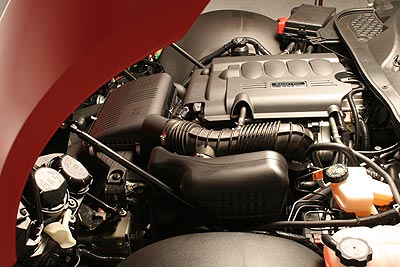
Saturn has made a big improvement over its corporate twin, the Pontiac Solstice, with regard to the five-speed manual transmission. Engineers have added something called a torque tube, which puts the mechanicals further back in the car while refining the shift action. Thus, the clunky and noisy shifting about which we complained with the Solstice is almost gone from the 2007 Saturn Sky. The standard four-cylinder engine, however, isn't the most refined piece of work. The Sky is quick – not fast – and delivered unimpressive fuel economy during our test driving. We average 20.3 mpg in the Sky. A Mazda MX-5 Miata that we drove for a week delivered 24.4 mpg and lots more powertrain refinement.
Handling
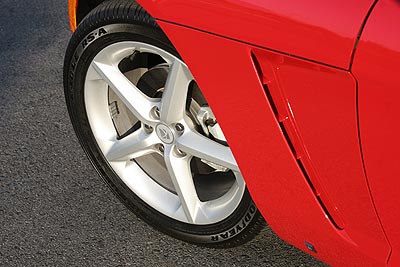
Endowed with plenty of grip thanks to 18-inch wheels and 245/45 Goodyear RSA tires, handling is definitely a Saturn Sky strong point. The car feels better connected to the road than a Mazda MX-5 Miata, but at the same time also heavier and wider. The Saturn's brake pedal needs to be recalibrated to deliver better feel so that the driver can feed fine-tuned amounts of pressure to the effective binders. Steering is responsive but lacks road feel. For a sport-tuned roadster, the Sky delivers a terrific ride quality that doesn't come at the expense of handling.
Visibility
Typically, roadsters are easy to see out of with the top down, but the driver sits so low in the Saturn Sky that the right headrest fairing on the rear decklid can hinder the rear three-quarter view. The side mirrors are also too small, and the long hood with prominent fenders – as sexy as they may appear – adds to the feeling that the Sky is wider and longer than it really is. Put the top up, and outward visibility problems worsen.
Fun to Drive
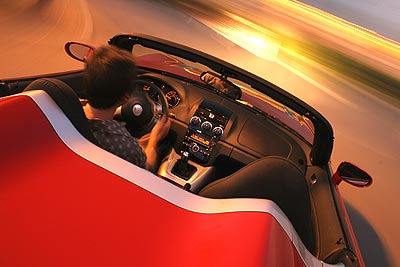
Gawk factor is high with the Saturn Sky, so if that's important to you this car is a good time. I also enjoyed driving it on the downhill portions of my test loop. Otherwise, the Sky is not a thrill ride. It lacks the spirit and connection to the road that great sports cars possess, feeling too big, too clunky, and too unrefined to trust when running hard and fast.
Comfort
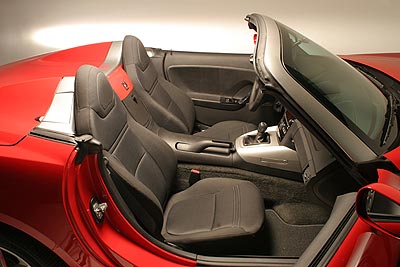
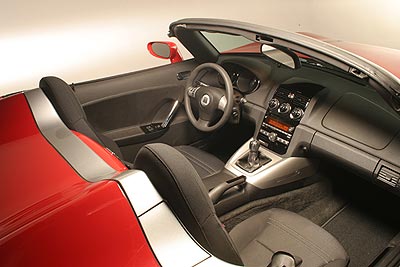
Yank the mesh fabric seats out of the Saturn Sky, and they'd be comfortable. Installed in this roadster, however, they cannot overcome thinly padded spots to rest your arms, the cheaply trimmed steering wheel rim's displeasing grip and lack of telescopic function, and the hard plastic upper door panels.
Interior Noise
Wheezes, whirrs, groans, moans, and grumbles are your constant companions when driving the Saturn Sky thanks to its unrefined powertrain. Additionally, the car clicks and clunks and rattles and squeaks. When the top is raised, wind noise starts at 50 mph and climbs from there.
Loading Cargo
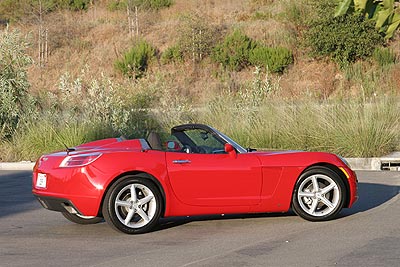
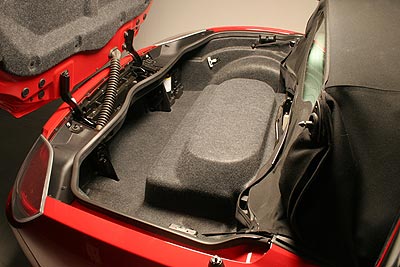
Every time you use the Saturn Sky's trunk, it's gonna look like a fire drill. Pop the decklid, lift the clamshell opening, and load from either side, lifting high and leaning over the body work – which may or may not be dirty, wet, or both. Once you've stuffed the trunk with 5.4 cu.-ft. of whatever, now you need to slam the decklid down and then clip the top back into place on both sides of the car. And if you want to roll with your stuff and sunshine beaming down on your face, you're limited to two cu.-ft. of strategically placed items. Good times.
Build Quality
Sloppy and indifferent are the key words when discussing the Saturn Sky's build quality. Our list of flaws is long, so we'll highlight the most egregious in this space. Inside, the driver's side window seal and the lower left dash panel were seemingly slapped into place with no regard for actually to compete with the Honda S2000 or Mazda MX-5 Miata. Outside, we discovered a huge gap disparity between the chrome grille garnish and the hood on either side. Protective plastic from the assembly or shipping process was sticking out from the seal between the headlight and fender, the right side of the rear decklid sat higher than the body work, and the greenhouse weatherstripping didn't fit well. Don't GM's assembly line workers understand that if they continue to let quality like this slip out the door that market share is going to continue to decline?
Materials Quality
When you're a corporate giant squeezing every last penny of profit out of suppliers, quality suffers, and that's evident inside the Saturn Sky. Our test car's glove box plastic had a ragged edge that was plainly visible from the driver's seat, and many of the parts and pieces inside the Sky carry the pungent scent of cost-cutting. However, there are bright spots. Take, for instance, the nice fabric on the seats, or the piano black plastic trim, or the climate dials with rubber grips on them, or the fabric top with a nice liner on the inside. Still, at this price, the Sky oughta have a leather-wrapped steering wheel.
Styling
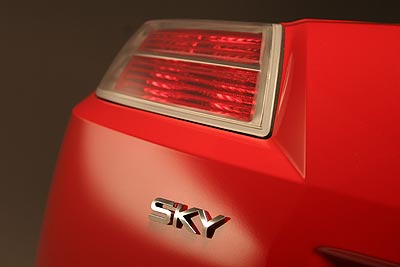
Styling is what will sell the Saturn Sky more than anything else, even if the chrome hood vents and alloy-trimmed taillights are bit over the top. Inside and out, the Saturn Sky is an extremely good-looking car. It conveys excitement and speed at a glance, unfortunately promising more than it can ultimately deliver and placing form over function.