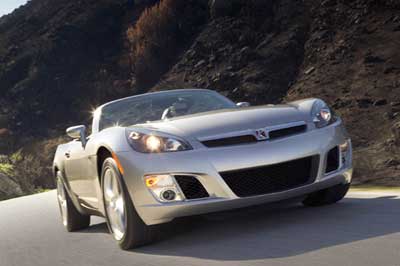
A pretty new face for Saturn
By Brian Chee
|
May 10, 2006
Introduction
NAPA VALLEY, Calif. – It was as if the trees leaned in to take a closer look at the 2007 Saturn Sky cruising down the open, two-lane country road. They craned over and met in the middle, making an evergreen tunnel splashed with sunshine and accented by swirling batches of runaway leaves. Along with the rustling murmur of the trees, the cool morning air and acres of grapes stretching out on either side of the car, the scene tickled memories of special moments on special roads in special cars, and served as a timely reminder why it is that we all love springtime.So long, winter.
And hello, summer, won’t you please take a look at this stunner of a car? We did, and found a roadster that will delight most everyone who drives it, while at the same time leaving them wanting for more: more leg room, more power, and ultimately, more of the look and the verve that makes up the 2007 Saturn Sky. Available now at your friendly local Saturn “retailer,” the Sky is well-equipped and competitively priced, though the 2.4-liter, 170-horsepower engine left us hungry for more. That’s coming, in the guise of the turbocharged, 260-horsepower 2007 Sky Red Line, but for now we’re left with the normally-aspirated Sky. From outside and in, however, the Sky is sure to serve as a perfect bookend to its corporate sibling, the Pontiac Solstice.
It’s also the perfect new face for a suddenly energized Saturn. The General Motors brand, known for lousy cars and great customer service, is poised to deliver greatness on both counts starting with this convertible, and the excitement among business managers and product people is palpable. It all starts with the Sky, followed closely by the new Aura sedan, an eight-passenger crossover vehicle called Outlook, a hybrid Vue Green Line sport utility vehicle, and stylish replacements for the Ion and the Vue. In fact, serious money is betting that a derivative of the fun Opel Astra will replace the Ion, a dud of an econocar that you might not recommend to your worst enemy. That would follow form, as Saturn is basing its revitalized lineup on Opel vehicles, or, for you Brits, Vauxhalls. The Sky, for example, takes its style from the Vauxhall VX Lightning concept, and has a twin in the export-only Opel GT announced at this year’s Geneva Motor Show. From our side of the pond, this seems to be a brilliant strategy: give us Yanks upscale, trendy cars based on vehicles we don’t see on every Avis lot, and, in the process, save some cash in the development of an all-new and much-improved Saturn lineup. The one-two punch of stylish and well-appointed cars, with Saturn’s reputation for excellent customer service, is a combination that will surely make car buyers pay close attention.
The Sky, however, should make you pay attention all by itself, especially on a crisp spring morning, with the blue sky above, and the Saturn Sky below.
Model Mix
Model Mix With one trim, two transmission choices and few options available, the 2007 Saturn Sky is pretty much an out-of-the-box kind of car. It’s meant to be, as a point of difference between this GM roadster and that other, slightly more famous two-seater, the Pontiac Solstice, which starts thousands of dollars lower than the Sky.
Equipped with a 2.4-liter four-cylinder engine that makes 170 horsepower and a five-speed manual transmission, the 2007 Saturn Sky has a sticker price of $23,690 including the $575 destination charge. Add another $850 to the price of your Sky and drive off with a five-speed automatic transmission. Either way, you get a roadster full of standard features like air conditioning, a CD player with six-speaker stereo, cruise control, a driver’s side visor vanity mirror, a glass rear window, a leather-wrapped manual shifter, power door locks and windows, power mirrors, a rear window defroster, reclining cloth bucket seats, remote keyless entry, 18-inch alloy wheels adorned with Goodyear P245/45R18 tires, and a polished aluminum exhaust tip. Standard safety features include four-wheel disc brakes with ABS, driver and front passenger airbags, an OnStar telematics system with a free one-year “Safe and Sound” service plan, and fog lamps.
By way of comparison, the base Pontiac Solstice, which is largely the same car, stickers for $20,690, or $3,200 less than the Sky but without standard features such as power door locks and windows, air conditioning, a tilt steering wheel, and remote keyless entry. Of course, whether you buy the Sky or the Solstice largely depends on the kind of cool swagger you want to communicate: if it’s sex appeal, you probably want the Solstice, and if a more sophisticated and contemporary look is your style, you’re sure to like the Sky. You’ll like it even more when you add options such as chrome alloy wheels ($795), a rear limited-slip differential ($195), XM satellite radio ($325), a rear spoiler ($275) and leather seat inserts that are part of a Premium Package ($750) that adds metallic sill plates, stainless steel pedal covers, and a leather-wrapped steering wheel.
If you like the Sky but want more performance, wait until this fall and pony up for the 2007 Saturn Sky Red Line, a performance variant that, for about $4,000 more, will provide a massive power boost courtesy of a 2.0-liter, four-cylinder turbocharged engine. The premium paid will add 83 horsepower to the Sky, bringing the total to 260, complementing the 260 lb.-ft. of torque. Additional differences between the Sky and Sky Red Line include dual exhaust outlets, polished wheels, and brake cooling vents in the front fascia. Inside, differences include a standard leather-wrapped steering wheel, Red Line-specific seats, special floor mats, and a digital boost gauge. The Sky Red Line also comes standard with StabiliTrak stability control and a sport-tuned suspension. Pontiac will sell a similar upgrade called the Solstice GXP.
Nuts and Bolts
Nuts and Bolts Built more for touring then tearin’ up, the 2007 Saturn Sky does offer a healthy dash of sport thanks to excellent handling, big 18-inch wheels, a short-throw manual shifter, and a good-enough powertrain.
Built more for touring than hair-on-fire driving, the 2007 Saturn Sky comes across as a roadster built first for comfort and style, and then for sport. The theory, according to Saturn, is that those who place a premium on sport driving will be quite happy to wait for the Saturn Sky Red Line, due out later this year with a 260-horsepower turbocharged four-cylinder engine. It’s inaccurate to portray the regular Sky as sedate, however, as its 2.4-liter four-cylinder engine is capable but a little whiny, working up 170 horsepower at 6,600 rpm and 162 lb.-ft. of torque at 4,800 rpm. The base transmission, a five-speed manual with crisp short throws and a very workable clutch, makes the most of the engine. The optional five-speed automatic transmission is, uh, not really an option you should be considering at all.
We’ll wait.
The reason is because the Red Line promises to fly like a mad bat, thanks to a turbocharged, direct-injection 2.0-liter engine that makes an eye-opening 260 horsepower at 5,300 rpm and a torque rating of 260 lb.-ft at 2,500 rpm. That beauty will cost you around $4,000 more than the normally-powered Sky, though, so if the decaf version is enough, well, we understand. And besides, the regular Sky has more than its share of attributes, like a compliant ride thanks to a short- and long-arm suspension setup that’s tuned differently than what is currently on the Solstice (though officials say the Solstice will eventually get the same tuning), Bilstein shocks, and special dampers at each corner of the vehicle to further soften the ride. Sky and Solstice are from the same chassis, a notably stiff hydroformed tube structure that’s proving to be an excellent platform for sporting vehicles. The Sky Red Line’s suspension will include bigger stabilizer bars and coil springs compared to the standard setup. Maneuvering the rear-drive Sky is accomplished with rack-and-pinion steering, stopping is handled by 11.7-inch ventilated front discs and 10.9-inch solid rear discs with standard ABS.
Both the Sky and Sky Red Line get the benefit of beefy 18-inch wheels and 18-inch Goodyear P245/45R18 tires, pushed to the edges and on a wheelbase that’s three inches wider than the MX-5 Miata at 95.1 inches. The Sky is also longer, at 161.1 inches, and heavier by a whopping 459 lbs. over the Miata. That’s like riding around town with a fat, full grown steer in the passenger’s seat, so it’s hardly a surprise that the engine whines a bit, or that GM is springing for nice 18-inch wheels and tires.
Yet another reason why we’ll wait for that Red Line.
Design
Design Saturn’s new face is contemporary, well executed and, despite a few flaws, excellent inside and out.
Listen to Saturn engineers and its clear that great care went into the development of the 2007 Saturn Sky. That’s the case with every car ever built, of course, especially when it comes from a professional who has just spent a good chunk of his or her life dedicated to making said car as good as possible – within budget restraints and focus group complaints. The difference is that this time, Saturn seems genuinely proud of the Sky, touching the car during its presentation, opening up the clamshell top and the hood, waving their arms, opening the doors and practically jumping up and down on the seats.
Silly engineers. Get ‘em revved up about a car and they act like toddlers on Candy Day. And well they should for the Sky, while the twin of the Pontiac Solstice, is different in significant ways, inside and out. What it comes down to is that Sky engineers and designers enjoyed the benefit of getting to work after the Pontiac Solstice, which had tied to its tailpipe a management mandate to sell at a base price of less than $20,000. Since then, the base price of the Solstice has crept up, leaving one to wonder just why that $19,995 price was so important to begin with. The Sky, meanwhile, had no such weighty anchor, its mission from the start to be a more upscale roadster.
Consider it mission accomplished. The 2007 Saturn Sky is a compelling, contemporary car, its angular lines hard-edged yet soft enough to create what looks like a classic roadster for a modern age. Combined with a well designed interior that’s a nice enough place to be for most people, the Sky is a Solstice – for grown-ups. The mood starts on the outside, with a design based on the Vauxhall VX Lightning concept and, largely, penned by a group of GM European designers, including Brian Nesbitt of Chrysler PT Cruiser, Chevrolet HHR and Saab Aero X Concept fame. The result of this collaboration is perhaps one of the most attractive cars GM has built in quite some time, Solstice included.
That’s clearly subjective. And close. But the Sky’s taut lines and high beltline snap where the Solstice swerves; where the Pontiac undulates, the Sky stands at attention, where one roadster is all grace and classic lines, the other is drawn by a draftsman pen, hard and sure. Proportions are typical in roadster land, with a long snout and short deck, but the Sky adds to that through wheels that are pushed out, short overhangs, prominent lamps at the corners, and large 18-inch wheels that do an admirable job of filling the wheel wells. The Sky’s body is adorned with chrome touches that add an upscale feel, especially on darker-colored models. Indeed, the Sky is most beautiful when its dark blue or green, because the large fog lamps, slatted chrome hood inserts, oversized headlamps, and jeweled accessories stand out against the background. The back of the Sky is finished with large taillights that sit up high on the edges of the car, and a single oversized and squared-off exhaust pipe centered at the bottom. The Sky Red Line boasts two such exhaust outlets, along with special badges. Construction on the outside of our GM-prepped test samples was excellent, with nice and tight body panels that finished flush with the plastic sections and lighting. Our tester did have some irregularities in the front, such as loose-fitting plastic chrome on the nose, ill-matched chrome plastic inserts on the hood, and variations in gap tolerances around the headlamps.
It’s beautiful. But that beauty comes at a price, that being one of convenience and cargo room. For example, the manually operated top hides in the back, good because it keeps the Sky’s classic lines intact but bad because its design makes for a fight to lower or raise the roof, and results in virtually useless trunk space.
There’s little useless space inside the cabin, and its design is, overall, well executed. The climate controls are built into a strip of piano black trim, which adds a touch of class to a simple design of three large and nicely weighted knobs that make for a nice tactile feel and easy adjustment. Radio controls share the GM corporate setup, which is intuitive and easy to use. Chrome trim rings the shifter and the gauges to bring some bling to the interior, but about those gauges: they’re large and easy to read, even with the top down, but it’s curious why Saturn decided not to place a temperature gauge in the cluster along with the speedometer, tachometer and fuel gauge. Optional two-tone leather inserts in the seats, door panels and on the steering wheel finish off the interior with a sporty, comforting flair.
The more practical aspects of the Saturn Sky’s interior fare worse. All three cupholders are poorly placed, and the two located behind occupants’ elbows in the rear bulkhead are virtually impossible to reach while driving. Worse yet, the lone sliding cupholder on the dashboard sticks out into the passenger’s legroom when deployed, rendering it impractical unless one is driving alone. It’s also a bit flimsy, and has some trouble holding an empty vessel. In this car, there’s no back seat in which to toss your trash, but then your Mama taught you not to do that, right? Compartment space is tight, but that’s to be expected and, in fact, Sky designers did build in as many cubbyholes as possible: there’s one behind each seat, and the seats also have map book holders. There’s a healthy compartment at the back, between the seats, though one wonders why there’s no lock on that particular compartment. The glove box, however, as very small and wobbly. Other than that, the Sky’s construction looks marvelous on the inside. Gaps are matched nicely and are close together; plastics feel like high quality, and the steering wheel has a nice heft to it.
Sky vs. Solstice
Sky vs. Solstice If you want a softer ride, better equipment and a contemporary style, reach for the Sky. If you’re a sucker for the classic roadster and need a low price more than air conditioning or power windows, opt for the Solstice.
We know what you’re thinking: the 2007 Saturn Sky is yet another example of GM’s infamous badge engineering strategy. That’s true – except that the Sky is a good example of badge engineering, done correctly. While the two vehicles are very similar, there are enough differences in the price, style, interior design, and performance to attract different types of buyers. The styling, of course, is evident: where the Solstice curves the Sky has a hard edge. The Solstice is straight out of the classic roadster design book, while the Sky offers a more contemporary, aggressive look. On the inside, the Sky offers an upscale design, while the Solstice is more driver-centric. Differences include the center stack of controls, air vents, instrument panel, and the design and placement of environmental controls. One of our bugaboos about the Solstice, in fact, is that the controls are isolated in a sea of plastic, and the result is a bit cheap looking. The Sky avoids this downmarket look by segmenting the dash into sections, and doing it nicely. Instead of two round vents awash in a plastic wave, as in the Solstice, the Sky’s two center vents are squared off and placed above the three main environmental controls, which are finished with a hard black compound. Vehicle space and volume between the two cars, including that good-for-nothin’ trunk, are virtually identical.
Similarities are also evident on the road, with both boasting excellent ride and handling character. The only change comes in the Sky’s suspension tuning, which makes for a more compliant ride. Also, thanks to a horsepower and torque deficit in the Saturn, the Sky does feel a little sluggish compared to what we remember from our drive in the Solstice. If so, it’s probably due to the power loss and a weight gain of 73 lbs. That’s not much, sure, but perhaps enough to make a difference on a roadster.
There are some differences in equipment and price, however. The Sky is better equipped and more expensive, but before you assume that the Solstice is the bargain, however, consider that at a new base price of $20,490, the Solstice is bare bones, while the Sky, at $23,690, is relatively loaded. The $3,200 premium gets you an acoustic headliner, OnStar telematics, four-wheel antilock brakes, air conditioning, cruise control, power door locks, power windows, and remote keyless entry – all of which are options on the Solstice. Equipping your Solstice like a standard Sky jacks the sticker price up to just over $24,000.
So – which one? We’d pick the Solstice for the work week and the Sky for the weekend. It’s nice to show off Monday through Friday, and the Solstice simply has more buzz about it than the Sky, thanks to Bob Lutz and every single car magazine on earth. On the weekend, however, we’d opt for the Sky, the more comfortable ride with the nicer interior, and in fact, the style we really love the most.
Driving Impressions
Driving Impressions As much as we loved driving the 2007 Saturn Sky for its design, ride, and interior execution, we were annoyed by quirks that made living with the roadster inconvenient. Still, we’re anxiously awaiting the Sky Red Line.
Driving the 2007 Saturn Sky is a beautiful weekend romance that ends in stilted silence and uncomfortable pauses. That’s harsh, true, but as much as we loved the Sky for its sweet looks, its ride and handling, and its interior, we hated the little things that made the experience of living with it less pleasant than what we thought it would be like.
Ultimately, the Sky is to blame. Sitting in the seats, enjoying the design and appreciating the quality and creativity that went into the making of this vehicle, raises expectations that the car simply can’t live up to in every way. The result is an experience that is part sublime, part sub par. The interior is a perfect example: it is here where drivers will be pleasantly surprised – and simultaneously annoyed. It’s as if designers focused so intently on building an upscale interior that they passed on some nuts and bolts elements that open top drivers appreciate. Yes, the instrument panel is stylish and well-built, and the speedometer and tachometer gauges are big and beautiful, but the digital readouts fade considerably in the sun and there’s no temperature gauge. You can flick through the driver control center and get a temp readout, but most drivers – especially drivers who like to put in a sporting effort – want to see that little needle floating on a gauge.
These sporting types also like good, firm seats, and the Sky delivers. They’re excellent, period, among the car’s best attributes, holding occupants no matter what kind of road, and quite refreshing throughout a long, hot day behind the wheel. You could drive for many a mile in these seats with no backache or leg fidgeties. In fact, the only negative about the seats comes when you wish to make an adjustment: limited room between the seat bottom and the door panel means that you must stop, open the door and make the change. That seems to be a theme on how the interior of the Sky is oriented, with plenty of room between driver and passenger, yet not enough room between people and doors. It’s as if designers used the available track width to preserve personal space rules.
The design of that space is smartly executed, with a wide center area and those substantial seats as the centerpiece. Even with the top up, there’s plenty of space between occupants. It’s on the outside where space is compromised. The high beltline creates a feeling of protection when the top is down, though if you like to put your elbow on the top of the door it feels awkward. With the top up, the high beltline serves to make the cabin slightly narrower, and confining.
Getting out of the Sky is easier than one would expect, with light doors and a relatively easy step out. That’s a little surprising, because you sit low in the Sky, and it feels as though you would have to drag your carcass out of the cabin. Getting in lacks some of that ease, and most people will find themselves stutter-sliding their derrieres to avoid contact with the steering wheel. The door itself is easy to handle, nicely upholstered and made of quality plastics, but the controls are located halfway up the armrest. Using the switches requires a person to contort her left arm, in a sort of Emu the Elephant pose.
There are three cupholders, and all are barely useful. The dual holder at the back of the center console is awkward, especially when driving. One can imagine Sky drivers knocking a latte while underway, which sure would be an unpleasant experience. The other cupholder, up front on the center console on the passenger side, is a sliding unit that pops out. That’s a nice design, and works great when one is driving solo, but it protrudes into the available passenger legroom. And it’s not as if there’s a lot of legroom to go around. Even though the Sky is bigger than the MX-5 Miata, it offers slightly less leg room, a constraint felt most when trying to stretch out: those with a long inseam will find their piggies pushed right up against the firewall. There’s plenty of room side-to-side, however, and in that way it’s a comfortable ride, even during aggressive maneuvers. Those who like to brace themselves against the center console will appreciate how it gives very little ground.
That type of driving will likely be a rare thing in this low-wattage version of the Sky. This is a roadster built more for a fun cruise than a spirited run up a mountain road, though with the five-speed manual transmission the Sky delivers just about as much fun as most people expect. The short throws, combined with the easily manipulated clutch pedal, make for a spirited driving experience, though the 170-horsepower four-cylinder engine is just barely up to the job of lugging around this 2,933-lb. roadster. You can tell because the engine sounds and feels pretty unrefined when you dig into the throttle, though it does behave nicely when you’re tooling around town, or just not pushing it all that much. That’s the first and best reason to wait for the Sky Red Line, assuming that you can afford the $4,000 premium. If, however, you’re looking for fun – as opposed to Miata-munching, baldy-dome making fun – this Sky, with the manual transmission, should be enough. Just be sure to pass on the five-speed automatic transmission. The lag in acceleration, the wanting for more torque, the screams that come from the engine as you pound the throttle in search of more power…yeah, stick with the standard.
It’s yet another example of the Sky tease, because the rest of its performance is admirable. Steering is responsive and nicely weighted at all speeds, and GM’s new three-spoke steering wheel feels good in hand. You feel in control of the Sky at all times thanks to that steering, the Sky’s wide track, a compliant suspension, a stiff chassis, and some big 18-inch rubber underneath. It’s hard to shake the Sky loose even during hard cornering, though a little bit of oversteer is detectable when pushed hard. Throughout, however, the roadster keeps its poise, firmly planted on the road and very enjoyable.
Enjoyable.
That’s where the Sky’s at, even more so than the Solstice. For us, the most noticeable difference is the ride quality. Where the Solstice is a bit harsh, the Sky is compliant, soaking up more road irregularities and returning a smoother ride. This feels like a touring roadster with a penchant for fun, one perfectly suited for commuter traffic or a weekend getaway. Either way, the wind will probably be the first thing to fatigue its occupants, though even though it’s well-handled. You can have a perfectly nice conversation inside the Sky with the top down, and the stereo comes through clearly at a normal open-top volume setting. Buyers may want to spring for the wind screen accessory, however, as there is a fair amount of buffeting. Top up driving is quiet, thanks to the cloth top’s inner lining which comes standard on the Sky and optional on the Solstice – though with the top up the Sky feels small. Top up, road noise is muted, and the interior is nicely buttoned down, but given the flimsy build of the glove box it’s easy to see some squeaks eventually developing in that area.
That’s the good side. By now, we know that the bad side of the Sky is lurking, and sure enough, there it is, waiting for you to change your mind and put the top down, and then back up. It’s not hard. But it’s inconvenient and takes longer than most would like. First, you’ve got to pull over to a safe location – no stoplight switches in the Sky – then pop the button in the glovebox, get out, and on each side of the car push the top up (or down) and snap the rear corners into place. That’s the price of beauty, indeed, along with the lack of trunk space. Here again: your partner will love cruising down the highway in the Sky, headed for a romantic weekend trip, but will positively hate the Sky’s limited trunk space.
FAQs
FAQs Chosen as the car to usher in the new face and attitude of Saturn, this 2007 Sky roadster is a stylish home run, with nice interior features, a capable engine and better than expected ride and handling character. If you’re shopping for a Solstice – or an MX-5 – make a special point of trying out the Saturn Sky.
Which is better, the 2007 Saturn Sky or the Pontiac Solstice?
It really depends on what style you prefer. The Solstice is arguably sexier, while the Sky has a sharper, more aggressive look. The nuts and bolts are virtually the same, though the Sky does weigh slightly more – mainly due to its added standard features.
Why would General Motors give a roadster like the Sky to Saturn?
GM would like very much to change the image of Saturn – hence the new tagline: “Like Always, Like Never Before.” What that means is that buyers will get the same old great service from their friendly, no-haggle Saturn dealership, but with exciting new cars. The Sky, as an affordable halo vehicle, leads the way. Stay tuned for the new Saturn OUTLOOK crossover, the new Saturn AURA sedan, and a to-be-named Saturn small car to replace the Ion. There are no dent-resistant bumpers on any of these cars!
What’s the best thing about the 2007 Saturn Sky?
Easily, the styling. This is one of the most attractive cars built in a long time. On top of that, the interior offers comfort in a small space, with nice standard features such as power door locks, power windows and air conditioning. While it drives a little soft, and, when compared with the pesky Mazda MX-5 Miata, the Sky’s weight puts it at a disadvantage, it is still a fun and sporty car to drive, especially when the sun is out and the road curves to points unknown.
Specifications
Specifications The 2007 Saturn Sky competes against the Honda S2000, Mazda MX-5 Miata, Nissan 350Z Roadster, and Pontiac Solstice.
Test Vehicle: 2007 Saturn Sky
Base Price: $23,690 (including the $575 destination charge)
Engine Size and Type: 2.4-liter four-cylinder engine
Engine Horsepower: 170 at 6,600 rpm
Engine Torque: 162 at 4,800 rpm
Transmission: Five-speed manual
Curb Weight, lbs.: 2,933 lbs.
EPA Fuel Economy (city/highway): 20/28
Observed Fuel Economy: 18.5 mpg
Length: 161.1 inches
Width: 71.4 inches
Wheelbase: 95.1 inches
Height: 50.1 inches
Legroom (front/rear): 42.7 inches
Headroom (front/rear): 38.4 inches
Max. Seating Capacity: Two
Max. Cargo Volume: 5.4 cu.-ft.
Competitors: Honda S2000, Mazda MX-5 Miata, Nissan 350Z Roadster, Pontiac Solstice
Model Mix With one trim, two transmission choices and few options available, the 2007 Saturn Sky is pretty much an out-of-the-box kind of car. It’s meant to be, as a point of difference between this GM roadster and that other, slightly more famous two-seater, the Pontiac Solstice, which starts thousands of dollars lower than the Sky.
Equipped with a 2.4-liter four-cylinder engine that makes 170 horsepower and a five-speed manual transmission, the 2007 Saturn Sky has a sticker price of $23,690 including the $575 destination charge. Add another $850 to the price of your Sky and drive off with a five-speed automatic transmission. Either way, you get a roadster full of standard features like air conditioning, a CD player with six-speaker stereo, cruise control, a driver’s side visor vanity mirror, a glass rear window, a leather-wrapped manual shifter, power door locks and windows, power mirrors, a rear window defroster, reclining cloth bucket seats, remote keyless entry, 18-inch alloy wheels adorned with Goodyear P245/45R18 tires, and a polished aluminum exhaust tip. Standard safety features include four-wheel disc brakes with ABS, driver and front passenger airbags, an OnStar telematics system with a free one-year “Safe and Sound” service plan, and fog lamps.
By way of comparison, the base Pontiac Solstice, which is largely the same car, stickers for $20,690, or $3,200 less than the Sky but without standard features such as power door locks and windows, air conditioning, a tilt steering wheel, and remote keyless entry. Of course, whether you buy the Sky or the Solstice largely depends on the kind of cool swagger you want to communicate: if it’s sex appeal, you probably want the Solstice, and if a more sophisticated and contemporary look is your style, you’re sure to like the Sky. You’ll like it even more when you add options such as chrome alloy wheels ($795), a rear limited-slip differential ($195), XM satellite radio ($325), a rear spoiler ($275) and leather seat inserts that are part of a Premium Package ($750) that adds metallic sill plates, stainless steel pedal covers, and a leather-wrapped steering wheel.
If you like the Sky but want more performance, wait until this fall and pony up for the 2007 Saturn Sky Red Line, a performance variant that, for about $4,000 more, will provide a massive power boost courtesy of a 2.0-liter, four-cylinder turbocharged engine. The premium paid will add 83 horsepower to the Sky, bringing the total to 260, complementing the 260 lb.-ft. of torque. Additional differences between the Sky and Sky Red Line include dual exhaust outlets, polished wheels, and brake cooling vents in the front fascia. Inside, differences include a standard leather-wrapped steering wheel, Red Line-specific seats, special floor mats, and a digital boost gauge. The Sky Red Line also comes standard with StabiliTrak stability control and a sport-tuned suspension. Pontiac will sell a similar upgrade called the Solstice GXP.
Nuts and Bolts
Nuts and Bolts Built more for touring then tearin’ up, the 2007 Saturn Sky does offer a healthy dash of sport thanks to excellent handling, big 18-inch wheels, a short-throw manual shifter, and a good-enough powertrain.
Built more for touring than hair-on-fire driving, the 2007 Saturn Sky comes across as a roadster built first for comfort and style, and then for sport. The theory, according to Saturn, is that those who place a premium on sport driving will be quite happy to wait for the Saturn Sky Red Line, due out later this year with a 260-horsepower turbocharged four-cylinder engine. It’s inaccurate to portray the regular Sky as sedate, however, as its 2.4-liter four-cylinder engine is capable but a little whiny, working up 170 horsepower at 6,600 rpm and 162 lb.-ft. of torque at 4,800 rpm. The base transmission, a five-speed manual with crisp short throws and a very workable clutch, makes the most of the engine. The optional five-speed automatic transmission is, uh, not really an option you should be considering at all.
We’ll wait.
The reason is because the Red Line promises to fly like a mad bat, thanks to a turbocharged, direct-injection 2.0-liter engine that makes an eye-opening 260 horsepower at 5,300 rpm and a torque rating of 260 lb.-ft at 2,500 rpm. That beauty will cost you around $4,000 more than the normally-powered Sky, though, so if the decaf version is enough, well, we understand. And besides, the regular Sky has more than its share of attributes, like a compliant ride thanks to a short- and long-arm suspension setup that’s tuned differently than what is currently on the Solstice (though officials say the Solstice will eventually get the same tuning), Bilstein shocks, and special dampers at each corner of the vehicle to further soften the ride. Sky and Solstice are from the same chassis, a notably stiff hydroformed tube structure that’s proving to be an excellent platform for sporting vehicles. The Sky Red Line’s suspension will include bigger stabilizer bars and coil springs compared to the standard setup. Maneuvering the rear-drive Sky is accomplished with rack-and-pinion steering, stopping is handled by 11.7-inch ventilated front discs and 10.9-inch solid rear discs with standard ABS.
Both the Sky and Sky Red Line get the benefit of beefy 18-inch wheels and 18-inch Goodyear P245/45R18 tires, pushed to the edges and on a wheelbase that’s three inches wider than the MX-5 Miata at 95.1 inches. The Sky is also longer, at 161.1 inches, and heavier by a whopping 459 lbs. over the Miata. That’s like riding around town with a fat, full grown steer in the passenger’s seat, so it’s hardly a surprise that the engine whines a bit, or that GM is springing for nice 18-inch wheels and tires.
Yet another reason why we’ll wait for that Red Line.
Design
Design Saturn’s new face is contemporary, well executed and, despite a few flaws, excellent inside and out.
Listen to Saturn engineers and its clear that great care went into the development of the 2007 Saturn Sky. That’s the case with every car ever built, of course, especially when it comes from a professional who has just spent a good chunk of his or her life dedicated to making said car as good as possible – within budget restraints and focus group complaints. The difference is that this time, Saturn seems genuinely proud of the Sky, touching the car during its presentation, opening up the clamshell top and the hood, waving their arms, opening the doors and practically jumping up and down on the seats.
Silly engineers. Get ‘em revved up about a car and they act like toddlers on Candy Day. And well they should for the Sky, while the twin of the Pontiac Solstice, is different in significant ways, inside and out. What it comes down to is that Sky engineers and designers enjoyed the benefit of getting to work after the Pontiac Solstice, which had tied to its tailpipe a management mandate to sell at a base price of less than $20,000. Since then, the base price of the Solstice has crept up, leaving one to wonder just why that $19,995 price was so important to begin with. The Sky, meanwhile, had no such weighty anchor, its mission from the start to be a more upscale roadster.
Consider it mission accomplished. The 2007 Saturn Sky is a compelling, contemporary car, its angular lines hard-edged yet soft enough to create what looks like a classic roadster for a modern age. Combined with a well designed interior that’s a nice enough place to be for most people, the Sky is a Solstice – for grown-ups. The mood starts on the outside, with a design based on the Vauxhall VX Lightning concept and, largely, penned by a group of GM European designers, including Brian Nesbitt of Chrysler PT Cruiser, Chevrolet HHR and Saab Aero X Concept fame. The result of this collaboration is perhaps one of the most attractive cars GM has built in quite some time, Solstice included.
That’s clearly subjective. And close. But the Sky’s taut lines and high beltline snap where the Solstice swerves; where the Pontiac undulates, the Sky stands at attention, where one roadster is all grace and classic lines, the other is drawn by a draftsman pen, hard and sure. Proportions are typical in roadster land, with a long snout and short deck, but the Sky adds to that through wheels that are pushed out, short overhangs, prominent lamps at the corners, and large 18-inch wheels that do an admirable job of filling the wheel wells. The Sky’s body is adorned with chrome touches that add an upscale feel, especially on darker-colored models. Indeed, the Sky is most beautiful when its dark blue or green, because the large fog lamps, slatted chrome hood inserts, oversized headlamps, and jeweled accessories stand out against the background. The back of the Sky is finished with large taillights that sit up high on the edges of the car, and a single oversized and squared-off exhaust pipe centered at the bottom. The Sky Red Line boasts two such exhaust outlets, along with special badges. Construction on the outside of our GM-prepped test samples was excellent, with nice and tight body panels that finished flush with the plastic sections and lighting. Our tester did have some irregularities in the front, such as loose-fitting plastic chrome on the nose, ill-matched chrome plastic inserts on the hood, and variations in gap tolerances around the headlamps.
It’s beautiful. But that beauty comes at a price, that being one of convenience and cargo room. For example, the manually operated top hides in the back, good because it keeps the Sky’s classic lines intact but bad because its design makes for a fight to lower or raise the roof, and results in virtually useless trunk space.
There’s little useless space inside the cabin, and its design is, overall, well executed. The climate controls are built into a strip of piano black trim, which adds a touch of class to a simple design of three large and nicely weighted knobs that make for a nice tactile feel and easy adjustment. Radio controls share the GM corporate setup, which is intuitive and easy to use. Chrome trim rings the shifter and the gauges to bring some bling to the interior, but about those gauges: they’re large and easy to read, even with the top down, but it’s curious why Saturn decided not to place a temperature gauge in the cluster along with the speedometer, tachometer and fuel gauge. Optional two-tone leather inserts in the seats, door panels and on the steering wheel finish off the interior with a sporty, comforting flair.
The more practical aspects of the Saturn Sky’s interior fare worse. All three cupholders are poorly placed, and the two located behind occupants’ elbows in the rear bulkhead are virtually impossible to reach while driving. Worse yet, the lone sliding cupholder on the dashboard sticks out into the passenger’s legroom when deployed, rendering it impractical unless one is driving alone. It’s also a bit flimsy, and has some trouble holding an empty vessel. In this car, there’s no back seat in which to toss your trash, but then your Mama taught you not to do that, right? Compartment space is tight, but that’s to be expected and, in fact, Sky designers did build in as many cubbyholes as possible: there’s one behind each seat, and the seats also have map book holders. There’s a healthy compartment at the back, between the seats, though one wonders why there’s no lock on that particular compartment. The glove box, however, as very small and wobbly. Other than that, the Sky’s construction looks marvelous on the inside. Gaps are matched nicely and are close together; plastics feel like high quality, and the steering wheel has a nice heft to it.
Sky vs. Solstice
Sky vs. Solstice If you want a softer ride, better equipment and a contemporary style, reach for the Sky. If you’re a sucker for the classic roadster and need a low price more than air conditioning or power windows, opt for the Solstice.
We know what you’re thinking: the 2007 Saturn Sky is yet another example of GM’s infamous badge engineering strategy. That’s true – except that the Sky is a good example of badge engineering, done correctly. While the two vehicles are very similar, there are enough differences in the price, style, interior design, and performance to attract different types of buyers. The styling, of course, is evident: where the Solstice curves the Sky has a hard edge. The Solstice is straight out of the classic roadster design book, while the Sky offers a more contemporary, aggressive look. On the inside, the Sky offers an upscale design, while the Solstice is more driver-centric. Differences include the center stack of controls, air vents, instrument panel, and the design and placement of environmental controls. One of our bugaboos about the Solstice, in fact, is that the controls are isolated in a sea of plastic, and the result is a bit cheap looking. The Sky avoids this downmarket look by segmenting the dash into sections, and doing it nicely. Instead of two round vents awash in a plastic wave, as in the Solstice, the Sky’s two center vents are squared off and placed above the three main environmental controls, which are finished with a hard black compound. Vehicle space and volume between the two cars, including that good-for-nothin’ trunk, are virtually identical.
Similarities are also evident on the road, with both boasting excellent ride and handling character. The only change comes in the Sky’s suspension tuning, which makes for a more compliant ride. Also, thanks to a horsepower and torque deficit in the Saturn, the Sky does feel a little sluggish compared to what we remember from our drive in the Solstice. If so, it’s probably due to the power loss and a weight gain of 73 lbs. That’s not much, sure, but perhaps enough to make a difference on a roadster.
There are some differences in equipment and price, however. The Sky is better equipped and more expensive, but before you assume that the Solstice is the bargain, however, consider that at a new base price of $20,490, the Solstice is bare bones, while the Sky, at $23,690, is relatively loaded. The $3,200 premium gets you an acoustic headliner, OnStar telematics, four-wheel antilock brakes, air conditioning, cruise control, power door locks, power windows, and remote keyless entry – all of which are options on the Solstice. Equipping your Solstice like a standard Sky jacks the sticker price up to just over $24,000.
So – which one? We’d pick the Solstice for the work week and the Sky for the weekend. It’s nice to show off Monday through Friday, and the Solstice simply has more buzz about it than the Sky, thanks to Bob Lutz and every single car magazine on earth. On the weekend, however, we’d opt for the Sky, the more comfortable ride with the nicer interior, and in fact, the style we really love the most.
Driving Impressions
Driving Impressions As much as we loved driving the 2007 Saturn Sky for its design, ride, and interior execution, we were annoyed by quirks that made living with the roadster inconvenient. Still, we’re anxiously awaiting the Sky Red Line.
Driving the 2007 Saturn Sky is a beautiful weekend romance that ends in stilted silence and uncomfortable pauses. That’s harsh, true, but as much as we loved the Sky for its sweet looks, its ride and handling, and its interior, we hated the little things that made the experience of living with it less pleasant than what we thought it would be like.
Ultimately, the Sky is to blame. Sitting in the seats, enjoying the design and appreciating the quality and creativity that went into the making of this vehicle, raises expectations that the car simply can’t live up to in every way. The result is an experience that is part sublime, part sub par. The interior is a perfect example: it is here where drivers will be pleasantly surprised – and simultaneously annoyed. It’s as if designers focused so intently on building an upscale interior that they passed on some nuts and bolts elements that open top drivers appreciate. Yes, the instrument panel is stylish and well-built, and the speedometer and tachometer gauges are big and beautiful, but the digital readouts fade considerably in the sun and there’s no temperature gauge. You can flick through the driver control center and get a temp readout, but most drivers – especially drivers who like to put in a sporting effort – want to see that little needle floating on a gauge.
These sporting types also like good, firm seats, and the Sky delivers. They’re excellent, period, among the car’s best attributes, holding occupants no matter what kind of road, and quite refreshing throughout a long, hot day behind the wheel. You could drive for many a mile in these seats with no backache or leg fidgeties. In fact, the only negative about the seats comes when you wish to make an adjustment: limited room between the seat bottom and the door panel means that you must stop, open the door and make the change. That seems to be a theme on how the interior of the Sky is oriented, with plenty of room between driver and passenger, yet not enough room between people and doors. It’s as if designers used the available track width to preserve personal space rules.
The design of that space is smartly executed, with a wide center area and those substantial seats as the centerpiece. Even with the top up, there’s plenty of space between occupants. It’s on the outside where space is compromised. The high beltline creates a feeling of protection when the top is down, though if you like to put your elbow on the top of the door it feels awkward. With the top up, the high beltline serves to make the cabin slightly narrower, and confining.
Getting out of the Sky is easier than one would expect, with light doors and a relatively easy step out. That’s a little surprising, because you sit low in the Sky, and it feels as though you would have to drag your carcass out of the cabin. Getting in lacks some of that ease, and most people will find themselves stutter-sliding their derrieres to avoid contact with the steering wheel. The door itself is easy to handle, nicely upholstered and made of quality plastics, but the controls are located halfway up the armrest. Using the switches requires a person to contort her left arm, in a sort of Emu the Elephant pose.
There are three cupholders, and all are barely useful. The dual holder at the back of the center console is awkward, especially when driving. One can imagine Sky drivers knocking a latte while underway, which sure would be an unpleasant experience. The other cupholder, up front on the center console on the passenger side, is a sliding unit that pops out. That’s a nice design, and works great when one is driving solo, but it protrudes into the available passenger legroom. And it’s not as if there’s a lot of legroom to go around. Even though the Sky is bigger than the MX-5 Miata, it offers slightly less leg room, a constraint felt most when trying to stretch out: those with a long inseam will find their piggies pushed right up against the firewall. There’s plenty of room side-to-side, however, and in that way it’s a comfortable ride, even during aggressive maneuvers. Those who like to brace themselves against the center console will appreciate how it gives very little ground.
That type of driving will likely be a rare thing in this low-wattage version of the Sky. This is a roadster built more for a fun cruise than a spirited run up a mountain road, though with the five-speed manual transmission the Sky delivers just about as much fun as most people expect. The short throws, combined with the easily manipulated clutch pedal, make for a spirited driving experience, though the 170-horsepower four-cylinder engine is just barely up to the job of lugging around this 2,933-lb. roadster. You can tell because the engine sounds and feels pretty unrefined when you dig into the throttle, though it does behave nicely when you’re tooling around town, or just not pushing it all that much. That’s the first and best reason to wait for the Sky Red Line, assuming that you can afford the $4,000 premium. If, however, you’re looking for fun – as opposed to Miata-munching, baldy-dome making fun – this Sky, with the manual transmission, should be enough. Just be sure to pass on the five-speed automatic transmission. The lag in acceleration, the wanting for more torque, the screams that come from the engine as you pound the throttle in search of more power…yeah, stick with the standard.
It’s yet another example of the Sky tease, because the rest of its performance is admirable. Steering is responsive and nicely weighted at all speeds, and GM’s new three-spoke steering wheel feels good in hand. You feel in control of the Sky at all times thanks to that steering, the Sky’s wide track, a compliant suspension, a stiff chassis, and some big 18-inch rubber underneath. It’s hard to shake the Sky loose even during hard cornering, though a little bit of oversteer is detectable when pushed hard. Throughout, however, the roadster keeps its poise, firmly planted on the road and very enjoyable.
Enjoyable.
That’s where the Sky’s at, even more so than the Solstice. For us, the most noticeable difference is the ride quality. Where the Solstice is a bit harsh, the Sky is compliant, soaking up more road irregularities and returning a smoother ride. This feels like a touring roadster with a penchant for fun, one perfectly suited for commuter traffic or a weekend getaway. Either way, the wind will probably be the first thing to fatigue its occupants, though even though it’s well-handled. You can have a perfectly nice conversation inside the Sky with the top down, and the stereo comes through clearly at a normal open-top volume setting. Buyers may want to spring for the wind screen accessory, however, as there is a fair amount of buffeting. Top up driving is quiet, thanks to the cloth top’s inner lining which comes standard on the Sky and optional on the Solstice – though with the top up the Sky feels small. Top up, road noise is muted, and the interior is nicely buttoned down, but given the flimsy build of the glove box it’s easy to see some squeaks eventually developing in that area.
That’s the good side. By now, we know that the bad side of the Sky is lurking, and sure enough, there it is, waiting for you to change your mind and put the top down, and then back up. It’s not hard. But it’s inconvenient and takes longer than most would like. First, you’ve got to pull over to a safe location – no stoplight switches in the Sky – then pop the button in the glovebox, get out, and on each side of the car push the top up (or down) and snap the rear corners into place. That’s the price of beauty, indeed, along with the lack of trunk space. Here again: your partner will love cruising down the highway in the Sky, headed for a romantic weekend trip, but will positively hate the Sky’s limited trunk space.
FAQs
FAQs Chosen as the car to usher in the new face and attitude of Saturn, this 2007 Sky roadster is a stylish home run, with nice interior features, a capable engine and better than expected ride and handling character. If you’re shopping for a Solstice – or an MX-5 – make a special point of trying out the Saturn Sky.
Which is better, the 2007 Saturn Sky or the Pontiac Solstice?
It really depends on what style you prefer. The Solstice is arguably sexier, while the Sky has a sharper, more aggressive look. The nuts and bolts are virtually the same, though the Sky does weigh slightly more – mainly due to its added standard features.
Why would General Motors give a roadster like the Sky to Saturn?
GM would like very much to change the image of Saturn – hence the new tagline: “Like Always, Like Never Before.” What that means is that buyers will get the same old great service from their friendly, no-haggle Saturn dealership, but with exciting new cars. The Sky, as an affordable halo vehicle, leads the way. Stay tuned for the new Saturn OUTLOOK crossover, the new Saturn AURA sedan, and a to-be-named Saturn small car to replace the Ion. There are no dent-resistant bumpers on any of these cars!
What’s the best thing about the 2007 Saturn Sky?
Easily, the styling. This is one of the most attractive cars built in a long time. On top of that, the interior offers comfort in a small space, with nice standard features such as power door locks, power windows and air conditioning. While it drives a little soft, and, when compared with the pesky Mazda MX-5 Miata, the Sky’s weight puts it at a disadvantage, it is still a fun and sporty car to drive, especially when the sun is out and the road curves to points unknown.
Specifications
Specifications The 2007 Saturn Sky competes against the Honda S2000, Mazda MX-5 Miata, Nissan 350Z Roadster, and Pontiac Solstice.
Test Vehicle: 2007 Saturn Sky
Base Price: $23,690 (including the $575 destination charge)
Engine Size and Type: 2.4-liter four-cylinder engine
Engine Horsepower: 170 at 6,600 rpm
Engine Torque: 162 at 4,800 rpm
Transmission: Five-speed manual
Curb Weight, lbs.: 2,933 lbs.
EPA Fuel Economy (city/highway): 20/28
Observed Fuel Economy: 18.5 mpg
Length: 161.1 inches
Width: 71.4 inches
Wheelbase: 95.1 inches
Height: 50.1 inches
Legroom (front/rear): 42.7 inches
Headroom (front/rear): 38.4 inches
Max. Seating Capacity: Two
Max. Cargo Volume: 5.4 cu.-ft.
Competitors: Honda S2000, Mazda MX-5 Miata, Nissan 350Z Roadster, Pontiac Solstice
Photos courtesy of General Motors