Recent Articles
Popular Makes
Body Types
2007 Pontiac Solstice GXP Review
Flawed beauty

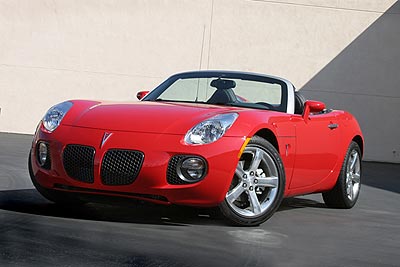
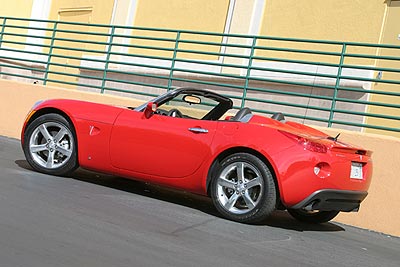
Pontiac Solstice GXP – Review: Pontiac wasted no time making early adopters who bought a Solstice over sticker feel like they got ripped off. The new Pontiac Solstice GXP is the car they should've pined for, the car they should've waited for, the car they should've paid over sticker for. It's got the same great styling but includes a few refinement tweaks and a sweet new turbocharged engine that delivers the performance promised by the Pontiac's design. It's a flawed beauty to be sure, but like that crazy girlfriend in college, its fun factor trumps its personality quirks – for a little while, anyway.
What We Drove
To gauge the difference between the regular-strength Solstice and the new extra-strength Solstice GXP, we grabbed an Aggressive Red model with the standard five-speed manual transmission. To the $25,995 base price, which includes the $600 destination charge, our test car added leather seats, air conditioning (not standard, can you believe it?), OnStar, an upgraded Monsoon audio system, XM satellite radio an auxiliary input jack, a rear spoiler, and a premium acoustic headliner. The options ran $3,394, bringing the as-tested price to $29,389. The car spent part of our test week at a local Pontiac dealer because the trunk ajar warning chime wouldn't stop its incessant , even when the trunk was solidly closed.
Performance
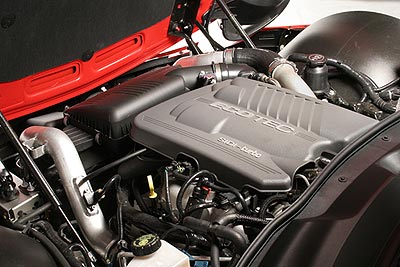
Seamless, prodigious power flows from the Pontiac Solstice GXP's 2.0-liter direct-injection turbo four, one of the best power plants GM has produced in recent memory. Thanks to 260 horsepower and 260 lb.-ft. of torque the car is quick and pulls all the way to redline, all while delivering a test average of 21.1 mpg. The transmission, on the other hand, is not as enjoyable. The clunky manual from the 2006 is improved thanks to the installation of a torque tube which makes shifts smoother and isolates the mechanicals (though several drivers thought otherwise). Now all GM needs to do is fix the spring-loaded clutch, which in this car is somewhat tiring and difficult to modulate.
Handling
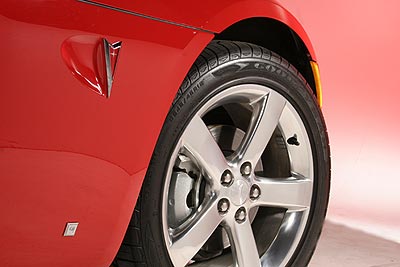
Grip from the Pontiac Solstice GXP's 18-inch Goodyear Eagle F1 tires is impressive, but at lower speeds this rubber squeals easily. Fortunately, the problem abated while running hard in local canyons. Or, maybe the wind noise and cabin buffeting overtook it. Either way, the Solstice GXP sticks. That's good, because the steering sure isn't interested in having much of a conversation and the brake pedal lacks emotion. During one panic stop, the Solstice took its sweet time coming to a halt. Around town, the suspension is supple, soaking up bumps without transferring them to occupants. Plus, the Solstice is impressively stiff, with noticeable cowl shake only on the roughest pavement or transitions.
Visibility
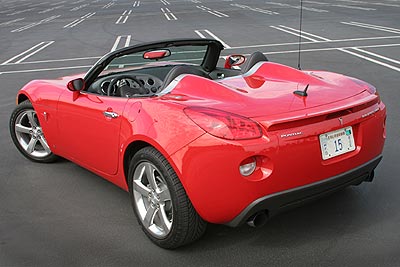
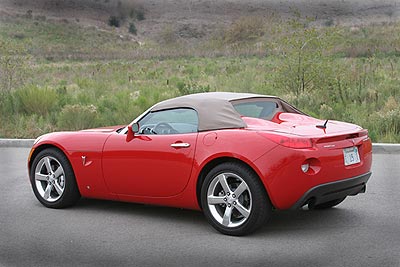
Visibility out of the Pontiac Solstice is awful. Top up or down, changing lanes and reversing is an educated guess. The side mirrors are too small, the headrest fairings too large, the top's quarter sails too wide, and the driving position too low with no option of adjusting the seat height. The narrow sliver of a rear window is glass with a defroster, though, so the Solstice has that going for it.
Fun to Drive
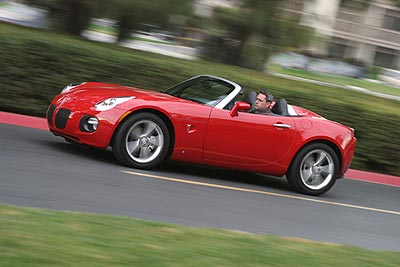
If all you ever did was dump the Solstice GXP's clutch and run to redline through the first three gears, it would be easy to fall in love with this car – more so when running along a palm-lined coast at sunset. Fast in a straight line, equipped with plenty of grip, and featuring a comfortable around-town ride quality, the Pontiac Solstice GXP has plenty going for it. But to deliver classic roadster responsiveness, it needs to communicate better through its steering wheel and brake pedal, and it could use a taller driving position. There's a promising fun-to-drive factor here, but as it stands there's room for improvement.
Front Comfort
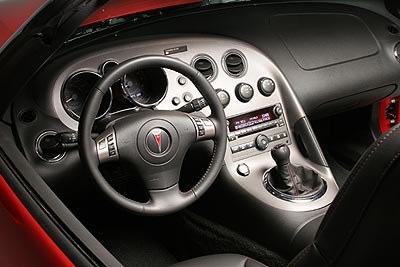
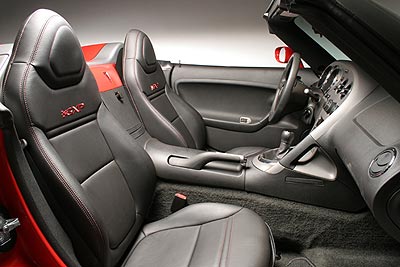
The Pontiac Solstice GXP is not comfortable. Even for a roadster, the driver sits too low, there's too much lumbar support in the backrest and not enough lateral support in the side bolsters, the steering wheel rim can bruise your palms, and the gauges and controls seem to be about six inches too high and aimed at the driver's forehead. Making matters worse, the side sills are too high to serve as an armrest, forcing the use of those molded into the door panels. The center tunnel has a padded cover, but the gearshift boot cover falls readily to hand rather than the lever.
Interior Noise
Top up, wind noise starts at 35 mph and gets louder from there. At 60 mph, it sounds like a rainstorm is pounding the roof. Top down, there's so much wind buffeting, even with the windows up, that any other interior noises are drowned out, including the muddy-sounding stereo. Get earplugs, or noise-canceling earphones. But then you wouldn't hear the turbocharger whooshing on and off at lower speeds like a Peterbilt, which is kinda cool.
Loading Cargo
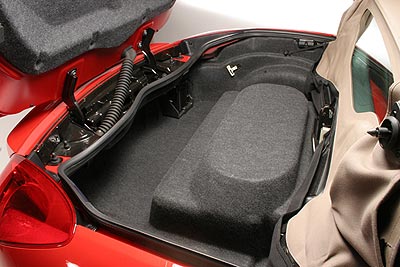
Rumor has it that Bob Lutz insisted on keeping the sexy headrest fairings of the Solstice concept car intact for production. That's why the Solstice has a rear-hinged trunk lid and stupid twin top clips that make it a complete pain in the ass to put anything in the trunk. Loading must be done from the tall sides, and if the roof is sitting in there, as in this photo, forget putting anything inside except for a few plastic grocery bags. Top up, there's the centrally located fuel tank to arrange luggage around. Unquestionably, this is the worst aspect of the Pontiac Solstice's design.
Build Quality
The Pontiac Solstice is no poster child for GM's improved build quality. Our car's hood was tweaked to the right, overlapping the front fenders. The decklid was also tweaked to the right and didn't fit flush with the bulkhead section. The rear fascia, likewise, was tweaked to the right. It's as if the car was constructed in a stiff wind that was hitting the Solstice on the driver's side. Interior construction was similarly disappointing, with warped plastic covering the windshield header, large and inconsistent dash panel joints, creaking hand grips, and a loose center tunnel pad.
Materials Quality
GM has taken heat for the Pontiac Solstice's interior materials, but it's not all bad. The graphite dash panel looks and feels good, the knobs for the stereo and climate system have rubber grips and refined action when spun, and the leather on the seats is decent. Even the center tunnel is padded in low-gloss, durable feeling material. What deserves criticism is the black plastic used to construct the dash, the door panels, and the rear bulkhead trim. It's so low rent it could have been cut out of a 1995 Chevy Cavalier. For example, the silver plastic bezels used to surround the power mirror and window switches mimic metal as convincingly as Whitesnake.