Recent Articles
Popular Makes
Body Types
2006 Pontiac Solstice Review
Sexy Solstice flaunts supermodel looks but does it face a future of nips and tucks to stay runway?
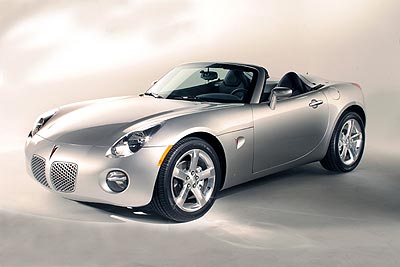
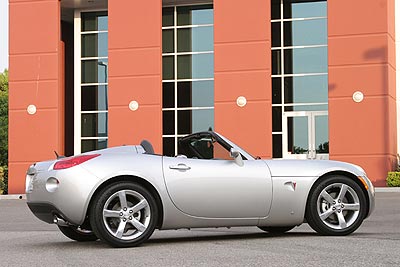
Pontiac Solstice – Driving Impressions: Growing up, we all probably remember hearing the saying “sometimes things just aren’t what they’re cracked up to be,” usually spoken by a parent or teacher. That lament was a favorite of my father’s and I found it appropriate that these childhood memories slammed to the forefront of my thoughts while sitting in heavy traffic on a drive home in the Solstice because it really sums up Pontiac’s new roadster. From the outside, the Pontiac Solstice is a looker, turning heads everywhere it’s driven and sporting a look of quality and refinement. The curvaceous bodylines are sensual, but the Solstice retains a serious sports car guise. In other words, it’s not considered to be a chick car. The attention you get driving the Solstice makes you feel like a celebrity, and the only thing missing is the red carpet treatment upon arrival and build quality to rival its competitors. The Solstice handles as well as it looks, cutting corners tighter and tighter, staying flat and delivering excellent feedback while almost taunting you to push it past your own comfort zone. A 177-horsepower, four-cylinder engine propels the little two-seater with either a five-speed manual transmission aimed at the enthusiast crowd or a five-speed automatic for those that prefer a more relaxed driving experience. A turbocharged GXP version is also in the works, upping the horsepower and adding a sport suspension, four-wheel disc brakes and traction control. The sport suspension is also available on the standard Solstice as an option. From the start, the Pontiac Solstice (also sold as the Sky under the Saturn brand) was intended to be a comeback car for GM, an entry-level image car that would bring buyers back to the American market and boost GM’s sales and image. Our test car, with less than 3,000 miles on the odometer, suffered from bad air leaks from the side windows with the top up, squeaky brakes, a moaning automatic transmission when decelerating from 30 mph, and a plethora of design problems from the convertible top and the lack of a power door lock button to a missing passenger visor mirror and a radio screen that becomes illegible in the sunlight. Plus, we averaged just 18.7 mpg with the Solstice’s four-cylinder engine. This is disappointing from a car enjoying so much hype. In typical GM fashion, the company had a good thing going with the Solstice but substandard interior quality, frustrating design and build execution issues could ultimately slow sales of the Solstice faster than its own four-wheel-disc brakes.
Performance
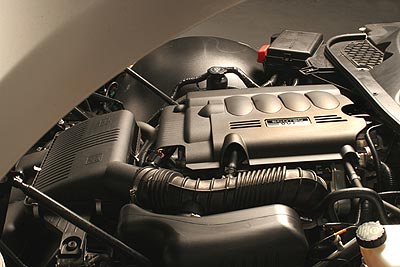
The Pontiac Solstice’s 2.4-liter DOHC four-cylinder engine produces 177 horsepower and 166 lb.-ft. of torque, giving the roadster a surprisingly spirited feel with either the five-speed manual or five-speed automatic transmission. Our test car came with the recently introduced automatic, and good torque and gearing keep this model lively although no paddle shifters are available and it doesn’t measure up to the Miata’s quick shifting six-speed sequential transmission. Even though the automatic transmission shifted smoothly, a whining noise when decelerating from 30 mph could be duplicated at will, which really throws doubt on the car’s long-term reliability and the build quality. A few weeks ago we had a Solstice with a manual transmission and actually returned it a day after picking the car up because of the strange noises it was making. Later, we were reassured by GM’s public relations department that the noises were normal and were being isolated from the cabin in the future.
Handling
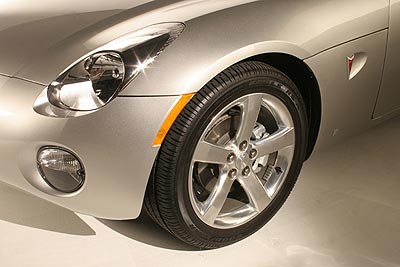
The Pontiac Solstice’s handling can best be described like a food processor: it chops, slices and dices. The Solstice corners flat, thanks to 27.2 mm front and 24.2 mm rear stabilizer bars that keep the 18-inch Goodyear tires glued to the asphalt, relaying at all times where you are relative to the car’s limits. There is no feeling of uncertainty or surprise with this car. In fact, it seems the Solstice begs you to push it harder even if it might be against your better judgment. Pontiac has also kept the ride surprisingly supple for a car that can attack a corner like the Solstice can, keeping the daily commute comfortable. Brake and steering feel are also well balanced, communicating all needed information to the driver. Pontiac gets high accolades for its work in terms of the Solstice’s handling.
Visibility
Like all roadsters, the Solstice is intended to be driven top down. However, when the need does arise to raise the top, one expects to have uninterrupted views of the traffic around them. Not surprisingly, the Pontiac Solstice offers good visibility with the top lowered but when the roof is raised, the thick quarters can require a double take before lane changes. The side mirrors do a good job of showing the view, as does the rearview mirror despite the small back window. My only visibility issue was a bit of uncertainty when it came to trusting the passenger’s side mirror but that was quickly overcome.
Fun to Drive
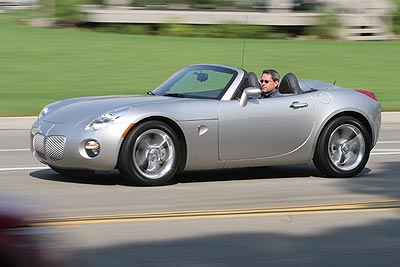
Sure, the Pontiac Solstice is fun to drive! It’s a relatively peppy convertible with great handling, and the styling speaks for itself. It’s also new enough to turn heads everywhere you go, making you the center of attention. Even with the top up the Solstice is a head turner, but the real fun starts when you drop the top and bask in the sunshine. At speed there is the typical wind-in-the-hair buffeting but normal conversation is easy enough. If you like attention and want to feel important, the Pontiac Solstice is a ride that can bring it all to the table.
Front Comfort
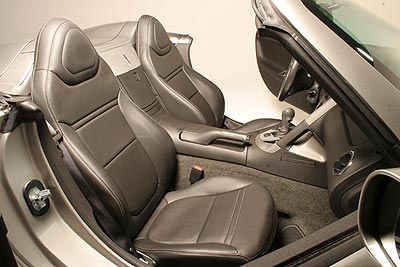
Dropping into the Pontiac Solstice – yes dropping as opposed to sliding – you quickly realize you’re sitting low, sports car style. The seats are well padded and the backrest offers good bolstering, although I would have been more comfy with a bit more thigh support or bottom cushion adjustment. The center console sits at a great height for resting your right arm, but the lack of padding quickly takes a toll on your elbow. The door panel offers an armrest and even though it’s padded, it feels as though GM skimped on it. Jammed between the seat and the door panel, the knob that reclines the seatback is also a problem. There is hardly room for your hand to reach this control, let alone room to actually twist it. A simple lever would have been a better idea. Exiting the Solstice can also be tricky; for me, the best method was to grab the thick steering wheel with my right hand while swiveling my feet to the pavement and pulling hard to gain the needed boost to launch myself out of the car.
Interior Noise
With the top raised, wind poured through the poor seals between the windows and the top, creating white noise that quickly became annoying. Wind noise from around the rear window is also ever present. Plus, on our test car, at 30 mph we uncovered a moaning sound from the transmission when accelerating or decelerating that would have an owner quickly heading back to the dealer. Our final nit is that during hard cornering, the seats rub the back panel and make a squeaking noise. The driver could move the seat forward, or Pontiac could use a twill material on the seatbacks that would eliminate the squeaking. With the top down, buffeting is minimal and normal conversation is easy. Wind noise, obviously, is always present but not obtrusive. The Solstice is clearly made for top down motoring.
Loading Cargo
As is the case with most roadsters, trunk space in the Pontiac Solstice is extremely limited. With the top in the raised position, you can arrange medium-sized soft luggage around the fuel tank bulge in the middle of the trunk. With the top down, forget the bags, because your best chance of storing clothes for a short weekend getaway would be to stuff them around the sides of the folded top. There simply is not enough room for a weekend’s worth of clothing, let alone a golf bag. There’s also a high liftover to deal with since the decklid lifts opposite of a typical trunk lid, clamshell style. Plus, it forces loading from the sides of the car, rather than the rear. This is a serious issue that needs correcting, because otherwise the Solstice is perfect for a nice weekend getaway of top-down cruising. Closing the lid is also a challenge. Slamming it down is the easiest way to get it shut, and prevents palm-sized dents on the headrest fairings. Unfortunately, most people feel a good push on the decklid fairings is the proper way to get the lid closed, and the folly of this method was evident on our test car. Paintless dent removal guys will love the Solstice.
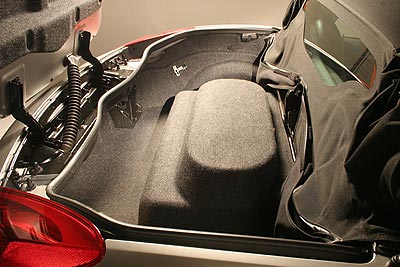
Build Quality
Sadly, the Pontiac Solstice suffers from a bad case of GM cost-cutting syndrome. If the cheap plastics used on the interior aren’t bad enough, how about the fact that some of them are barely attached – as found on our test car’s center console. We also experienced excessive wind leaks around the windows with the top up, exterior panels that didn’t fit flush, squeaking brakes, and a moaning transmission, all on a car with less than 3,000 miles on the clock. These issues bring up the potential for questionable reliability, which can kill car sales by simple word of mouth let alone independent quality surveys. On a positive note, the Solstice’s chassis is tight, exhibiting very little flex over rough surfaces, which adds to the comfort and handling.
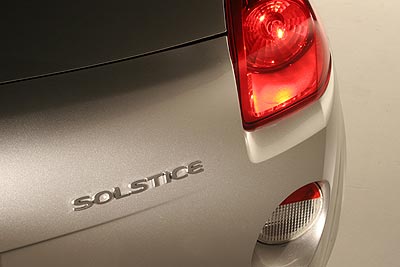
Material Quality
Cheap plastic is abundant inside and out. The Pontiac Solstice’s grille is silver honeycomb which helps to upgrade the look, but the rear gets a full lower valance of inexpensive-looking black trim from tire to tire. Stick your head inside the car and you’re likely to notice the vast amounts of hard plastic before anything else. Its unfortunate GM chose to take this course, because with a little more attention to detail the Solstice could have truly been what it was intended to be, an image-building sports car for Pontiac. With regard to material quality, it is an image-confirming sports car for Pontiac.
Styling
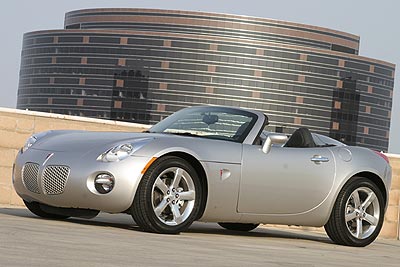
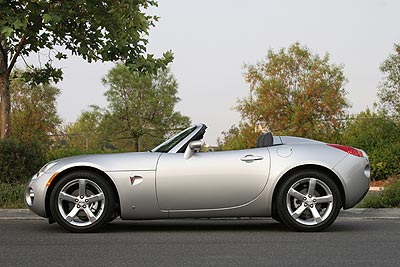
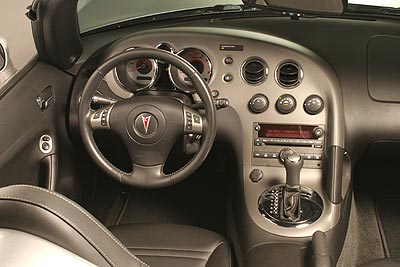
Styling is where GM really hit the nail on the head with the Solstice. The design is excellent, turning heads wherever it goes. The Solstice even looks good with the top up. It’s low, sleek and aggressive, all the things a sports car should be. The headrest fairings on the decklid really add to the Solstice’s appearance and the 18-inch wheels highlight the car’s curvaceous wheel openings. Where designers have room to improve is with the design of the top. The flying buttresses at each corner of the top must be individually pressed back into the deck lid every time you open the trunk, and that requires a 180-degree trip around the car. They also don’t fit flush to the bodywork, which usually results in a second or third push to ensure they are fastened. Dropping the top is easy enough but does require the driver to exit the car to complete the process. Closing the lid requires a good slam to prevent pushing on the headrest fairings, which can dent easily. The Solstice’s interior is simple and clean with no serious flaws. I would, however, like to see the emergency brake moved from the center console to the space between the door and the seat. This would make for a cleaner design and additional arm space on the center console. The large center-mounted tachometer and speedometer are easy to read and are a welcome addition in any sports car, but where’s the temperature gauge?