Recent Articles
Popular Makes
Body Types
2008 Nissan Pathfinder SE-V8 Review
Nissan keeps Pathfinder in the game with a healthy shot of power
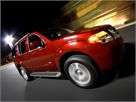
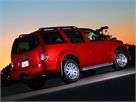
Like the high school track star who bulks up to play running back, Nissan took the Pathfinder to the weight room and added a V-8 engine. Just like the track star turned running back, the mid-size SUV is healthier on the inside, a little tougher looking and stronger than before. For Nissan, the V-8 is a competitive thing, but its value for the buyer is primarily towing capacity. An additional 1,000-pound’s worth. Much-needed improvements grace the interior of the 2008 model, while the exterior retains the brand’s aggressive light-truck styling. With the V-8 and third-row seating, Nissan keeps the Pathfinder competitive in the rough-and-tumble game called mid-sized SUV.
By Bob Beamesderfer
Photo credit: Oliver Bentley, Toyota
Page 2
We drove a Nissan Pathfinder SE with the 5.6 liter V-8 engine, five-speed automatic transmission and all-mode four-wheel drive, which starts at $33,555 including a $705 destination charge. Among the standard features, rear-view monitor, dual zone climate control, and stability control. Option packages included the SE Premium package with moonroof, automatic headlights, and 10-speaker Bose audio system; Airbag package, which adds side impact and side curtain units; and SE Leather package, which covers the front and second rows with hide, adds heaters to the front seats and outside mirrors, and adds power to the four-way front passenger seat. Those options brought the total to $38,260.
Page 3
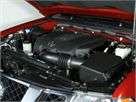
This is the first time a V-8 has been offered in the Pathfinder. At times there’s no replacement for displacement, like when you need torque. With 388 lb.-ft. of torque, the 5.6 liter V-8 offers plenty of grunt, enough to bring the towing capacity to 7,000 pounds. Power comes on early and delivery is smooth all the way to redline. The five-speed automatic transmission’s gear ratios seem too close together for towing, but it’s smooth and never went hunting for a gear. Manual mode lets the driver select the right gear for the job.
Page 4
The Nissan Pathfinder has very good on-road manners for a mid-size, off-road capable. The steering has a solid feel and is quick and precise for a truck of this size. Stability in corners and a lack of the usual wallowing that plagues other SUVs was a welcome surprise. The brakes have good pedal feel and are easy to modulate. Nissan put discs at all four corners, and it’s an antilock system with electronic force distribution. The ride is comfortable without being springy, unlike many vehicles designed for off-road use.
Page 5
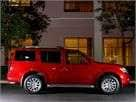
For the most part visibility is good to the sides and rear. Not as good out of the front because of the high dashboard and hood, and the rear seat assist handle on the door pillar is distracting at first. Visibility to the rear gets more cluttered with the all the headrests raised, especially the third row headrests, which raise higher than those in the middle row. Outside mirrors are big enough and the rear monitor makes backing up easier, with a bright image and helpful trajectory overlay.
Page 6
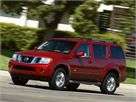
The Pathfinder is a true SUV that’s pretty easy to live with, except for the low fuel economy: 14.2 mpg in mixed driving conditions. It has a comfortable ride, overall decent handling and very good power from the V-8 engine. While the EPA estimate for the V-8 is 12 mpg city and 18 on the highway, the V-6 only improves to 14/20. The extra towing capacity is also a plus.
Page 7
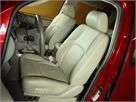
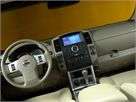
When SUVs like the Pathfinder first debuted, interior comfort was secondary. Now there’s an expectation of the creature comforts found in sedans, and Nissan meets that expectation with generously sized seats. They’re supportive and comfortable and the driver’s adjusts eight ways. As expected in a truck, there’s good head and leg room. There’s a nicely padded center armrest, but it sits too far back. Door armrests are soft-touch and slightly padded. The steering wheel is covered in smooth and perforated leather and feels good in your hands. Getting in and out is fairly easy thanks to assist handles.
Page 8
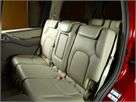
Outboard seats are comfortable, and there’s adequate room for adults with good head, leg and shoulder room. However, foot space under the front seats is negligible. An adult probably shouldn’t sit in the middle position because the headrest doesn’t extend far enough to be safe, and it’s not very comfortable because it’s harder. A nice, plush center armrest folds down for when only two people are in the second row, and the outboard seats tilt back. It’s fairly easy to get in and out, but children might find the exterior handles hard to reach. There are assist handles above the doors and on the B-pillars.
Page 9
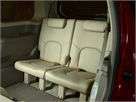
Adults will have a hard time getting in and out of the third row seats. The second row headrests must be lowered for the seat to move out of the way enough for ingress or egress. Once back there, adults won’t be comfortable. Head room is good, but leg room is cramped for anyone other than small children. Not too small, though; there aren’t any anchors for child seats. But the seats are easy to stow and raise from the back of the vehicle. Middle row seats do need to be upright, however, in order to stow the third row.
Page 10
While the days of spartan interiors of rubber and vinyl are gone, there’s one thing that SUV’s have a tough time avoiding: wind noise. There’s some of that audible in the Pathfinder off the mirrors and roof rack, but otherwise it’s quiet, with road and tire noise subdued. You can hear the engine under acceleration, but it’s not muscle-car loud, and just enough to make V-8 fans happy. Cruising in Drive, the engine and transmission noise is nicely muffled.
Page 11
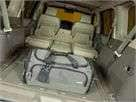
The rear hatch opens and closes easily and the cargo deck is low, making loading and unloading a snap. With the third row stowed, there’s 88.2 cubic feet of space on a flat floor that can accommodate a lot of gear. Surface is rubbery plastic, round-dot texture and there are plastic rub strips. With the third row seats raised, cargo space drops to 32.7 cubic feet. There’s a 12-volt power outlet and six tie-down hooks, along with hooks for a cargo net. There are a couple of small storage bins, one on the left side of the cargo area and one in the hatch, both with net fronts.