Recent Articles
Popular Makes
Body Types
2007 Nissan Altima Hybrid Review
Driving Al Gore crazy
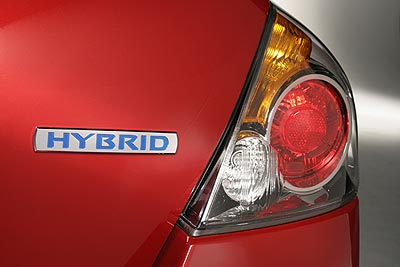
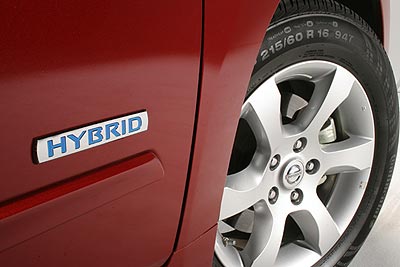
Nissan Altima Hybrid – Review: She drove a white Prius, and my, did she ever want to race. Kept revving her engine. Rolling, forward and back and glaring over. So when the light changed, we were off, both cars inching off the line, neither wanting to be the first to start their engines. It was exhilarating: five, 10 and up to 30 mph, until she accidentally goosed the throttle, the Prius coughed to life and took off, leaving just the memory of its “Hillary” bumper sticker behind. Sure, the Nissan Altima Hybrid may not make a statement like the Prius, it may be noisy and overpriced, but it's still one of the more fun and comfortable hybrids on the road, at speed or in silent racer mode.
What We Drove
If you're gonna drive a hybrid, you may as well do so in southern California where Prius – is it Priie? – roam in packs. To make it even better, our Altima Hybrid was decked out with all the best stuff: leather (kind of), Bose audio, sunroof, reversing camera w/navigation, and more. Though we did not have a window sticker, we did a price check and found the hybrid to cost a whopping $32,625, including $615 destination charge and two main option packages: Technology, for $7,250, and Convenience, for $1,300. Without the extras but with the destination, an Altima Hybrid would cost about $25,015. Good luck with that, however. Nissan is only building a few of these and in “green” states, and most will be optioned to the nines.
Performance
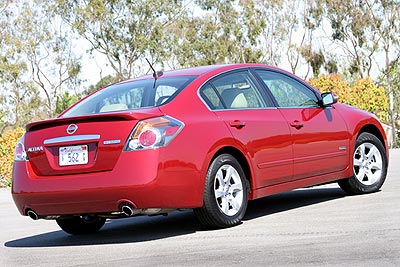
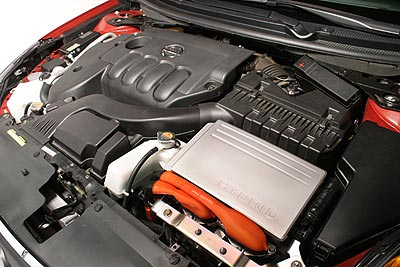
The Altima Hybrid is a credible competitor to its virtual brother, the Toyota Camry Hybrid, and may in fact be more fun to drive. A combined 198 horsepower and a bunch of hearty, low-end torque (162 lb.-ft at 2,800 rpm from the engine, 199 lb.-ft at 1,500 rpm from the electric motor) makes for spirited take-offs and enough power to get you over hill and dale. Perhaps more to the point, however, is how the clean-air side of the Altima hybrid works: impressively, we drove it past 40 mph on just electric juice. That's not easy, however: We babied the throttle and chanted “AL GORE” sixteen times to make it happen. We ended up with a real-world average of 28.6 miles per gallon.
Handling
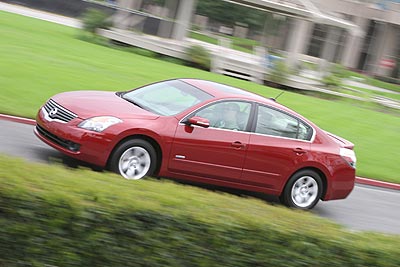
Granted, the redesigned 2007 Nissan Altima is not tuned for sport handling, and the Altima Hybrid is certainly no exception: Take the Altima with the 2.5-liter four cylinder engine, add almost 400 pounds and what you get is a sedan that wallows around corners like a drunk. Elsewhere, steering is vague, especially at slow speeds, and though it improves as the speed increases, it still feels quite imprecise. Aggressive braking reveals a spongy pedal, some plow and a little tug in the front end, while normal braking is plagued by a touchy pedal, but one you do get used to. On the bright side, the suspension absorbs bumps well while feeling crisp and planted during normal driving situations. Just take it easy around those corners.
Visibility
The squared-off rear-view mirrors of the 2007 Nissan Altima Hybrid improve visibility, and our tester had a fabulous back-up camera that made pulling out of shopping center parking slots a breeze. You don't really need the camera, however, because the A-and B-pillars are thin and there's a wide expanse of glass in back. Rear side windows are large, as well, while the integrated head restraints in back are a potential visual block, but that's a small concern.
Fun to Drive
Hybrids really aren't too fun to drive, unless the initials “GS” are glued to the back of the car, right next to the word “Lexus”. Mainstream commuter hybrids, well, they're designed to do less: less pollution, less gasoline, and, as a result, less fun. It's pretty simple, and one of the culprits is that continuously variable transmission (CVT): it takes the sporting life out of a powertrain that actually has quite a bit of pep to offer. On the other side of fun, however, is driving the Altima Hybrid without engaging the engine. Sure, that's fun, in a nerdy sorta way.
Front Comfort
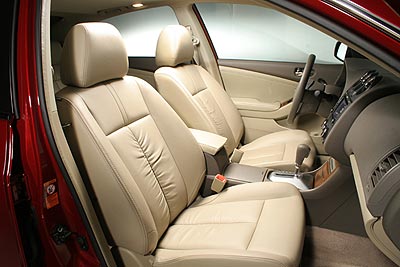
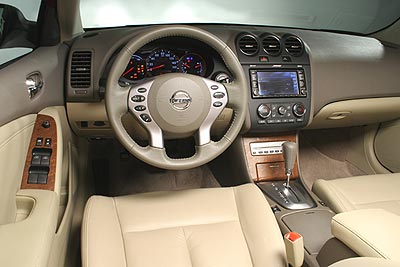
It's pretty roomy inside the Altima, with nice amounts of leg room, shoulder room and head room. Seats offer satisfactory support: nice, firm bolsters and a wide seat bottom for, um, larger loads. The leather upholstery seems pretty low-grade, however, as does the steering wheel. It lacks grip and is encased in what looks and feels like poor quality plastic. Nissan, however, didn't spare expense on the dash cap: It's a low gloss and soft area, which eliminates glare and increases preservation. Same goes for the arm rests: all are wrapped in soft leather.
Rear Comfort
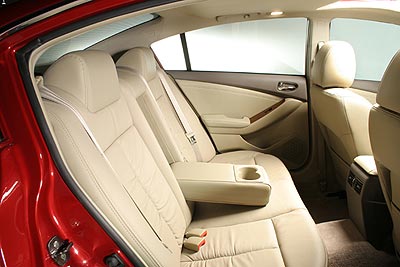
Nissan clearly has a winner with the redesign of the Altima, at least from a comfort perspective. Front to back, there's plenty of room for legs, and there's also comfortable seats, though the back seat bottom bench felt a little too flat and the beltline a little too high, making one feel unduly constrained. Despite this, there's plenty of room, and as with the front, soft touch surfaces all around. It's one of the more comfortable sedans we've driven in some time.
Interior Noise
Dang, that powertrain sure makes a bunch of noise, whining all the time. It's especially irritating when you put your foot down and hammer the throttle. That's when you get to listen to the squealing cries of the continuously variable transmission (CVT), the shiver that goes up the chassis when the four-cylinder kicks on and the thunks and electric whine when you slow to a stop. Wind and tire noise is also pretty noticeable, but those bugaboos are drowned out by the sound of the hybrid powertrain, doin' it's magic. That's okay – just turn up the nice Bose audio system and pretend you don't hear a thing.
Loading Cargo
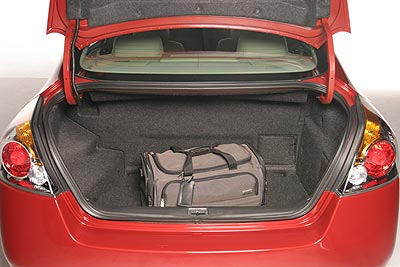
This is where Altima hybrid shoppers suffer perhaps the most. With all that synergy drive stuff stashed in back, cargo room vanishes from a 15.3-cubic feet trunk to 9.1 cubic-feet. Also because of those batteries, there's no pass through or 60/40 split – though the little door is still there. It leads to a manual trunk release, though we're not quite sure why there needs to be two manual release levers for the trunk. Otherwise, liftover is low, and the opening is big enough for most things. Finish materials such as covering and carpeting, however, are pretty low-grade; this is one trunk that may not age well.
Build Quality
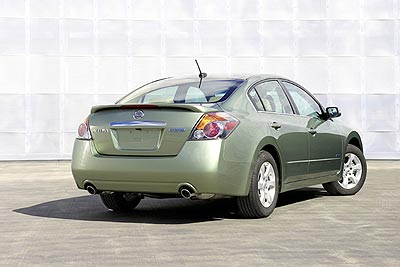
For $32,000 and change it wasn't too much to ask for a test car with a glovebox that closed all the way, nor was it too much to expect a center console unit that's stable and affixed, as opposed to loose and loopy. And there's more: the center panel plastic that surrounds the environmental controls had slightly protruding sharp edges on the bottom side; the passenger side vent was loose, the sunglass holder in the ceiling-mounted unit rubed. Outside, the hood was on slightly crooked, the trunk didn't fit evenly, the badge was tweaked on the back and the chrome trim along the passenger side was loose at the front door.