Road Test: 2009 Mitsubishi Outlander

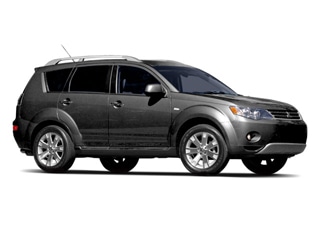
2009 Mitsubishi Outlander SE 4WD

When people talk about Japanese automakers lately, it seems like most of the attention goes to Honda and Toyota. As dominant as those two automakers are, the country's remaining automakers still offer plenty of reasons to be noticed. Nissan usually focuses on sporty, enthusiastic vehicles, Subaru has full lineup of safe, all-wheel drive cars and crossovers while Mitsubishi is known for its more aggressive vehicle design language evident by the latest Lancer sedan. For that reason, it was surprising when Mitsubishi introduced a compact crossover, called the Outlander, in 2001 with conservative, Subaru-like styling. When the second-generation Outlander debuted in 2007, Mitsubishi ditched the vanilla design of the previous model giving the new Outlander an angular, aggressive and more modern look.

Going up against other small crossovers like the Toyota RAV4, Subaru Forester , Mazda CX-7 and Ford Escape, the Outlander has an unenviable task of competing in one of the most popular and competitive vehicle segments in the automotive industry. The 2009 Mitsubishi Outlander comes in three trim levels (ES, SE and XLS) and has a base MSRP of $20,295. Last year, we reviewed a base model 2008 Outlander ES 2WD very few options and a $21,460 total MSRP, but this go around we tested the midlevel SE with four-wheel drive which bumped up our baseline price to $25,095 with an as-tested price of $28, 644 after a few options and vehicle destination. Although this Outlander offers impressive technology, four-wheel drive and a sporty design, we attempt to see how an entry-level crossover handles itself in a price range nudging a price close to where bigger, more luxurious vehicles are starting.

2009 Mitsubishi Outlander Exterior

Through vehicles such as the Lancer and Eclipse, Mitsubishi has learned that one of the best ways to stand out from the crowd of its competitors is to not match the conservative styling that most other vehicles exhibit. This is further highlighted on the Outlander which gets an angular, aggressive and more modern look emphasized by design aspects such as the scowling headlights, bulging wheel flares and clear-lensed LED taillights. Our test model Outlander SE also had an added elegant flare thanks to the Diamond White Pearl paint hue with chrome accents on the lower side sills and door handles, while aluminum accents were added to the front fascia and the standard roof rack rails. Finishing off the sporty looks, this Outlander was equipped with 18-inch, seven-spoke alloy wheels.

2009 Mitsubishi Outlander Interior

Inside, the Outlander furthers itself from most of its competition by offering an interior design that has more in common with a sports sedan than a compact crossover, but it doesn't sacrifice the ever-important cargo capacity and versatility expected from such a vehicle. Technically, our test model had seating for seven passengers thanks to the optional ($500) third-row seat, but the collapsible rear seat is better suited for small children as legroom is not very generous. As for the front five passengers, the front seat occupants are welcomed by stylish seating, while the middle row gets sufficient legroom and the seats have the ability to slide fore and aft as well as recline to offer optimal comfort.

The Outlander has a similar instrument gauge layout as the Lancer with two large pods flanking a digital readout display, but our test model added Mitsubishi's optional ($1,999) navigation system. This system uses a large touch-screen display that allows for easy and intuitive use and offers a decent picture and resolution. One of the best parts of this system is that it uses some of the 40 gigabyte hard drive as a music server to play through the Rockford Fosgate® sound system that includes a large subwoofer in the rear cargo area. Although some manufacturers are offering Bluetooth connectivity at no charge these days, others, including Mitsubishi, continue to charge extra for the convenient technology - on the Outlander ES and SE, the hands-free device adds $250 to the bottom line price, but it is standard on the top of the line XLS model.

In addition to the Outlander's nine cupholders, there are a multitude of storage compartments and cubbyholes. On the instrument panel alone, there are two glove boxes, smaller storage compartments above and below the center stack and large storage areas in the lower door panels. In addition to the many storage areas, the Outlander can accommodate up to 72.6 cubic feet of storage space with the rear seat(s) folded out of the way (five-passenger models can hold up to 36.2 cubic feet of cargo behind the second row).

2009 Mitsubishi Outlander Performance & Handling

Although a more powerful V-6 is available on the Mitsubishi Outlander XLS, the SE model we tested uses a 2.4-liter MIVEC inline-4 that produces 168 horsepower and 167 lb-ft of torque. The high-revving, aluminum engine hits its peak horsepower and torque at 6,000 rpm and 4,100 rpm, respectively. One aspect that allows the engine to hit higher rpms is the Sportronic® continuously variable transmission (CVT) that Mitsubishi uses both the ES and SE; XLS models use a Sportronic® six-speed automatic transmission. Mitsubishi's CVT doesn't allow the Outlander to exhibit the same level of sportiness as its exterior and interior would imply, so for more exhilarating driving, Mitsubishi equipped the Outlander SE with magnesium shift paddles to give the driver more control. In the end, the CVT does add up to decent fuel economy with EPA estimates of 20 miles per gallon in the city and 25 mpg on the highway.

The Lancer-based Outlander handled traffic, curves and potholes like a car without feeling top heavy thanks to the aluminum roof shell (helping to lower the vehicle's center of gravity), but the extra weight from the four-wheel drive system and third-row seat may have taken a little away from the sporty ride we exhibited from the 2008 Outlander SE especially when it came to acceleration. Still, the compact crossover's true full-time four-wheel drive system (not all-wheel drive or part-time four-wheel drive like some of the competition) allows the driver to choose between three modes for either fuel-efficient street driving or capable off-road driving. In 2WD, the Outlander operates in front-wheel drive, but in both 4WD and LOCK modes, the system sends more torque to the rear wheels under acceleration to maximize traction. In 4WD mode, the Outlander easily managed driving on the white sand beaches of Amelia Island, Fla.

2009 Mitsubishi Outlander Safety

Besides styling, vehicle safety is probably one of Mitsubishi's strongest suits. The National Highway Traffic Safety Administration (NHTSA) gave the 2009 Outlander essentially a perfect score for a crossover with five-star ratings for both front- and side-impact protection and a four-star rating for rollover avoidance. The Insurance Institute for Highway Safety (IIHS) went one step further and named the Outlander a Top Safety Pick for 2009. To achieve a Top Safety Pick rating, a vehicle must receive a rating of Good for front-, side- and rear-impact protection as well offer stability control either as standard equipment or as an option. The 2009 Outlander offers Active Stability and Traction Control (ASTC) as standard safety equipment along with six airbags, tire pressure monitoring system and four-wheel antilock brakes (ABS).

Summary

The Mitsubishi Outlander we test drove offered a new combination of options for 2009 allowing the fuel-efficient inline-4 to be paired with the available three-row seating, which offers increased flexibility for this capable crossover. Combining a stylish design with a well-executed, highly versatile interior, Mitsubishi manages to offer one of the sportiest crossovers on the market. With the possibility of a design update based on the 2009 Outlander GT Concept coming in the near future, the aggressive looks of Mitsubishi's entry-level crossover will get much meaner as it matches the front styling of the 2008 Lancer Evolution.