Recent Articles
Popular Makes
Body Types
2008 Mitsubishi Lancer GTS Review
Note to enthusiasts: Get a stick
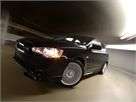
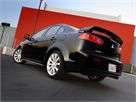
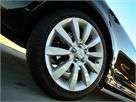
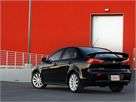
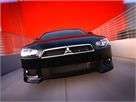
The2008 Mitsubishi Lancer GTS looks ready to rumble. Its grille gapes wide enough to devour competitors, its rear wing thrusts skyward, and its big 18-inch wheels and low-profile tires give it a track-ready presence. However, it has a glass chin in the form of the CVT automatic. This sloppy, poor shifting device ruins what is otherwise a well-equipped, decent handling and reasonably priced entry in the economy car segment. Enthusiasts should ignore the marketing and get the manual transmission if they want their Lancer GTS to even approximate the performance promised by its looks.
By Keith Buglewicz Photo credit: Oliver Bentley
Page 2
Our 2008 Mitsubishi Lancer GTS was about as fully loaded as it gets from the factory. The base $19,115 includes the dreadful CVT; we again suggest you save $1,000 and get the manual transmission. The trim level is well equipped, sporting standard features such as automatic climate control, a leather steering wheel, and power mirrors, locks and windows. It also featured the $1,500 Sun and Sound package, which bundled the sunroof with the upgraded Rockford Fosgate audio system. The $2,000 Navi and Tech package bundled keyless entry and a hard-drive based navigation/audio system, bringing the total to $22,615.
Page 3
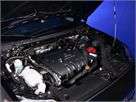
On paper the drivetrain is promising, with 152 horsepower and 146 lb.-ft. of torque (143 horses and torques in California and other states with the same emissions laws) and a manually-shiftable CVT automatic. In practice it’s a mess. The transmission sucks the life out of the car with poorly spaced ratios that do little but make the engine scream powerlessly. Shifting drops revs only about 800 rpm, too little to be useful. It’s slow to respond in fully automatic mode, and we only got 18.9 mpg to boot. We strongly suggest the manual.
Page 4
The fact that the Lancer GTS handles well makes the lousy transmission that much more frustrating. The chassis is stiff and composed, with good turn in and only mild understeer at the relatively high limits. Luckily, while the Lancer is tossable and fun, there’s little ride penalty. It’s solid on the road, but firm and not punishing. True, the big tires drum thump heavily over expansion joints, but you hear it more than you feel it. Mitsubishi did its chassis homework on this car, and it shows. Now, if they’d just reprogram that CVT to help rather than hinder the driving experience…
Page 5
The Lancer’s thin pillars and generous glass make for good visibility. There are no glaring blind spots, and even the pillars are thin enough in cross section that they don’t intrude on your lane changing ability. We wish that the outside mirrors had more surface area, but it’s a minor complaint. The only real impediment to your outward view is the ridiculously sized rear wing. It’s standard on the GTS and can’t be deleted, so if you want the best handling Lancer currently available, you’re stuck with it and the resulting bifurcated rear view.
Page 6
The most fun we had with the Lancer was going downhill. There, we didn’t have to worry about the troublesome transmission and could just enjoy the car’s handling balance. It turns in and sticks, and promises great things when the turbocharged Evolution debuts on this platform in a few months, or even the GTS 2.4, with its bigger and more powerful engine. However, when we had to shift for ourselves, the CVT’s intrusive nature made us concentrate too much on finding a good ratio, ruining the experience.
Page 7
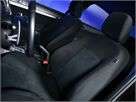
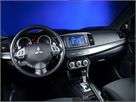
We were a little mixed on the front seat comfort of the Lancer. Some of us thought the bottom cushion was poorly positioned, while others thought that the front seat was very well done. Regardless, there were no complaints about the soft faux-suede cloth on the seats, door and center armrests. We would have liked soft-touch surfaces on the door tops, but that’s increasingly rare in this budget-conscious segment. Everything is within reach, too, such as the protruding navigation system, shift handle and shifter paddles that are long enough to click at all but the most extreme steering angles.
Page 8
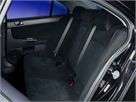
We were pleasantly surprised with the amount of rear seat room in the Lancer. It’s no limousine, but for a compact sedan there’s good leg, hip, toe and head room. Shoulder room is tight thanks to the seat shape, and three people would be cramped. Our knees also touched the seatbacks in the “self-behind-self” test, but they’re soft so it’s not a problem, at least on short trips. Rear seats are covered in the same suede-like cloth as the fronts, and a final nice touch is the soft arm rest that folds down from the center seatback position.
Page 9
Continuously variable transmissions like the one in the Lancer tend to make the engine hang at redline for extended periods of time. This is fine if there’s adequate sound deadening, or if the engine just sounds good to start with. Unfortunately, neither is true in the Lancer. Stand on the gas and the Lancer’s uncomfortably noisy. Back off and cruise and you discover that the engine was hiding constant tire, wind and road noise at freeway speeds. The Lancer competes in a generally noisy class, and unfortunately, the Lancer is near the head of the class in this category, at least subjectively.
Page 10
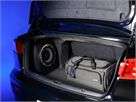
The short rear deck looks cool on the Lancer and probably results in good aerodynamics (except for the drag-inducing wing), but the upshot is a small trunk opening that can’t accept anything taller than about 18 inches. Additionally, the subwoofer from the Rockford Fosgate audio system takes a sizable whack out of the left side of the cargo area. Despite this, liftover is low, and there’s a good lip to keep small items from rolling onto the ground when you open the trunk lid. The rear seatbacks fold down in a 60/40 split, but must be released from inside the car.
Page 11
The Lancer’s build quality is significantly improved from its predecessor, but still a half-step behind the class leaders. Most seams are tight inside, and the flush fit dash panels mostly live up to their billing. The dash uses a minimum of panels in its construction, giving it a clean appearance. Fit and finish were good outside too, where we found only minimal variations in panel gaps. The only glaring flaws were the wrinkling of the headliner fabric around the pillar covers, and the quarter-inch gap between the B-pillar covers and the bottom part of the interior trim.