Mitsubishi gets eclipsed by the competition
Introduction
TO THE POINT What’s New? The Mitsubishi Eclipse has been completely redesigned for the 2006 model year.Selling Points: Strong engine
Deal Breakers: Visibility, as-tested price, materials, comfort, rear seat access and room, interior design
Our Advice: Though its competitors number few, most are arguably better than this Mitsu. Look past the engine and warranty and strongly consider the alternatives.
For as long as many folks can remember, the U.S. car market has been increasingly dominated by Japanese manufacturers while domestic automakers have recorded declining sales. Today, it seems that Fords are fine for rental lots, while Toyotas and Hondas are preferred for personal driveways. However, a shift is occurring, whereby American cars are becoming desirable and worthy of consideration again, now serving as an example for certain Japanese nameplates that seemed to have lost their way.
One such company, Mitsubishi, has been selling vehicles in the United States for about 25 years. Among the brand’s most impressive early models was the Eclipse coupe, available at one time with a gutsy turbocharged engine and road-hugging all-wheel drive, while Chevy was pushing its mundane Cavalier. Those were the good days when Japan delivered sporty and engaging cars, whereas the domestics delivered boring, low-quality transportation. Fast forward to 2006 and Toyota and Honda are still building hot-selling rides, and surprisingly, so is GM. Its reinvigorated large suvs are well-built and stylish, and models like the Pontiac Solstice and Cadillac CTS are attracting buyers. Ironically, 2006 is also the year of the redesigned Mitsubishi Eclipse, now featuring poor build quality, many low-grade interior materials, a lofty price, a powerful V6 that lacks the spirited character of the original turbo four-banger, and a bloated exterior design. Plus, it’s a front-driver only.
There seems to be one simple rule adopted by all successful car companies – build vehicles people want to drive and sell them at reasonable prices. And as a caveat, build them well. Toyota and Honda get it, Nissan gets it, Hyundai and Kia are starting to get it, and it’s even starting to sink into GM’s thick head. But after spending a week in the 2006 Eclipse GT, we’d say Mitsubishi needs to do some studying. Maybe it can call Detroit about getting a tutor.
Performance Key Points:
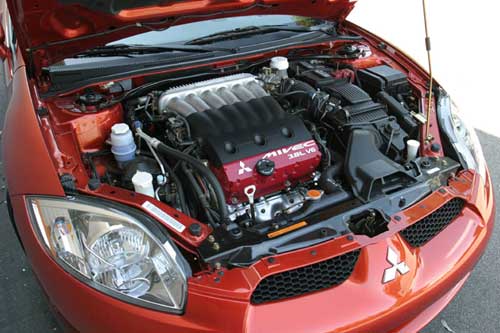
With 263 horsepower on tap from its 3.8-liter V6, the 2006 Mitsubishi Eclipse coupe has ample grunt to help it pull hard throughout the rev range. That horsepower rating peaks at 5,750 rpm and is supported by 260 lb.-ft. of torque rolling on at 4,500 rpm, all pushed to the front wheels by a six-speed manual or a five-speed automatic transmission with a manual mode. With the six-speed, it’s easy to run the V6 up to redline, though the relatively quiet engine would hardly let the driver know. Instead, one needs to keep an eye on the tachometer or wait until engine power is automatically cut in an act of self preservation. It sounds like fun to an enthusiast, but peak power is achieved quickly and wringing out the motor can be short-lived. Leave the Eclipse GT in second for spirited runs between canyon corners only to be handcuffed mid-sprint by the sputtering engine’s need for third gear. Mashing the throttle also unleashes an abundance of torque-steer. However, the manual transmission’s shift knob is well-placed and precise, accented by a light-effort clutch.
Once you’ve determined how best to smoothly extract the 2006 Mitsubishi Eclipse GT’s power, you’ll ultimately have to slow it all down. Saddled with that task are antilock brakes with ventilated discs and electronic brake-force distribution. The system is characterized by a touchy pedal with little effectiveness for the first half to one inch of progression followed by a rather abrupt unleashing of stopping power. Adjusting to the setup around town is quick; learning how to finesse the pedal during aggressive driving, when foot movement is faster and too much sudden brake pressure can be dangerous, takes a bit more time.
Handling
Handling Key Points:
It’s hard to believe that this car, touted as a thrilling sports coupe, comes from the same minds that developed the amazing Evolution. One can only imagine what the Evo’s turbocharged engine and all-wheel-drive capability could do for this bloated two-door, but that’s a point for another day.
What we currently have is the 2006 Mitsubishi Eclipse, complete with its large turning radius and annoying torque-steer that rears its ugly head at green lights as well as during drop-a-gear-or-two highway passes. The one positive about all this front-end power is its ability to aggressively pull the Eclipse through the exit of a tight corner, which can be a good time. There’s minimal body roll showcased in the twisties, yet the heavy tail end can be sent slightly adrift by lifting off the throttle to induce a touch of oversteer. The power rack-and-pinion steering is tight and devoid of any dead spots. However, continuous correction is required on grooved highways, and the feel is numb compared to the responsive Evolution. All occupants will notice the Eclipse’s firm ride that lands it someplace between a track-ready Nissan 350Z and a Hyundai Azera with its Serta-sourced suspension.
Interior Comfort
Interior Comfort Key Points:
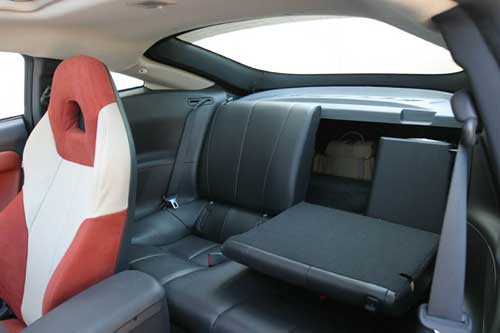
Sometimes, looking good means sacrificing a bit of comfort. And some may argue that it’s not a worthy trade for the 2006 Mitsubishi Eclipse. In any case, behind that curvy skin is a four-passenger cabin, at least on paper. The rear bench seat, deeply contoured to resemble real buckets, is so seriously lacking in headroom that even short occupants will be banging their heads against the hatch glass. Add to that the nonexistent headrests, rigid plastic front seatbacks, hard and hopelessly tiny outboard armrests, and downright cruel foot and leg room dimensions, and the result is a completely inhospitable space to travel. Oh, and don’t forget that there are no storage areas or cupholders to be had back there, and the “pleather” is an utter disgrace for a car heading toward thirty large. Getting in is aided by a quick-release lever on the passenger side.
Front riders are afforded only slightly better accommodations. The front buckets feature ample bolsters, though they have too much give under pressure, and lumbar support does little to compensate for the hard seatback. A tilt steering wheel is a nice bonus, as is the padding on the doors and center armrest; however, the steering wheel needs to tilt higher, and hard plastic on the door and center console greets the driver’s knee in hard corners. Typical of a coupe, the low roofline and low seats make ingress and egress a bit difficult.
Once inside the 2006 Mitsubishi Eclipse, occupants will be treated to a rather loud ride thanks to a thin layer of carpet that allows noise from pebbles hitting the undercarriage to be amplified throughout the interior. Plus, there’s an annoying rattle from the sunroof, and the engine seems to register a bit high on the decibel meter. Thankfully, the exhaust offers a pleasant raspy note.
Interior Design
Interior Design Key Points:
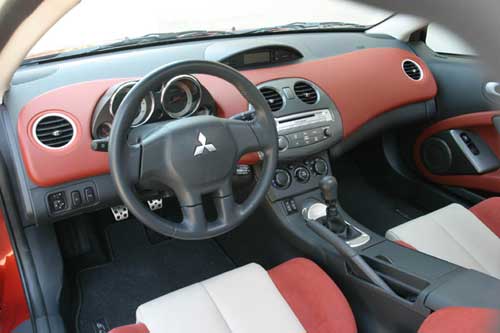
Interior design may be the 2006 Mitsubishi Eclipse’s biggest shortcoming. The most obvious stylistic violation involves the use of two-tone suede seats, a grotesque tan/orange combo on our GT tester, and the poor excuse for a rear seat being swathed in cheap black pleather. As if using completely different materials on the front and rear buckets wasn’t bad enough, the aesthetics-challenged folks at Mitsubishi went on to use different side panels, with the result looking much like a rebuilt salvage car with parts sourced from two different wrecks. Or maybe those designers recognized that no one in his right mind would use those rear buckets, folding them from day one to maximize storage and lessening (though not eliminating) the possibility that a passenger would notice the discrepancy. Ah, right, but that would mean said passenger would have to be more than legally blind, considering how difficult it is to miss the massive orange panel stretching the width of the dash.
On the plus side, the gauges emit a blue hue at night that not only looks cool, but overpowers the orange interior.
Control Layout
Control Layout Key Points:
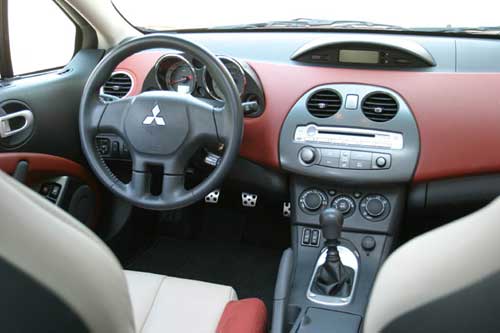
Navigating the 2006 Mitsubishi Eclipse’s interior for oft-used controls is mostly a positive experience, with a few exceptions. To the designers’ credit, stereo controls are limited to the basics – a power and volume knob, a tuning knob, clearly-labeled buttons for seek and scan – and the system features attractive blue backlighting. Praise also goes to the climate controls, consisting of intuitive dials for the temperature setting, fan speed, and air flow direction. Plus, the system heats and cools the interior quickly and effectively. Buttons for the power windows and door locks are logically placed on the door panels, while switches for the power mirrors and fog lights are on the left side of the dash.
Falling into the “needs some work” category is the radio display positioned atop the dash instead of with the head unit down in the instrument panel, and secondary audio controls positioned on the rear of the steering wheel without any markings or illumination.
Storage and Cargo
Storage and Cargo Key Points:
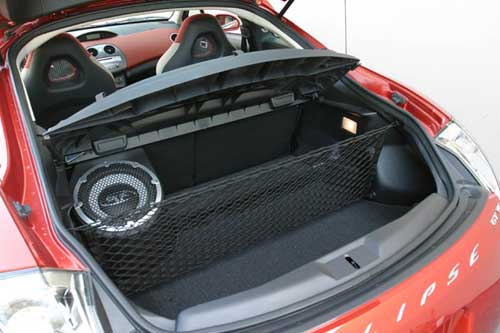
At least Mitsubishi can claim that its 2006 Eclipse coupe has more than twice the cargo capacity of a Nissan 350Z coupe. Of course, that competitor is a two-seater with a plastic-clad strut tower brace eating up half the trunk, but that’s beside the point.
For its part, the Eclipse’s rear fascia is tall and curvy and makes for a very high liftover height, so getting dirty while loading or unloading cargo is a definite possibility. Once that threshold has been crossed, the trunk can be extended by easily lowering the split rear seat, though the floor has a permanent hump in the middle over the suspension, the optional subwoofer eats up gobs of space on the left side, and the steeply slanted rear glass can crush items when the rear hatch is closed.
Elsewhere, interior storage is acceptable if not plentiful. The center armrest sits atop an ample storage slot with an integrated card clip, coinholder, and power outlet; small pockets on the doors are useful for sunglasses or a compact cell phone, though probably not both at the same time; the glovebox is spacious; and two non-adjustable cupholders take up residence in the center console. Rear passengers are left wanting, as there are no storage cubbies or cupholders behind the front buckets.
Exterior Design
Exterior Design Key Points:
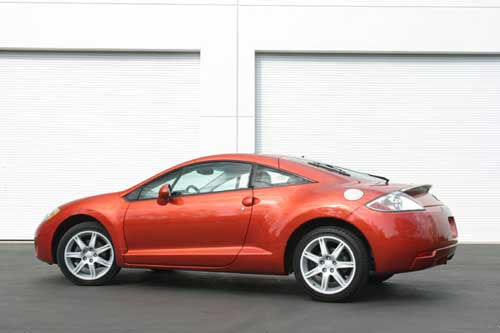
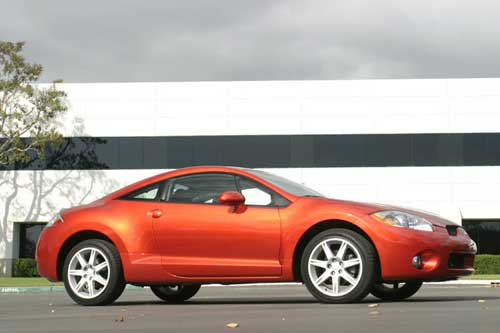
They say that beauty is in the eyes of the beholder. If the number of 2006 Mitsubishi Eclipses on the road is any indication, there are only a few beholders of this bloated coupe. And that’s with good reason.
The first-generation Eclipse featured all-wheel-drive and a turbocharged engine wrapped in a distinctive, compact package. That car was a capable pocket-rocket with a cult following. Subsequent models gradually lost the edge as the unique styling was nixed, the boosted four-banger was replaced by a tame V6, and the all-wheel-drive option disappeared. For 2006, those same key ingredients are again absent from the list of features, and the exterior design is a mish-mash of hits and misses.
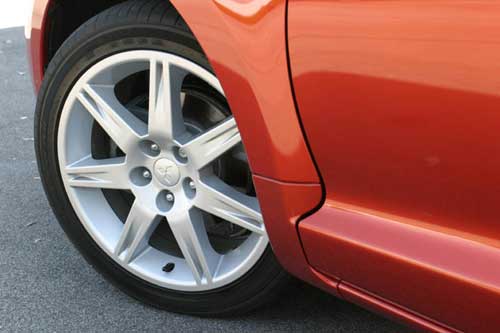
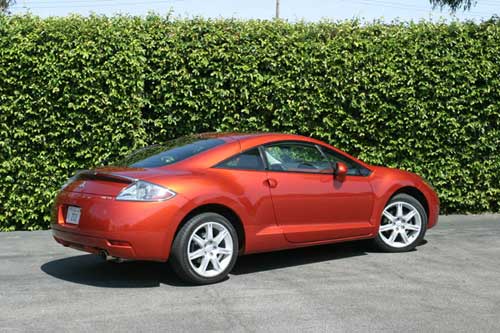
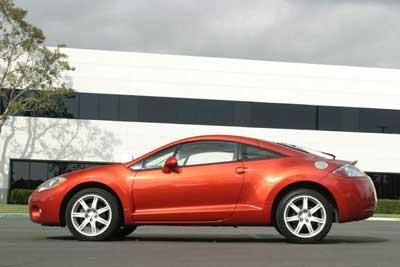
For one thing, the car is too big. Squeeze it into a parking spot at work, and you’ll instantly recognize that this is a wide ride. The curvaceous wheel flares, flattened at the edges, give an aura of power, but the 17-inch alloy wheels are dwarfed in the gaping wheel wells, and the short side windows are a visibility nightmare. And what’s up with the front quarter glass? Useless side windows went bye-bye with the demise of the Subaru SVX. Up front are expressionless headlights surrounding a simple grille and sitting in front of a flat hood. It’s almost as though the designers spent time on the flanks and then just threw the front end together. The rear offers a sporty look thanks to the high tail and low roof, with a subtle spoiler adding character. Even the clear taillights work, despite resembling a dated aftermarket product.
Build Quality
Build Quality Key Points:
Second only to the 2006 Mitsubishi Eclipse’s primary failing, interior design, is the car’s quality. The interior of our GT tester, a $27,964 premium model, was riddled with low-grade black plastics with differing grain patterns and varying degrees of shine, a fuzzy headliner, despicably cheap leather wrapping the rear split bench seat, and a sunroof shade that slid half way back when accelerating. A plastic cover on the vanity mirror was ready and willing to pop off, the center console shouted a disheartening echo when the lid was shut hard, noticeable casting flash was visible on the steering wheel spokes and back side of the center console, and the silver finish on the door handles and outboard vents didn’t match the alloy look given to the door inserts, shifter plate, and radio face. What’s more, the passenger door panel popped out of place, plastic seat frame covers came loose, the joint where the dash and A-pillar met was off, and the driver’s A-pillar was obviously warped. Again, Mitsubishi has the audacity to ask about $28,000 for this ride.
On the other hand, there were a few (very few) points chalked up in the pros column. The front seats were wrapped in soft suede and leather, material also used on the door inserts; a leather-wrapped steering wheel featured color-keyed stitching; and the exterior build quality was quite good, aside from a rear hatch that showcased minor gap inconsistencies.
Specifications
Specifications Key Competitors:
Test Vehicle: 2006 Mitsubishi Eclipse GT
Base Price: $27,964 (includes a $595 destination charge)
Engine Size and Type: 3.8-liter V6
Engine Horsepower: 263 at 5,750 rpm
Engine Torque: 260 at 4,500 rpm
Transmission: Six-speed manual
Curb Weight, lbs.: 3,472
EPA Fuel Economy (city/highway): 18/27 mpg
Observed Fuel economy: 22.9 mpg
Length: 179.7 inches
Width: 72.2 inches
Wheelbase: 101.4 inches
Height: 53.5 inches
Legroom (front/rear): 42.8/29.2 inches
Headroom (front/rear): 38.5/34.6 inches
Max. Seating Capacity: Four
Max. Cargo Volume: 15.7 cubic feet
Competitors: Acura RSX, Chevrolet Monte Carlo, Ford Mustang, Honda Accord Coupe, Mazda RX-8, Pontiac G6 Coupe, Toyota Camry Solara, Volkswagen GTI
FAQs
FAQs Key Points:
Is Mitsubishi still offering 100,000-mile powertrain coverage on its cars?
Yes. The 2006 Mitsubishi Eclipse is backed by a 10-year/100,000-mile powertrain warranty, a five-year/60,000-mile basic warranty, and seven years or 100,000 miles of corrosion protection.
What’s the worst aspect of the 2006 Mitsubishi Eclipse GT?
It’s gotta be that rear seat, or at least what Mitsu calls a seat. It’s painfully cramped and the black leather in our tester was pathetic, not to mention altogether different from the two-tone suede up front.
For buyers hell bent on buying an Eclipse, should they opt for the less expensive GS model?
Price and horsepower would be the major points to consider here. Though the GT offers an additional 101 horsepower and a slick six-speed manual transmission, it also carries a $4,000 premium. Otherwise, upgraded brakes and a few nonessential features are all that separate the two. The options list is longer for the GT, but they have the potential of adding thousands of dollars to the sticker price.
2nd Opinion - Chee
2nd Opinion - Chee Key Points:
Perhaps it is the Age Monster, that silent and creeping grouch who takes a man’s enthusiasm for new things and turns it into frustration and intolerance, the self-same monster that ruins the color of burnt orange to an eye and makes what might be a sexy car look only cartoonish. The monster doesn’t know sex from support hose, and thusly, can’t relate to the 2006 Mitsubishi Eclipse. Here is a car that should herald the emergence of Mitsubishi on the shores of North America, the Icon that will push this struggling car maker into respectability, much like the 350Z did for Nissan.
Um, no. Again, blame it on the monster, but there will likely be a strong disconnect with car buyers over 17, a terrible thing to say given the fact that an Eclipse GT, nicely loaded, runs almost $28,000 – a price well out of reach for most kids outside of the good ol’ 90210. Those liveried around Rodeo Drive wouldn’t buy this car anyway, because it simply tries too hard to be cool – like the kid who works all summer for a new wardrobe only to find that, come September, crème and orange jackets are no longer en vogue. Rich kids can shrug and go buy something else, but that poor kid in the corner, working hard to be something she’s not, will have to wear that sherbet coat until the next season.
Just like that hard-working kid, Mitsubishi needs the Eclipse to be en vogue. And perhaps there is a chance it will be, given a nice powertrain, great warranty and decent handling. With the exception of a little too much torque steer, submarine-like side visibility and an interior put together at the Supplier Discount Barn, the Eclipse is an interesting-looking, sporty car with loads of attitude and a healthy serving of fun. There’s that torque steer, though – a virtual inevitability when you stick a 3.8-liter V6 inside a front-wheel-drive platform. That’s a load of torque, bubba, 260 lb.-ft. at 4,500 rpm, to be exact, matching up well with a horsepower rating of 263 at 5,750 rpm. The rack-and-pinion steering setup provides some nice driver feedback, combined with its four-wheel independent suspension. One problem is that the Eclipse feels heavy, and you can feel it leaning and groaning a bit during hard corners. During aggressive city driving, the Eclipse felt unsure, though braking was quite capable and the mid-throw shifter was easy to use, along with a nice soft clutch. The six-speed manual is easy enough for anyone to use, and fun for all.
Just be sure to look twice when you change lanes.
And try to ignore the quality issues that plague the inside of the cabin, from the utter lack of anything spring-loaded to orange and white seats looking strangely out of place, as the rear seats share neither color theme or material. There’s a massive orange rubber mat pasted to the dashboard area that seems oddly out of place. There’s a bevy of flimsy-feeling plastics, including the parking brake, climate controls and center console. The seats, while comfortable, feel as though they will wear poorly, get grungy and wind up orange and grey within a year of ownership. So too will the crème headliner, especially given the low-slung roof.
Ugh. There’s that monster again. But then there’s a little bit of monster in everyone – and there’s a little bit of both kinds – from the happy powertrain to the grungy interior – in the 2006 Mitsubishi Eclipse.
– Brian Chee
2nd Opinion - Wardlaw
Key Points:
What is so difficult about putting a two-door, hatchback body on the Lancer/Evolution platform? Take a Ralliart sedan, stick a sexy wrapper on it, and make that the base Eclipse. Do the same thing with the Evolution. Then watch people line up around the block to buy it.
Instead, we get this porker, which probably drives rapper Sir-Mix-A-Lot insane with desire. Except this hottie ain’t little in the middle. It’s wide inside, with seats that don’t hold you still in turns and with nowhere to brace your legs when slamming down a canyon road. And for as big as it is, the Eclipse’s rear seat is about as useless as the one in a MINI Cooper S, which costs less but is a heckuva lot more fun to drive.
Dynamically, the Eclipse delivers given its outer dimensions. It is a much better car than, say, a Chevrolet Monte Carlo. And I’d even say it handles better than a Ford Mustang despite its front-wheel-drive and frustrating torque steer. Braking, steering response, suspension action, and tire grip provide an entertaining experience, and the Eclipse GT is even quick, with a solid-feeling shifter and a clutch that engages with authority. It even sounds good, despite having a V6 rather than V8 engine.
But the fact remains that this Project America car, built using a common platform shared with the Galant sedan and Endeavor SUV, is just too big. Though it drives decently, it never feels tossable, and it’s hard to park because the corners are difficult to place and it’s darn near impossible to see out the back. And, like its brethren, it’s got a lot of cheap plastic inside.
When the third-generation Eclipse debuted for 2000, with no turbocharged engine and no all-wheel-drive and much larger proportions, the car’s core loyalists cried foul long and loud. You’d think a company on the ropes, like Mitsubishi, might listen to the people who really want to buy its products. Nope, instead we get a Japanese version of what Dale Earnhardt Jr. might want to drive if he lived in Tokyo. Hey, at least it’s got a good warranty.
If you want performance, get an Evolution. If you want a poseur, the Eclipse is right up your alley.
– Christian Wardlaw
Photos by Ron Perry