Compact and inexpensive meets stylish and entertaining
By Thom Blackett
|
September 21, 2005
Introduction
If there’s one thing we Americans have plenty of, it’s choice. Take television programming, for example. Not too long ago there were only 13 standard channels, most of which went off the air during the wee hours of the night. Today, there are hundreds of channels churning out content 24/7. That’s a great setup for couch potatoes, but it creates a do-or-die scenario for TV producers looking to rise above thousands of other viewing opportunities. Many shows, some brilliantly written and directed, come and go amongst the cutthroat competition, never able to find an audience.Kia executives face a similar dilemma – as impressive as their current crop of cars may be, they aim to succeed in a market saturated with great cars at good prices and good cars at fire sale prices. Such an environment makes it that much harder for impressive vehicles, such as the totally redesigned 2006 Kia Rio and Rio5, to end up on shoppers’ lists. However, this Korean automaker is confident that once it gets people in the door and behind the wheel, the cars are capable of selling themselves.
After a 1,400-mile test drive along the Pacific coast and a week commuting around Orange County, Calif., in a 2006 Rio5 SX, we count ourselves among the first to be pleasantly surprised by what Kia has brought to the compact car segment. With an as-tested price of about $14,500, we’re obviously not talking about Lexus-like refinement, but with an abundance of airbags, attractive styling, and a comfortable interior, the Rio and Rio5 put some heavy muscle on the Chevy Aveo and Scion xA in vying for buyers’ attention.
Model Mix
Model Mix It’s the Kia Rio5 SX model that represents the most value, with extra cargo capacity and a sportier design added to the features of the LX sedan. But, if we were buying, we’d scrape together a few extra pennies each month and opt for the convenience of the $600 Power Package.
Shoppers looking at the 2006 Kia Rio sedan will be able to choose from base and LX trim levels, while buyers considering the five-door Rio5 are limited to the SX model. All Rios are equipped with a four-cylinder engine and a five-speed manual transmission. And, of course, every Kia buyer gets one of the best warranties in the business – basic coverage that spans five years or 60,000 miles, powertrain coverage that endures ten years or 100,000 miles of driving, and corrosion protection lasting five years or 100,000 miles. New for 2006 models is a one-year, 12,000-mile tire and road hazard warranty, something usually offered by tire manufacturers but not automakers.
The 2006 Kia Rio sedan starts at $11,110 (including a $540 destination charge) and includes variable intermittent windshield wipers, a rear window defroster, dual vanity mirrors, a trunk light, and an 8,000-rpm tachometer. Added touches include a delayed interior courtesy light and headlights that turn off automatically to preserve the battery. Front and rear floor mats are optional.
Impressive warranty aside, the Base model is short on amenities, so those wanting a few creature comforts will need to move up to the LX model. The $12,985 starting price brings with it a four-speaker sound system with a CD player, tilt steering, air conditioning, a 60/40 split folding rear seat, a cigarette lighter, a digital clock, and power steering. Options are also more plentiful and include a four-speed automatic transmission; a four-wheel antilock brake package that adds rear discs and electronic brake force distribution; a body-color decklid spoiler; and a Power Package that adds power windows, power door locks, keyless entry, power heated mirrors, and tweeters for the stereo.
At the top of the ladder is the 2006 Kia Rio5 SX, priced at $14,040. In return for the extra coin, buyers of the SX get a rear window washer and wiper, front fog lights, a body-color rear roof spoiler, leather on the steering wheel and shift knob, and alloy wheels. Like the LX sedan, the SX can be outfitted with the automatic transmission, antilock brake package, and Power Package.
While at the 2006 Kia Rio’s press launch in Seattle, we had a chance to drive an LX sedan and a five-door SX. However, since it was a Sunset Orange SX that carried us roughly 1,400 miles from northern Washington to southern California, this review will focus primarily on our Rio5 tester. Added to the $14,040 base price was $400 for the antilock brake package and $70 for floor mats, with the total tally reaching $14,510. It’s the SX model that represents the most value, with extra cargo capacity and a sportier design added to the features of the LX sedan. But, if we were buying, we’d scrape together a few extra pennies each month and opt for the convenience of the $600 Power Package, bringing the total to $15,110.
Nuts and Bolts
Nuts and Bolts Motivation for the 2006 Kia Rio and Rio5 comes from a 1.6-liter four-cylinder engine that puts out 110 horsepower and 107 lb.-ft. of torque.
Power for the 2006 Kia Rio and Rio5 comes from a 1.6-liter, 16-valve four-cylinder engine with dual overhead cams and Continuously Variable Valve Timing (CVVT). This little powerplant, consisting of a cast iron block and alloy heads, produces 110 horsepower at 6,100 rpm and 107 lb.-ft. of torque at 4,500 rpm. Standard fare includes a five-speed manual transmission driving the front wheels, with a four-speed automatic optional on LX and SX models. With the five-speed, the EPA estimates the Rio and Rio5 will achieve 32 mpg in the city and 35 mpg on the highway, whereas those with the automatic transmission are expected to get 29 mpg and 38 mpg, respectively.
Stopping power is courtesy of 256-mm vented disc brakes up front and drums in the rear. The antilock brake package, optional on the Rio LX and Rio5 SX, adds 262-mm solid rear discs and electronic brake force distribution. The front suspension system includes MacPherson struts, coil springs, and a stabilizer bar, while the rear features a torsion beam and coil springs. Serving to keep everything on the straight and narrow is a rack-and-pinion steering setup, with engine speed sensing power assist reserved for the Rio LX and Rio5 SX. Base models, available only with manual steering, should be good for toning those forearms. Connecting the base Rio to the pavement are P175/70R14 tires and steel wheels, with the LX model moving up a bit to P185/65R14 tires. The 2006 Kia Rio5 SX gets P195/55R15 Hankook Optima tires that surround five-spoke alloy wheels.
Road Test
Road Test After a few miles behind the wheel, the 2006 Kia Rio5 SX feels adequately powered. No, it won’t win many races, but it’ll hit 90-100 mph, even on an incline, provided you’ve got enough time and pavement.
After a day of driving the 2006 Rio and Rio5, a Kia representative asked, “How’d you enjoy the driving experience?”
“Honestly? It could use more power,” I said.
With a look that said “You’re not too bright are ya, son?” he replied, “It’s a $10,000 car.”
Well, no, actually it goes for $11-15,000, but the point is clear – the Rio is a compact economy car, and holy-moly horsepower ain’t at the top of the priority list. Besides, the Rio actually has more ponies on tap than key competitors such as the Chevrolet Aveo and Scion xA, and it’s only five horsepower shy of an entry-level Mini Cooper.
Truth be told, after a few miles behind the wheel, the 2006 Kia Rio5 SX feels adequately powered. No, it won’t win many races, but it’ll hit 90-100 mph, even on an incline, provided you’ve got enough time and pavement, and you don’t mind watching the tachometer hover around 4,500 rpm. Thankfully, triple-sealed door frames and added sound insulation limit the intrusion of thrashy engine and road noise. While most Rio owners will never drive under these conditions, they should be pleased to know that the Kia feels just as secure at triple-digit speeds as it does at a safe 65 mph, and thanks to large mirrors and a generous greenhouse, they’ll always know where they sit amongst traffic. Passing power is a bit lacking, and drivers with a manual transmission will want to drop a gear or two before planting the throttle. If you opt for a Rio with the automatic transmission, you’ll want to be especially cautious when passing vehicles.
Though it steals some of the engine’s pep, that optional four-speed tranny offers smooth shifts and feels quite refined for such an inexpensive car. However, those who enjoy driving will want the five-speed manual that features a light-effort clutch pedal and slick shifting – it feels a lot like the manual in the 2005 Ford Focus, a unit that has drawn its own share of praise.
Whether your row your own gears or let the transmission do it for you, all of that built-up speed eventually needs to be hit with some capable brakes. The standard setup on all 2006 Rios is vented discs up front and drums out back. It’s effective, but a better alternative comes with the optional antilock brake package, which adds not only ABS but also rear discs and electronic brake force distribution.
Upon braking, the 2006 Kia Rio’s front end had a strong tendency to dive, equaled only by the amount of rear-end squat exhibited under hard acceleration. That suggests a soft suspension, so it’s not a shocker when a good dose of body roll shows up in turns. Of course, the benefit is a comfortable ride and an ability to quell road irregularities, and Kia engineers are quick to point out that the 2006 Rio’s body structure is 44 percent stiffer than the 2005 model. The steering system remains largely unaffected, continuously offering decent feedback with no significant dead spots.
Comfort
Comfort After two days and 1,400 miles with our butts planted in the seat of a 2006 Kia Rio5, it is clear that comfort is one of this car’s many strengths.
Most people are under the impression that compact economy cars are all about sacrifice, believing that such vehicles lack power, features, style, and possibly most important, comfort. However, after two days and 1,400 miles with our butts planted in the seat of a 2006 Kia Rio5, it is clear that comfort is one of this car’s many strengths.
Up front are bucket seats that, at first, seem a bit soft, which made us wonder how supportive they’d be after hours on the road. That concern disappeared after a few hundred miles, when it became obvious that Kia engineers had supplied Rio drivers with comfortable, supportive chairs that come standard with height adjustment, a fold-down padded armrest, and perfectly shaped and placed headrests. Rounding out the thumbs-up driving position is the tilt steering wheel, well-placed door armrest, and generous leg, foot, and shoulder room.
Rear passengers are afforded decent accommodations, though there are enough deficiencies to warrant feelings of jealousy pointed at front seat riders. There’s no center armrest to be had, the seatback is reclined too much, the door armrests are small, the headrests feel like fabric-covered construction paper, and minimal legroom means you’ll be rubbing your knees against the thinly-veiled cardboard on the front seatbacks. On a positive note, there is sufficient headroom and footroom, and the seat cushions are supportive and comfortable.
Convenience
Convenience Cargo capacity measures 11.9 cubic feet for the Kia Rio sedan and 15.8 cubic feet for the Kia Rio5, with the SX maxing out at 49.6 cubic feet with the rear seats folded.
Proving that small cars can be big on utility, the 2006 Kia Rio and Rio5 come with a variety of nooks and crannies, as well as a number of subtle features that are likely to make the ownership experience even more pleasant.
Cargo capacity measures 11.9 cubic feet for the Rio and 15.8 cubic feet for the Rio5, with the SX maxing out at 49.6 cubic feet with the rear seats folded – that’s more than five extra cubic feet of space compared to the Rio5’s predecessor, the 2005 Rio Cinco, and as many as 17 cubic feet more than its main competitors. That rear storage area features fabric on the seatbacks; a lined cargo floor, under which resides a temporary spare; a cargo light; small enclosed cubby holes; and four cargo tie-down hooks. The trunk lid has a grab handle, and rises high enough to so that individuals of average height won’t bump their heads when loading the car. Rio5 SX models add a standard cargo cover that, if necessary, easily pops out of place after releasing two straps. Thanks to a low liftover height, placing items in the cargo area is a cinch, and a black bumper cover prevents paint scratches. Simple buttons located next to the headrests allow the rear seat sections to be folded (LX and SX only), but don’t expect a flat load floor – even after the bottom cushions are folded up and forward, the collapsed rear seat sits a few inches higher than the standard trunk floor.
Move forward into the Rio5’s 108 cubic foot passenger cabin (104.1 cubic feet for the Rio sedan), which is significantly larger than most competitors’, and you’ll notice the large glovebox, storage pockets on each door, a rubber lined cubby in the center console, a fold-down storage slot on the lower dash, and pockets on the back of each front seat. There are also three cupholders, two between the seats that are standard size but a little too shallow, and a third that’s large and rubber-lined located at the rear of the center console.
Finally, Kia engineers pointed out a few extra touches they hope drivers will appreciate – a small slot below the radio for parking cards and a hook on the rear of the front passenger seat, designed to hold a purse or small bag. They work as designed, but thankfully for Kia’s sake, there are plenty of more compelling reasons to consider purchasing a Rio.
Design
Design For 2006, side body panels have been enhanced by exaggerated wheel flares stamped into the sheet metal, adding just enough testosterone to move the 2006 Kia Rio from feminine to unisex.
When designing or redesigning a vehicle, it seems that manufacturers go one of three routes – conservative, risky, or somewhere in between. With their generic shapes and expressionless front ends, the previous Rio models were as tight-cheeked as cars get. However, Kia designers apparently dipped into some soju when sketching the new Rio, with the result being a compact car that offers an edgier look, serving to add a bit of flair to this segment.
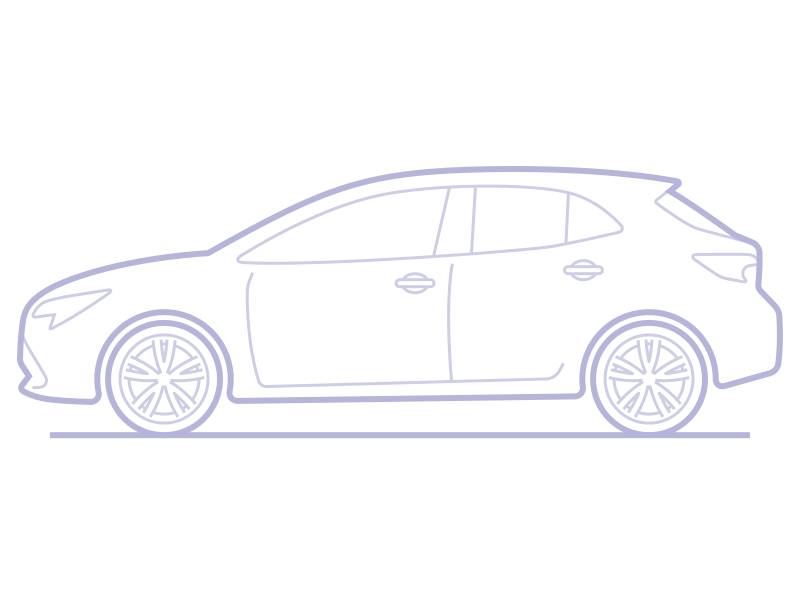
For 2006, side body panels have been enhanced by exaggerated wheel flares stamped into the sheet metal, adding just enough testosterone to move the Rio from feminine to unisex. This can also be seen in the new black mesh grille, lower air dam inserts, and more pronounced hood lines. But, the most significant changes are seen when comparing the 2005 Rio Cinco and the 2006 Rio5. Whereas the Cinco was a compact wagon, the Rio5 SX is a true five-door hatchback, with a short rear overhang that lends a much sportier appearance. The SX’s look is further accented with integrated front fog lights, five-spoke alloy wheels, and a body-color rear spoiler. Evidenced here, again, are the cracks in what was once a conservative design dictum.
That same mentality has been carried over to the Rio’s interior, which offers a fresh, more contemporary appearance. Last year’s shapeless dash has been swapped out for a two-tone contoured design, and cupholders that have been repositioned rear of the shift knob. Optional power controls are logically placed on the driver’s door panel, and the climate controls, consisting of three simple yet effective rotary dials, are placed in the center of the dash. Just above is the radio (if equipped), which has been thoughtfully angled toward the driver and, like the climate control system, features clearly marked knobs and buttons for volume, tuning, mode, and station presets. Rio5 SX models add silver accents to the pedals, radio surround, and steering wheel inserts, while leather is stitched onto the steering wheel and shift knob.
Those patches of leather have a quality feel, surprising for a car in this price range. The remaining interior materials are also better than you’d expect from one of America’s least expensive vehicles, among them mostly hard but sturdy plastics with a matte finish. Overall build quality was impressive, with only a few misaligned interior and exterior panels, exposed screws holding the visors in place, and some visible plastic casting around the steering column.
Safety
Safety Inside each 2006 Kia Rio are two front airbags, two front side airbags, and two side curtain airbags that cover the front and second rows, making the Rio one of the least expensive cars to offer this level of safety.
Safety doesn’t necessarily have to be expensive, as evidenced by the 2006 Kia Rio and Rio5’s impressive list of standard features designed to protect you and your passengers.
Inside each 2006 Kia Rio are two front airbags, two front side airbags, and two side curtain airbags that cover the front and second rows, making the Rio one of the least expensive cars to offer this level of safety. Though not yet crash tested, front and rear crumple zones have been engineered to dissipate crash energy, and a rear three-point center seatbelt ensures that all passengers are kept tight and secure. Antilock brakes are optional on Rio LX and Rio5 SX models. Keep in mind, however, that despite its focus on safety, the Rio and Rio5 are relatively lightweight vehicles and won’t likely fare well against large SUVs weighing twice as much.
Specifications
Specifications The 2006 Kia Rio’s primary competitors include the Chevrolet Aveo, Hyundai Accent, Scion xA, Scion xB, and Suzuki Reno.
Test Vehicle: 2006 Kia Rio5
Price as Tested: $14,510 (including a $540 destination charge)
Engine Size and Type: 1.6-liter four-cylinder with Continuously Variable Valve Timing (CVVT)
Horsepower: 110 at 6,000 rpm
Torque: 107 lb.-ft. at 4,500 rpm
Transmission: Five-speed manual
Curb Weight: 2,438 lbs.
EPA Fuel Economy (city/highway): 32/35 mpg
Observed Fuel Economy: 31.7 mpg
Length: 158.1 inches
Width: 66.7 inches
Wheelbase: 98.4 inches
Height: 57.9 inches
Legroom (front/rear): 42.8/34.3 inches
Headroom (front/rear): 39.6/38.8 inches
Max. Seating Capacity: 5
Max. Cargo Volume: 49.6 cubic feet
Competitors: Chevrolet Aveo, Hyundai Accent, Scion xA, Scion xB, Suzuki Reno
FAQs
FAQs The 2006 Kia Rio/Rio5 meets or beats the competition in regards to horsepower and interior room while offering comparable fuel efficiency.
How does the power for the 2006 Kia Rio and Rio5 compare with competitors like the Chevrolet Aveo and Scion xA? All 2006 Kia Rio and Rio5 models offer seven more horsepower than the Aveo, with equal torque ratings. Scions are also outmatched to the tune of seven horsepower, while the Kia also comes in with an additional six lb.-ft. of torque.
How does fuel mileage compare for these same vehicles? The 2006 Kia Rio and Rio5, rated at 32/35 mpg, offers slightly better fuel economy than the Chevrolet Aveo, while the Scion xA proves to be a bit more efficient than the Rio/Rio5.
And, finally, how do the Rio/Rio5, Chevrolet Aveo, and Scion xA compare in terms of passenger and maximum cargo volume? Compared to the Chevrolet Aveo, the 2006 Kia Rio and Rio5 provide 13 to 17 additional cubic feet of passenger room. The Rio5’s passenger volume beats the Scion xA by 22 cubic feet. For maximum cargo volume, the Rio5 beats the Chevy Aveo by 7.6 cubic feet and the Scion xA by 16.8 cubic feet.
2nd Opinion – Chee
2nd Opinion – Chee The seats are firm, the steering wheel nice to the touch, controls are simple to use and – get this – there’s actually an armrest on the driver’s right side.
So this is what 14 grand buys nowadays: A Kia with five doors and a very spot-on interior, a nice style but, sadly, a creeping sense that all the good stuff may not last. But perhaps that’s a bit too caustic. After all, a day spent commuting with the 2006 Kia Rio5 didn’t end on the side of the road, head in hands and cursing lips against cell phone. In fact, it was quite a pleasant ride, almost spirited – that little 110-horsepower engine churning to the beat and getting down the road, over hill, dale and back again.
But there were some trouble spots. Especially if you want to break in this car and expect it to operate the way it does during those first few thousand honeymoon miles. As a brand new baby, there’s already a vibration that comes up the shifter, and the lever isn’t very precise – especially with the soft-riding clutch. Under mid-to-hard driving situations, there’s what sounds like the beginning of a really irritating rattle around the exhaust – maybe a bracket working itself loose. If that’s all the bad stuff, well sure, that’s pretty darn good – right now. But at 10, maybe 20, definitely 30 thousand miles, noises and rattles will likely become louder, more tiresome and not at all what you want to hear on a long commute home. In some cars, you can just turn up the radio. But the trouble is, you really can’t do that in a Rio5, as the stock audio box is a nasty little piece that gets terrible reception.
But that’s okay. You can still luxuriate inside the 2006 Kia Rio5, with its interior so well done that it could pass for one that might cost 20 grand. The seats are firm, the steering wheel nice to the touch, controls are simple to use and – get this – there’s actually an armrest on the driver’s right side. All that, yes, and more for an entry-level car, and side curtain airbags as well. Put it together and your 14 grand goes a long way, though buyer beware: what looks pretty and poised today may age into a haggard old witch, once subjected to enough time on the mean streets of traffic jams and stop-and-go traffic.
2nd Opinion - Wardlaw
2nd Opinion - Wardlaw This is a great little car for the money. Don’t expect quick acceleration, entertaining handling, or lots of creature comforts when you get into one. But as an argument for competent, comfortable, cheap transportation, it might not get much better than the 2006 Kia Rio/Rio5.
After my first test drive of a Kia Rio in 2001, this is what I said about it: “It is, without question, the most horrible new car I've ever driven in my life.” Now, after my first sampling of the redesigned 2006 Kia Rio, such thoughts are the furthest thing from my mind.
This is a great little car for the money. Don’t expect quick acceleration, entertaining handling, or lots of creature comforts when you get into one. But as an argument for competent, comfortable, cheap transportation, it might not get much better than this. And with standard side-impact and side curtain airbags, a ten-year/100,000-mile warranty, and average fuel economy over the 30-mpg mark, the 2006 Kia Rio might just redefine “bang-for-the-buck.”
As far as the driving goes, our cute little Rio5 sampler was quick enough off the line, with a light clutch and a rubbery shifter not nearly as floppy as the one in the old Rio. Four-wheel-disc brakes produced smooth, short stops and good pedal feel, and though the steering communicates like it’s talking with its mouth full, it responds quickly enough and the Rio5 corners with a reasonably flat attitude if speeds are held in check. The ride quality is soft and absorbent without being wallowy, and the Rio5 is a breeze to park in the tight confines of metro L.A. The tires are quiet, but have a tendency to hunt on SoCal’s grooved freeways, and they lose grip early if you try to push the car too hard.
Interior comfort is decent, with a standard driver’s seat cushion height and tilt adjustment and an inboard-mounted armrest. The steering wheel rim is thick and pleasurable to hold, and there’s good leg space up front. Rear passengers will be cramped a bit if tall folks are sitting in front, but otherwise the seat cushion is tall and supportive, just like up front. The fabric even feels durable. And I like the utility of the Kia Rio5’s hatchback, though with the rear seatbacks folded the cargo floor isn’t flat.
Our test car had manual locks, manual windows, and manual mirrors – I didn’t know they even built ‘em like that anymore. But outside, the Rio5’s fog lights, alloy wheels, and jaunty good looks make it look a little more expensive than you might guess. The dashboard is laid out well, and there’s plenty of storage space for a car this size.
Kia did a terrific job with the Rio’s redesign. And with gas prices climbing a dime a day as I write this – just after Hurricane Katrina – Kia’s timing couldn’t be better.
Model Mix It’s the Kia Rio5 SX model that represents the most value, with extra cargo capacity and a sportier design added to the features of the LX sedan. But, if we were buying, we’d scrape together a few extra pennies each month and opt for the convenience of the $600 Power Package.
Shoppers looking at the 2006 Kia Rio sedan will be able to choose from base and LX trim levels, while buyers considering the five-door Rio5 are limited to the SX model. All Rios are equipped with a four-cylinder engine and a five-speed manual transmission. And, of course, every Kia buyer gets one of the best warranties in the business – basic coverage that spans five years or 60,000 miles, powertrain coverage that endures ten years or 100,000 miles of driving, and corrosion protection lasting five years or 100,000 miles. New for 2006 models is a one-year, 12,000-mile tire and road hazard warranty, something usually offered by tire manufacturers but not automakers.
The 2006 Kia Rio sedan starts at $11,110 (including a $540 destination charge) and includes variable intermittent windshield wipers, a rear window defroster, dual vanity mirrors, a trunk light, and an 8,000-rpm tachometer. Added touches include a delayed interior courtesy light and headlights that turn off automatically to preserve the battery. Front and rear floor mats are optional.
Impressive warranty aside, the Base model is short on amenities, so those wanting a few creature comforts will need to move up to the LX model. The $12,985 starting price brings with it a four-speaker sound system with a CD player, tilt steering, air conditioning, a 60/40 split folding rear seat, a cigarette lighter, a digital clock, and power steering. Options are also more plentiful and include a four-speed automatic transmission; a four-wheel antilock brake package that adds rear discs and electronic brake force distribution; a body-color decklid spoiler; and a Power Package that adds power windows, power door locks, keyless entry, power heated mirrors, and tweeters for the stereo.
At the top of the ladder is the 2006 Kia Rio5 SX, priced at $14,040. In return for the extra coin, buyers of the SX get a rear window washer and wiper, front fog lights, a body-color rear roof spoiler, leather on the steering wheel and shift knob, and alloy wheels. Like the LX sedan, the SX can be outfitted with the automatic transmission, antilock brake package, and Power Package.
While at the 2006 Kia Rio’s press launch in Seattle, we had a chance to drive an LX sedan and a five-door SX. However, since it was a Sunset Orange SX that carried us roughly 1,400 miles from northern Washington to southern California, this review will focus primarily on our Rio5 tester. Added to the $14,040 base price was $400 for the antilock brake package and $70 for floor mats, with the total tally reaching $14,510. It’s the SX model that represents the most value, with extra cargo capacity and a sportier design added to the features of the LX sedan. But, if we were buying, we’d scrape together a few extra pennies each month and opt for the convenience of the $600 Power Package, bringing the total to $15,110.
Nuts and Bolts
Nuts and Bolts Motivation for the 2006 Kia Rio and Rio5 comes from a 1.6-liter four-cylinder engine that puts out 110 horsepower and 107 lb.-ft. of torque.
Power for the 2006 Kia Rio and Rio5 comes from a 1.6-liter, 16-valve four-cylinder engine with dual overhead cams and Continuously Variable Valve Timing (CVVT). This little powerplant, consisting of a cast iron block and alloy heads, produces 110 horsepower at 6,100 rpm and 107 lb.-ft. of torque at 4,500 rpm. Standard fare includes a five-speed manual transmission driving the front wheels, with a four-speed automatic optional on LX and SX models. With the five-speed, the EPA estimates the Rio and Rio5 will achieve 32 mpg in the city and 35 mpg on the highway, whereas those with the automatic transmission are expected to get 29 mpg and 38 mpg, respectively.
Stopping power is courtesy of 256-mm vented disc brakes up front and drums in the rear. The antilock brake package, optional on the Rio LX and Rio5 SX, adds 262-mm solid rear discs and electronic brake force distribution. The front suspension system includes MacPherson struts, coil springs, and a stabilizer bar, while the rear features a torsion beam and coil springs. Serving to keep everything on the straight and narrow is a rack-and-pinion steering setup, with engine speed sensing power assist reserved for the Rio LX and Rio5 SX. Base models, available only with manual steering, should be good for toning those forearms. Connecting the base Rio to the pavement are P175/70R14 tires and steel wheels, with the LX model moving up a bit to P185/65R14 tires. The 2006 Kia Rio5 SX gets P195/55R15 Hankook Optima tires that surround five-spoke alloy wheels.
Road Test
Road Test After a few miles behind the wheel, the 2006 Kia Rio5 SX feels adequately powered. No, it won’t win many races, but it’ll hit 90-100 mph, even on an incline, provided you’ve got enough time and pavement.
After a day of driving the 2006 Rio and Rio5, a Kia representative asked, “How’d you enjoy the driving experience?”
“Honestly? It could use more power,” I said.
With a look that said “You’re not too bright are ya, son?” he replied, “It’s a $10,000 car.”
Well, no, actually it goes for $11-15,000, but the point is clear – the Rio is a compact economy car, and holy-moly horsepower ain’t at the top of the priority list. Besides, the Rio actually has more ponies on tap than key competitors such as the Chevrolet Aveo and Scion xA, and it’s only five horsepower shy of an entry-level Mini Cooper.
Truth be told, after a few miles behind the wheel, the 2006 Kia Rio5 SX feels adequately powered. No, it won’t win many races, but it’ll hit 90-100 mph, even on an incline, provided you’ve got enough time and pavement, and you don’t mind watching the tachometer hover around 4,500 rpm. Thankfully, triple-sealed door frames and added sound insulation limit the intrusion of thrashy engine and road noise. While most Rio owners will never drive under these conditions, they should be pleased to know that the Kia feels just as secure at triple-digit speeds as it does at a safe 65 mph, and thanks to large mirrors and a generous greenhouse, they’ll always know where they sit amongst traffic. Passing power is a bit lacking, and drivers with a manual transmission will want to drop a gear or two before planting the throttle. If you opt for a Rio with the automatic transmission, you’ll want to be especially cautious when passing vehicles.
Though it steals some of the engine’s pep, that optional four-speed tranny offers smooth shifts and feels quite refined for such an inexpensive car. However, those who enjoy driving will want the five-speed manual that features a light-effort clutch pedal and slick shifting – it feels a lot like the manual in the 2005 Ford Focus, a unit that has drawn its own share of praise.
Whether your row your own gears or let the transmission do it for you, all of that built-up speed eventually needs to be hit with some capable brakes. The standard setup on all 2006 Rios is vented discs up front and drums out back. It’s effective, but a better alternative comes with the optional antilock brake package, which adds not only ABS but also rear discs and electronic brake force distribution.
Upon braking, the 2006 Kia Rio’s front end had a strong tendency to dive, equaled only by the amount of rear-end squat exhibited under hard acceleration. That suggests a soft suspension, so it’s not a shocker when a good dose of body roll shows up in turns. Of course, the benefit is a comfortable ride and an ability to quell road irregularities, and Kia engineers are quick to point out that the 2006 Rio’s body structure is 44 percent stiffer than the 2005 model. The steering system remains largely unaffected, continuously offering decent feedback with no significant dead spots.
Comfort
Comfort After two days and 1,400 miles with our butts planted in the seat of a 2006 Kia Rio5, it is clear that comfort is one of this car’s many strengths.
Most people are under the impression that compact economy cars are all about sacrifice, believing that such vehicles lack power, features, style, and possibly most important, comfort. However, after two days and 1,400 miles with our butts planted in the seat of a 2006 Kia Rio5, it is clear that comfort is one of this car’s many strengths.
Up front are bucket seats that, at first, seem a bit soft, which made us wonder how supportive they’d be after hours on the road. That concern disappeared after a few hundred miles, when it became obvious that Kia engineers had supplied Rio drivers with comfortable, supportive chairs that come standard with height adjustment, a fold-down padded armrest, and perfectly shaped and placed headrests. Rounding out the thumbs-up driving position is the tilt steering wheel, well-placed door armrest, and generous leg, foot, and shoulder room.
Rear passengers are afforded decent accommodations, though there are enough deficiencies to warrant feelings of jealousy pointed at front seat riders. There’s no center armrest to be had, the seatback is reclined too much, the door armrests are small, the headrests feel like fabric-covered construction paper, and minimal legroom means you’ll be rubbing your knees against the thinly-veiled cardboard on the front seatbacks. On a positive note, there is sufficient headroom and footroom, and the seat cushions are supportive and comfortable.
Convenience
Convenience Cargo capacity measures 11.9 cubic feet for the Kia Rio sedan and 15.8 cubic feet for the Kia Rio5, with the SX maxing out at 49.6 cubic feet with the rear seats folded.
Proving that small cars can be big on utility, the 2006 Kia Rio and Rio5 come with a variety of nooks and crannies, as well as a number of subtle features that are likely to make the ownership experience even more pleasant.
Cargo capacity measures 11.9 cubic feet for the Rio and 15.8 cubic feet for the Rio5, with the SX maxing out at 49.6 cubic feet with the rear seats folded – that’s more than five extra cubic feet of space compared to the Rio5’s predecessor, the 2005 Rio Cinco, and as many as 17 cubic feet more than its main competitors. That rear storage area features fabric on the seatbacks; a lined cargo floor, under which resides a temporary spare; a cargo light; small enclosed cubby holes; and four cargo tie-down hooks. The trunk lid has a grab handle, and rises high enough to so that individuals of average height won’t bump their heads when loading the car. Rio5 SX models add a standard cargo cover that, if necessary, easily pops out of place after releasing two straps. Thanks to a low liftover height, placing items in the cargo area is a cinch, and a black bumper cover prevents paint scratches. Simple buttons located next to the headrests allow the rear seat sections to be folded (LX and SX only), but don’t expect a flat load floor – even after the bottom cushions are folded up and forward, the collapsed rear seat sits a few inches higher than the standard trunk floor.
Move forward into the Rio5’s 108 cubic foot passenger cabin (104.1 cubic feet for the Rio sedan), which is significantly larger than most competitors’, and you’ll notice the large glovebox, storage pockets on each door, a rubber lined cubby in the center console, a fold-down storage slot on the lower dash, and pockets on the back of each front seat. There are also three cupholders, two between the seats that are standard size but a little too shallow, and a third that’s large and rubber-lined located at the rear of the center console.
Finally, Kia engineers pointed out a few extra touches they hope drivers will appreciate – a small slot below the radio for parking cards and a hook on the rear of the front passenger seat, designed to hold a purse or small bag. They work as designed, but thankfully for Kia’s sake, there are plenty of more compelling reasons to consider purchasing a Rio.
Design
Design For 2006, side body panels have been enhanced by exaggerated wheel flares stamped into the sheet metal, adding just enough testosterone to move the 2006 Kia Rio from feminine to unisex.
When designing or redesigning a vehicle, it seems that manufacturers go one of three routes – conservative, risky, or somewhere in between. With their generic shapes and expressionless front ends, the previous Rio models were as tight-cheeked as cars get. However, Kia designers apparently dipped into some soju when sketching the new Rio, with the result being a compact car that offers an edgier look, serving to add a bit of flair to this segment.
For 2006, side body panels have been enhanced by exaggerated wheel flares stamped into the sheet metal, adding just enough testosterone to move the Rio from feminine to unisex. This can also be seen in the new black mesh grille, lower air dam inserts, and more pronounced hood lines. But, the most significant changes are seen when comparing the 2005 Rio Cinco and the 2006 Rio5. Whereas the Cinco was a compact wagon, the Rio5 SX is a true five-door hatchback, with a short rear overhang that lends a much sportier appearance. The SX’s look is further accented with integrated front fog lights, five-spoke alloy wheels, and a body-color rear spoiler. Evidenced here, again, are the cracks in what was once a conservative design dictum.
That same mentality has been carried over to the Rio’s interior, which offers a fresh, more contemporary appearance. Last year’s shapeless dash has been swapped out for a two-tone contoured design, and cupholders that have been repositioned rear of the shift knob. Optional power controls are logically placed on the driver’s door panel, and the climate controls, consisting of three simple yet effective rotary dials, are placed in the center of the dash. Just above is the radio (if equipped), which has been thoughtfully angled toward the driver and, like the climate control system, features clearly marked knobs and buttons for volume, tuning, mode, and station presets. Rio5 SX models add silver accents to the pedals, radio surround, and steering wheel inserts, while leather is stitched onto the steering wheel and shift knob.
Those patches of leather have a quality feel, surprising for a car in this price range. The remaining interior materials are also better than you’d expect from one of America’s least expensive vehicles, among them mostly hard but sturdy plastics with a matte finish. Overall build quality was impressive, with only a few misaligned interior and exterior panels, exposed screws holding the visors in place, and some visible plastic casting around the steering column.
Safety
Safety Inside each 2006 Kia Rio are two front airbags, two front side airbags, and two side curtain airbags that cover the front and second rows, making the Rio one of the least expensive cars to offer this level of safety.
Safety doesn’t necessarily have to be expensive, as evidenced by the 2006 Kia Rio and Rio5’s impressive list of standard features designed to protect you and your passengers.
Inside each 2006 Kia Rio are two front airbags, two front side airbags, and two side curtain airbags that cover the front and second rows, making the Rio one of the least expensive cars to offer this level of safety. Though not yet crash tested, front and rear crumple zones have been engineered to dissipate crash energy, and a rear three-point center seatbelt ensures that all passengers are kept tight and secure. Antilock brakes are optional on Rio LX and Rio5 SX models. Keep in mind, however, that despite its focus on safety, the Rio and Rio5 are relatively lightweight vehicles and won’t likely fare well against large SUVs weighing twice as much.
Specifications
Specifications The 2006 Kia Rio’s primary competitors include the Chevrolet Aveo, Hyundai Accent, Scion xA, Scion xB, and Suzuki Reno.
Test Vehicle: 2006 Kia Rio5
Price as Tested: $14,510 (including a $540 destination charge)
Engine Size and Type: 1.6-liter four-cylinder with Continuously Variable Valve Timing (CVVT)
Horsepower: 110 at 6,000 rpm
Torque: 107 lb.-ft. at 4,500 rpm
Transmission: Five-speed manual
Curb Weight: 2,438 lbs.
EPA Fuel Economy (city/highway): 32/35 mpg
Observed Fuel Economy: 31.7 mpg
Length: 158.1 inches
Width: 66.7 inches
Wheelbase: 98.4 inches
Height: 57.9 inches
Legroom (front/rear): 42.8/34.3 inches
Headroom (front/rear): 39.6/38.8 inches
Max. Seating Capacity: 5
Max. Cargo Volume: 49.6 cubic feet
Competitors: Chevrolet Aveo, Hyundai Accent, Scion xA, Scion xB, Suzuki Reno
FAQs
FAQs The 2006 Kia Rio/Rio5 meets or beats the competition in regards to horsepower and interior room while offering comparable fuel efficiency.
How does the power for the 2006 Kia Rio and Rio5 compare with competitors like the Chevrolet Aveo and Scion xA? All 2006 Kia Rio and Rio5 models offer seven more horsepower than the Aveo, with equal torque ratings. Scions are also outmatched to the tune of seven horsepower, while the Kia also comes in with an additional six lb.-ft. of torque.
How does fuel mileage compare for these same vehicles? The 2006 Kia Rio and Rio5, rated at 32/35 mpg, offers slightly better fuel economy than the Chevrolet Aveo, while the Scion xA proves to be a bit more efficient than the Rio/Rio5.
And, finally, how do the Rio/Rio5, Chevrolet Aveo, and Scion xA compare in terms of passenger and maximum cargo volume? Compared to the Chevrolet Aveo, the 2006 Kia Rio and Rio5 provide 13 to 17 additional cubic feet of passenger room. The Rio5’s passenger volume beats the Scion xA by 22 cubic feet. For maximum cargo volume, the Rio5 beats the Chevy Aveo by 7.6 cubic feet and the Scion xA by 16.8 cubic feet.
2nd Opinion – Chee
2nd Opinion – Chee The seats are firm, the steering wheel nice to the touch, controls are simple to use and – get this – there’s actually an armrest on the driver’s right side.
So this is what 14 grand buys nowadays: A Kia with five doors and a very spot-on interior, a nice style but, sadly, a creeping sense that all the good stuff may not last. But perhaps that’s a bit too caustic. After all, a day spent commuting with the 2006 Kia Rio5 didn’t end on the side of the road, head in hands and cursing lips against cell phone. In fact, it was quite a pleasant ride, almost spirited – that little 110-horsepower engine churning to the beat and getting down the road, over hill, dale and back again.
But there were some trouble spots. Especially if you want to break in this car and expect it to operate the way it does during those first few thousand honeymoon miles. As a brand new baby, there’s already a vibration that comes up the shifter, and the lever isn’t very precise – especially with the soft-riding clutch. Under mid-to-hard driving situations, there’s what sounds like the beginning of a really irritating rattle around the exhaust – maybe a bracket working itself loose. If that’s all the bad stuff, well sure, that’s pretty darn good – right now. But at 10, maybe 20, definitely 30 thousand miles, noises and rattles will likely become louder, more tiresome and not at all what you want to hear on a long commute home. In some cars, you can just turn up the radio. But the trouble is, you really can’t do that in a Rio5, as the stock audio box is a nasty little piece that gets terrible reception.
But that’s okay. You can still luxuriate inside the 2006 Kia Rio5, with its interior so well done that it could pass for one that might cost 20 grand. The seats are firm, the steering wheel nice to the touch, controls are simple to use and – get this – there’s actually an armrest on the driver’s right side. All that, yes, and more for an entry-level car, and side curtain airbags as well. Put it together and your 14 grand goes a long way, though buyer beware: what looks pretty and poised today may age into a haggard old witch, once subjected to enough time on the mean streets of traffic jams and stop-and-go traffic.
2nd Opinion - Wardlaw
2nd Opinion - Wardlaw This is a great little car for the money. Don’t expect quick acceleration, entertaining handling, or lots of creature comforts when you get into one. But as an argument for competent, comfortable, cheap transportation, it might not get much better than the 2006 Kia Rio/Rio5.
After my first test drive of a Kia Rio in 2001, this is what I said about it: “It is, without question, the most horrible new car I've ever driven in my life.” Now, after my first sampling of the redesigned 2006 Kia Rio, such thoughts are the furthest thing from my mind.
This is a great little car for the money. Don’t expect quick acceleration, entertaining handling, or lots of creature comforts when you get into one. But as an argument for competent, comfortable, cheap transportation, it might not get much better than this. And with standard side-impact and side curtain airbags, a ten-year/100,000-mile warranty, and average fuel economy over the 30-mpg mark, the 2006 Kia Rio might just redefine “bang-for-the-buck.”
As far as the driving goes, our cute little Rio5 sampler was quick enough off the line, with a light clutch and a rubbery shifter not nearly as floppy as the one in the old Rio. Four-wheel-disc brakes produced smooth, short stops and good pedal feel, and though the steering communicates like it’s talking with its mouth full, it responds quickly enough and the Rio5 corners with a reasonably flat attitude if speeds are held in check. The ride quality is soft and absorbent without being wallowy, and the Rio5 is a breeze to park in the tight confines of metro L.A. The tires are quiet, but have a tendency to hunt on SoCal’s grooved freeways, and they lose grip early if you try to push the car too hard.
Interior comfort is decent, with a standard driver’s seat cushion height and tilt adjustment and an inboard-mounted armrest. The steering wheel rim is thick and pleasurable to hold, and there’s good leg space up front. Rear passengers will be cramped a bit if tall folks are sitting in front, but otherwise the seat cushion is tall and supportive, just like up front. The fabric even feels durable. And I like the utility of the Kia Rio5’s hatchback, though with the rear seatbacks folded the cargo floor isn’t flat.
Our test car had manual locks, manual windows, and manual mirrors – I didn’t know they even built ‘em like that anymore. But outside, the Rio5’s fog lights, alloy wheels, and jaunty good looks make it look a little more expensive than you might guess. The dashboard is laid out well, and there’s plenty of storage space for a car this size.
Kia did a terrific job with the Rio’s redesign. And with gas prices climbing a dime a day as I write this – just after Hurricane Katrina – Kia’s timing couldn’t be better.
Photos courtesy of Kia Motors America