
‘Cruzin upmarket in a premium crossover
Introduction
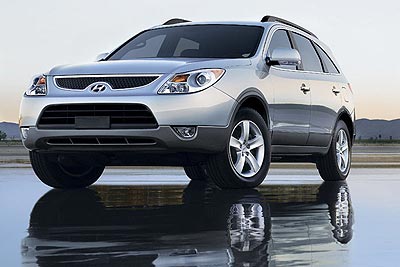
Hyundai Veracruz – 2007 First Drive: There’s one common element that ties the U.S. car market to the Indian caste system: Each strictly limits the social confines within which its “citizens” may exist. Toyota, Nissan and Honda realized this, and therefore created luxury brands to sell luxury products, a point Volkswagen would’ve been well served to heed with its Phaeton. Ignoring that lesson, Hyundai is stepping deeper into the premium pond with the all-new 2007 Veracruz crossover, upping the ante with top-notch materials, a hospitable cabin, and a well-equipped price that screams entry-luxury. Time will tell if shoppers are ready for a near-$40,000 Hyundai, or if the Veracruz is destined to sleep with the fishes, or Phaetons, as the case may be.
In developing its largest crossover to date, Hyundai stretched and widened the tested and proven platform of its current Santa Fe model. The Veracruz’s engine was borrowed from the Azera sedan, albeit with a little bit of tuning for heavier crossover duty. Much of what’s left is unique to the Veracruz, unless you’re comparing it side-by-side with a Lexus RX 350. Engineers used that Japanese luxury vehicle as their model, and those with an eye for detail will notice many of the interior parts are nearly identical in their look and feel. However, unlike the Lexus and its own U.S.-built Sonata and Santa Fe vehicles, Hyundai will build and export the 2007 Veracruz from its factories in Korea.
Model Mix – GLS Standard Features
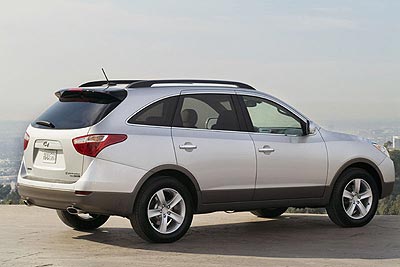
With a starting price of $26,995, including a $690 destination charge, the front-wheel-drive, seven-passenger GLS is the least expensive 2007 Hyundai Veracruz available. Included on the list of standard features are 17-inch alloy wheels, heated power mirrors with integrated turn signals, cloth seats with manual height and lumbar adjustments for the driver, and a sound system that features an MP3 player and XM satellite service (first three months free). In addition, the GLS buyer gets faux wood grain and leatherette trimmings, a manual tilt and telescoping steering wheel, a tire pressure monitoring system, and the basic array of powered goodies. Of course, we can’t forget about the keyless entry, the front-side and side-curtain airbags, and the 260-horsepower V6 engine mated to a six-speed automatic transmission.
Model Mix – SE Standard Features
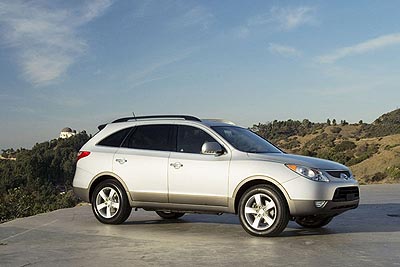
Smack dab in the middle of the Veracruz lineup is the SE, a model that starts at $28,695 when the $690 destination charge is included. Adding to the GLS’s features, the SE tacks on standard 18-inch alloy wheels, automatic headlights, front fog lights, automatic-dimming rearview mirrors, an eight-way power driver’s seat and four-way power passenger’s seat, a leather-wrapped steering wheel and shift knob, and a trip computer. Not bad for an extra $1,700, but there’s more, such as a Homelink universal remote system, a heated/cooled cubby under the front center armrest, and a compass built into the interior rearview mirror.
Model Mix – Limited Standard Features
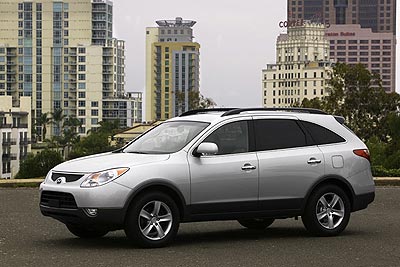
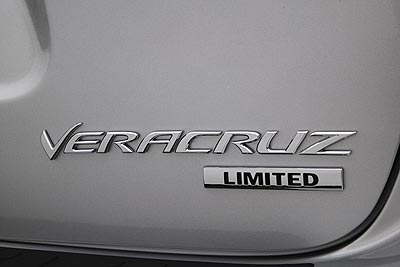
Move up to the top-of-the-line 2007 Hyundai Veracruz, dubbed the Limited, and you’ll be looking at a starting price of $32,995 including the $690 destination charge. As expected, the Limited starts with all of the offerings from the GLS and SE versions, and then adds chrome trim, a power liftgate, a rear park-assist system with sensors, a power sunroof, and leather upholstery. Hyundai’s most luxurious ride to date also pampers its owner with its dual-setting heated front seats, 315-watt Infinity sound system featuring a six-disc CD changer and a subwoofer, dual-zone automatic climate control, and a windshield de-icer technology.
Model Mix – Options
For those who long for a bit more than the base Veracruz, Hyundai offers the GLS Premium Package. Included in the $1,950 price are a power sunroof, heated front seats, an eight-way power driver’s chair, rear parking sensors, and leather on the steering wheel and shift knob. A similar package on the SE goes for $3,350 and adds the 315-watt Infinity stereo and leather seats. “All the bells and whistles” types will want the Ultimate Package, available only on the Limited. For $2,950, or $3,200 with upgraded leather, buyers get power pedals, driver memory settings, a power tilt and telescoping steering wheel, a rear DVD entertainment system with wireless headphones, a 605-watt Infinity surround sound system, illuminated sill plates, keyless ignition, rain-sensing wipers, and more.
What's New: Exterior Design
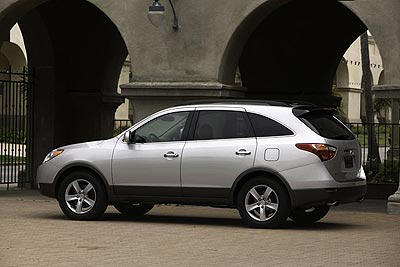
Unique styling has never been a Hyundai strong point. Look at the brand’s past models and you’ll notice in-house designs (including the previous generation Santa Fe) have been a bit, um, quirky, while others have heavily borrowed cues from competitors. The Veracruz serves as a prime example of this ultimate form of flattery, with a silhouette akin to that of the Lexus RX 350. Add in the wedge taillights, the shape of the tailgate and spoiler, and the windswept headlights, and you’ll be hard pressed to easily distinguish this Hyundai from the Lexus. That being said, Hyundai designers are working on their own style, the so-called K Factor (for Korean), and the early fruits of their labor include the “wave-like” belt line.
What’s New: Interior Design
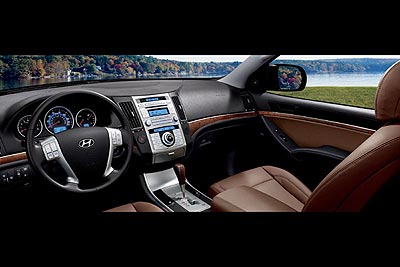
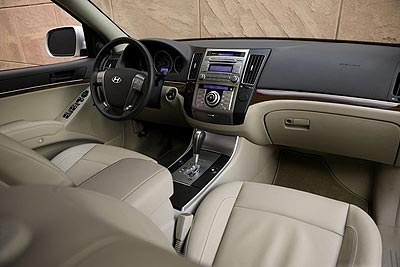
“Inviting, warm, almost high-tech.” Hyundai uses those terms to describe the interior of the Veracruz, and after some time in a Limited AWD model with upgraded leather, we can attest to the inviting and warm aspects. High-tech is more of a stretch, but high quality isn’t. As with the exterior, the Veracruz’s interior hints at the Lexus RX 350, though the Hyundai features a four-spoke steering wheel rather than a three-spoker, houses a one-piece front center console, and showcases an instrument panel that differs somewhat in its layout. The face of the dash is curvaceous; the flat top reflects too much glare in daylight. Part of the “warm” atmosphere comes from blue backlit gauges, not to mention the overhead light labeled “mood.”
What’s New: Front Seat Comfort
Our Limited test model was equipped with the Ultimate Package, which meant we were not only getting a power tilt and telescoping steering wheel with memory, we were also planting our backsides on the best leather Hyundai offers. The hides were soft, and when coupled with the ample cushions of the front buckets, made for a downright comfy spot even as the miles piled on. The upper and lower sections were wide enough for those more well-fed, but the inadequate bolsters made for some sliding around in spirited corners. Padded armrests and window sills are nice features that are standard across the lineup, though buyers must move up from the GLS if they want a steering wheel and shift knob wrapped in smooth leather.
What’s New: Second Row Seat Comfort
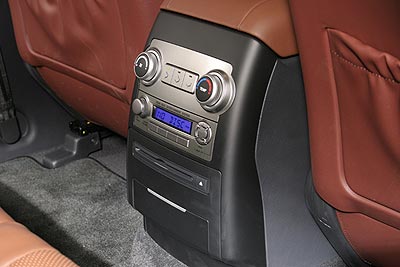
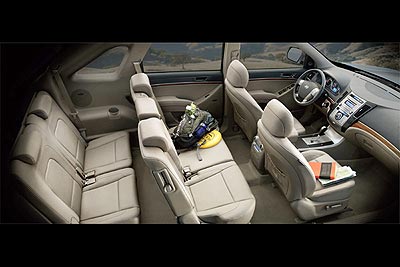
Though the second row split bench seat in the 2007 Hyundai Veracruz has lots of strengths, it’s not without a few faults. Listed under the pros column is the split bench’s width, which realistically allows for three abreast; three adjustable headrests; a reclining seat back offering a good range; soft door sills and armrests, including a center fold-down with storage and tow adjustable cupholders. There’s also plenty of foot and head room, and the optional rear DVD system with wireless headphones and audio controls and inputs is a definite must. Our tester also featured second row climate controls including fan speed, temperature, and mode. Under the cons column is the flatness of the seat, its low position, and hard front seatbacks.
What’s New: Third Row Seat Comfort
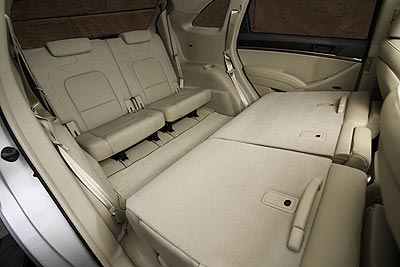
As part of the Veracruz launch, Hyundai provided three-row versions of the Honda Pilot and current Toyota Highlander for comparison. We can say that the Veracruz and Pilot beat the Highlander, though a slight edge goes to the Pilot. The curved roofline limits the Veracruz’s rear head room a bit, and the third row feels tighter overall. But, that’s for adults – average-size kids would be fine. The second row tilts and slides forward for easy entry, but again that sloped roofline hurts ingress, as does the intruding wheel well. Third-row headrests are provided and the seatbacks tilt. Furthermore, rearmost passengers get two cupholders, a small storage cubby, and a 115-volt outlet that allowed me to charge my laptop while writing this article.
What’s New: Primary Controls
Turn on the 2007 Hyundai Veracruz’s lights at night, and it quickly becomes apparent that the driver is faced with a host of attractive blue-backlit buttons and gauges. The main controls are stacked neatly in the middle dash, with a large fan speed dial being the most obvious feature. It offers smooth operation, but its silver trim stands apart from the faux alloy all around. The rest of the climate system is controlled with large and legible buttons, with dual-setting heated seat buttons on both sides of the shift lever. The Limited’s Infinity sound system, located above the a/c, includes two smaller dials and 20 clearly-labeled buttons, including one for XM. Illuminated steering wheel controls help with nighttime use.
What's New: Hardware
Depending on need and personal preference, buyers may opt for a Veracruz with front- or all-wheel-drive. For those with power going to all four corners, a button on the left dash locks in 50 percent of the engine’s power to the front tires and 50 percent to the rear. All iterations feature speed-sensitive steering, four-wheel antilock disc brakes with electronic brake force distribution and electronic brake assistance, along with standard electronic stability control which can be disabled using a button that is, again, on the left side of the dash. A fully-independent suspension, comprised of MacPherson struts up front and a multi-link setup under the tail, allows the Veracruz to provide 8.1 inches of ground clearance.
What's New: Under the Hood
Hyundai employs its biggest V6 in the all-new midsize Veracruz crossover. Under the hood is a 3.8-liter, double overhead cam, 24-valve, aluminum V6 pushing 260 horsepower at 6,000 rpm and 257 lb.-ft. of torque at 4,500 rpm. In terms of horsepower, that betters the Honda Pilot by 16 ponies and comes up 10 horses shy of the upcoming 2008 Toyota Highlander. The Veracruz’s V6 is backed up by a six-speed automatic transmission with Shiftronic manual controls, operated by clicking the shifter to the right and tapping forward for upshifts, rearward for downshifts. EPA-rated fuel economy registers 18 mpg city and 25 mpg highway for front-wheel-drive variants, while all-wheel-drive models see those figures drop to 17/24 mpg.
Driving: Test Day
Call us lucky. Just a few days prior to our arrival in La Jolla, California, the nearby mountains had been besieged by frigid temps and sleet. Not cool, or literally, quite cool. However, by the time we arrived all was sunny and warm again, just as SoCal is supposed to be. We started the day with a drive in the Lexus RX 350, the barometer by which the Veracruz is internally judged at Hyundai. We followed with a long haul in the Veracruz, specifically a Limited AWD model. Along the way, we stopped off for lunch and took longer than company officials would have liked comparing the Veracruz with the Honda Pilot and Toyota Highlander, both made available by Hyundai.
Driving: Powertrain
The Veracruz’s big V6 is effective, and the Shiftronic transmission bests most of the competition, at least on paper. That case is proven true any time the driver gradually rolls the throttle – the drivetrain responds accordingly and the Veracruz builds speed with little fuss. But goose the gas pedal for an aggressive pass and a confused throttle or off-guard transmission causes a noticeable delay. Either way, it won’t be a selling point for Gen X’ers and Gen Y’ers Hyundai is targeting. All buyers will appreciate the manual shift control, though the Veracruz executes its own upshifts early, which serves to steal some fun. We recorded up to 16.6 mpg on the highway and as little as 13.3 mpg in the city.
Driving: Ride and Handling
This is one composed crossover. The ride is controlled over all surfaces, with bumps scoring nary a blip on the driver’s radar, and the steering providing its share of road feel. You won’t feel as though your fingertips are tracing every groove in the road, and tight corners won’t be taken (prudently) at excessive speeds, but for the conditions under which a mainstream crossover is intended to travel – lots of traffic and commuting – the Veracruz provides little to complain about. Front-wheel-drive models exhibit slight torque-steer under hard acceleration and a stiffer suspension could offer some sportiness, but that’s not the Veracruz’s game. Finally, thumbs up for the tight turning circle and, with the exception of excess wind noise, a quiet ride.
Advice: Selling Points
We may not have enough space here to list all the reasons to consider the 2007 Hyundai Veracruz. No, we’re not on the company’s payroll - this is just an impressive crossover. The engine is refined and appropriately powered for the segment, the manually-interactive transmission adds some sport not found in various competitors, the interior is spacious and comfortable, and the materials are above and beyond what one would expect from a non-luxury brand like Hyundai. We’re also impressed with the reasonable starting price, standard safety equipment such as six airbags and stability control, and available features including a 605-watt Infinity sound system and rear DVD entertainment system. Oh, and there’s that 10-year/100,000-mile warranty...
Advice: Deal Breakers
Our editors are divided over the price of a loaded 2007 Hyundai Veracruz Limited AWD, which runs about $38,000. Some view that as a deal while others believe about $5,000 needs to be hacked off the sticker. Ultimately, buyers will hammer that one out. Those folks making the payments will decide whether real-world highway mileage registering about 15 mpg is sufficient, if the absence of a factory-installed navigation system (and, therefore, a rearview camera) is something Hyundai will regret (it may arrive for 2008), and if more distinct styling is necessary. Those checking out the Veracruz might also want to look at the small cargo area left when the third seat is in use, a common crossover issue, but an issue nonetheless.
Advice: Competitors
Hyundai set the Lexus RX 350 as the benchmark for refinement and quality, but in terms of direct competitors, the Veracruz has two very well-known, hot-selling crossovers in its sites – the Honda Pilot and the Toyota Highlander. As it enters the fray as a 2007 model, the Veracruz has been matched up against the current Highlander, though realistically Hyundai’s new crossover will be going head-to-head with the bigger and brawnier Toyota when it hits the streets later this year. Other competitors include the Ford Freestyle, Mazda CX-9, and Subaru B9 Tribeca. Stretching the criteria brings the Ford Edge and Saturn Outlook/GMC Acadia into the mix.
Photograph courtesy Toyota
Specifications: Price, Powertrain, MPG
Test Vehicle: 2008 Hyundai Veracruz Limited AWD
As-tested Price: $38,020 (including a $690 destination charge)
Engine Size and Type: 3.8-liter V6
Engine Horsepower: 260 at 6,000 rpm
Engine Torque: 257 lb.-ft. at 4,500 rpm
Transmission: Six-speed automatic
EPA Fuel Economy (city/highway): 17/24 mpg
Observed Fuel Economy (combined): 16.5 mpg
Specifications: Dimensions
Curb Weight: 4,431 lbs.
Length: 190.6 inches
Width: 76.6 inches
Wheelbase: 110.4 inches
Height: 68.9 inches
Legroom (1st/2nd/3rd): 42.6/38.4/31.5 inches
Headroom (1st/2nd/3rd ): 40.3/39.9/36.1 inches
Max. Seating Capacity: Seven
Max. Cargo Volume: 86.8 cu.ft.
Max. Towing Capacity: 3,500 lbs.
2nd Opinion – Buglewicz
Hyundai Veracruz – Buglewicz’s Opinion:
When I first got into the Hyundai Veracruz, I was impressed. The interior is great despite the small seats and upright driving position. The driving experience is good thanks to the powerful V6 engine, six-speed automatic transmission and comfortable – if not sporty – suspension. But at $38,000, Hyundai is in for a tough fight. If it’s competing against vehicles like the Lexus RX 350 and Acura MDX, it’s a bargain. But I think it loses out against vehicles like the Honda Pilot, which can be had with pretty much all the Veracruz’s goodies, plus a navigation system not even available on the Hyundai, for the same money. In my mind, the higher-content Honda trumps the Hyundai, faux Lexus interior notwithstanding.
Keith Buglewicz
Second Opinion – Chee
Hyundai Veracruz – Chee’s Opinion:
After a day spent traveling, I opened up the door to the Veracruz and breathed a happy sigh. It sure looked comfortable, exactly the kind of ride I needed to end my day. The ambiance inside, with the cascading blue light and soft leather seats, reminded me of a Lexus, kinda, and especially so when I looked at the price. Yikes! Almost 40k for a Hyundai? It almost holds up, too, except that the seats are too short and the throttle response slow at times. Otherwise, an excellent luxury-inspired ride, just one that luxury buyers may pass on thanks to the mainstream vibe of the Hyundai brand and the lack of crucial bells and whistles. Hint: navigation system/backup camera...
Brian Chee
Photography courtesy of Ron Perry and Hyundai


