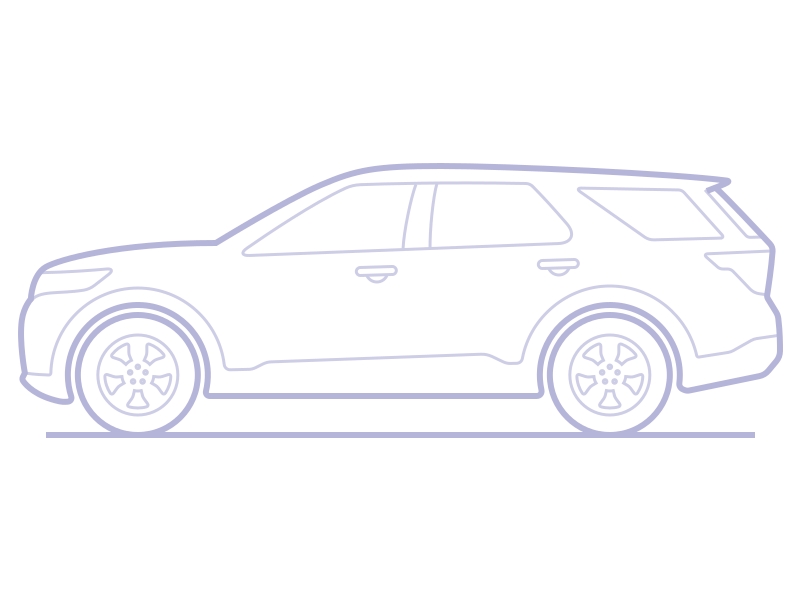
Hyundai’s got a stylish new attitude
By Brian Chee
|
July 25, 2006
Introduction
Hyundai Santa Fe – First Drive: Choice is a good thing in almost any situation, but especially when you’re shopping for a car. The more models you have to choose from, the more competitive the price, the more features you get and, ultimately, a better vehicle winds up in your driveway.This is assuming you research your vehicle purchase, of course. And if you’re among those who study up before you venture onto a dealership lot, this will come as no surprise: Hyundai, especially with the debut of a new 2007 Santa Fe, is on the move. Call it the New Toyota, and while doing so is unfair to both the point is nonetheless relevant: Hyundai is doing what Toyota has done for the past decade, which is build safe, reliable and well-made vehicles, set an aggressive price, and watch as one after another leave lots in the hands of happy motorists. Rest assured that officials in Tokyo and Kentucky are spending many more sleepless nights thinking about the emergence of Hyundai than they are worried over any comebacks mounted by Ford or General Motors. The domestic darlings, for all their efforts, have a long way to go before they wipe out years spent building second-rate cars and selling at a discount. Hyundai, on the other hand, is already beginning to craft a name for itself as the “better” buy. The days of being the low-price leader with a great warranty are over, yo – Hyundai is now among the makers of cars with the most to offer. Need a competitor for the Camry or the Accord? Check out the Sonata. Tired of looking at Siennas and Odysseys? Take a gander at the Entourage.
It all comes back to choice.
And now that choice extends to SUVs. The little Santa Fe is no longer so little. It’s grown up, with more room, more power, a more sophisticated style, and a fine interior full of nice touches and thoughtful design elements. Sure, there are holes – every car has its weak spots. For the Santa Fe, it looks like fit-and-finish is a potential issue, and there are competitors with more horsepower or that offer better fuel economy – a major issue in these $3-plus per gallon times. Curiously, Hyundai decided to offer its base Santa Fe with a smaller V6 engine instead of following the herd and bolting in a four-cylinder gas sipper. The difference in fuel economy may be debatable: Hyundai’s 2.7-liter V6 stacks up as an efficient powerplant, but the absence of a four-cylinder may leave the Santa Fe at a competitive disadvantage as rising fuel prices drive up the desirability of smaller engines.
All in all, however, the Santa Fe is everything a mid-size SUV needs to be – and slightly more – at a competitive price. In this, one of the most hotly contested of new car segments, that’s news other automakers will be loath to hear but music to the ears of thousands of SUV buyers looking for choice and who are, increasingly, choosing a Hyundai.
Model Mix
Model Mix From the base GLS to the top Limited trim, the 2007 Hyundai Santa Fe offers people a variety of features, style, and comfort at a competitive price.
Shopping for a mid-size SUV is like fishing for trout at a hatchery. You’re almost guaranteed to find the right vehicle to meet your needs. If fuel economy is your thing, there are quite a few mid-size SUVs with mpg ratings in the 20s – or better. Same goes with power, price, or just about any other criteria. In fact, one of the fastest growing segments in the mid-size SUV/crossover game is vehicles that offer third-row seating. Once the domain of larger utility vehicles and minivans, automakers have figured out a way to shoehorn an additional row into smaller vehicles. The result is a growing list of smaller SUVs that offer third-row seating – though the dimensions of the vehicles mandate that it’s a small third-row, indeed.
Enter the 2007 Hyundai Santa Fe. Bigger than the outgoing model, the Santa Fe is a well-rounded and capable vehicle that offers a third row of seats, improved fuel economy and power, and a host of standard features and options. With the GLS, SE and Limited trims, just about anyone can find a Santa Fe with an appropriate package of power and content. There are, however, competing SUVs that offer slightly more power, slightly better fuel economy, or slightly more room, and some that offer other benefits in critical areas for a slightly lower price. Overall, however, the 2007 Hyundai Santa Fe competes well against all comers.
With the redesigned Santa Fe, Hyundai is officially leaving behind its old low-priced value image, and emerging as a competitive automaker, on price, content, and, of course, value. To that end, all Santa Fe models come equipped with safety features such as six airbags, active front head restraints, Electronic Stability Control (ESC) with Traction Control System (TCS), an Anti-lock Braking System (ABS) with Brake Assist and Electronic Brake-force Distribution (EBD) as well as the government-mandated Tire Pressure Monitoring System (TPMS). All Santa Fe models are available with the third-row seat; just order the Touring Package, which adds $1,200 to the price of the vehicle – about $200 more than the third-row option on the Toyota RAV4. Later this year, the Santa Fe will also add standard XM satellite radio and optional Bluetooth hands-free telematics, and an optional navigation system will be available sometime in 2007.
For starters, the front-wheel-drive base GLS model starts at $21,595 including $650 shipping, and comes equipped with a 185-horsepower 2.7-liter V6 engine, a five-speed manual transmission, 16-inch wheels, a 112-watt audio system with six speakers and an MP3 player, a tilt and telescopic steering wheel, heated power side mirrors, power windows and door locks, remote keyless entry, and a roof rack. Key options for the GLS includes a four-speed Shiftronic automatic transmission ($1,200), and a Premium Package ($1,600 – includes a power sunroof and heated front seats). Shoppers content with GLS trim can expect to pay up to $26,000 for a fully optioned AWD model, making the Hyundai Santa Fe about $2,000 more expensive than the base 2006 Toyota RAV4, which is also available with Toyota’s Hill Start/Descent technology. The RAV4 also offers 17-inch wheels as an option, but comes up 20 horsepower short compared to the Santa Fe.
Moving up to the Santa Fe SE ($24,295 without AWD and $26,295 with AWD) adds a more robust 242-horsepower, 3.3-liter V6 mated to a five-speed Shiftronic automatic transmission. Other upgrades include 18-inch wheels, an auto-dimming rearview mirror with compass, fog lights, and secondary audio controls on the steering wheel. The SE’s optional Premium Package ($950) adds a power driver’s seat with power lumbar, a power sunroof, heated front seats, and more. Santa Fe SE shoppers can also add what Hyundai calls the Ultimate Package – for an ultimate price of $3,550 – which includes Premium Package features plus a rear-seat entertainment system, a 252-watt stereo system with seven speakers and CD-changer/MP3 player functions, as well as a 115-volt power outlet. With all-wheel-drive, a third-row seat and all the trimmings, the Santa Fe SE will tip the scales at a little more than $28,000, slightly more than some of its competitors such as the more powerful 269-horsepower Toyota RAV4 Sport V6 or the larger 242-horsepower Honda Pilot LX.
At the top of the trim ladder sits the Santa Fe Limited ($25,945 without AWD and $28,595 with AWD), which adds leather seating surfaces, heated front seats, a power driver’s seat with power lumbar support, and dual-zone automatic temperature control with an outside temperature display. Chrome accents on the grille and exterior door handles, as well as a body color rear spoiler, set the Limited model apart from the SE and GLS. Limited shoppers can bump up to the Ultimate Package, which is the same as the one offered on the SE but with a more powerful 605-watt Infinity Logic 7 Surround Sound system with 10 speakers and CD-changer/MP3 capability. At its most expensive, the Santa Fe Limited AWD rings the register at more than $32,000, including shipping. So much for Hyundai being the low-priced value automaker: the Santa Fe Limited stands shoulder to shoulder with the likes of the top Honda Pilot EX, with leather seats and DVD entertainment, though it does cost around $3,000 less than the most expensive – but larger and off-road ready – Nissan Pathfinder.
Nuts and Bolts
Nuts and Bolts All-new for the 2007 model year, the Hyundai Santa Fe is built on a Sonata-derived platform and features a revised suspension and a new V6 engine, among other highlights.
As is the trend in SUVs and crossovers, the Santa Fe is built using unibody construction for a car-like ride and more responsive handling. The benefit for consumers, of course, is refinement. Bumps and road blemishes are isolated from the cabin by the frame and suspension, dissipating jolts so that passengers remain comfortable. Think of a Sonata sedan with an SUV shell and you get the idea. Indeed, the Santa Fe is built on a Sonata-derived platform, at the same Hyundai plant in Montgomery, Ala., that manufacturers the company’s volume-selling sedan. That makes the 2007 Hyundai Santa Fe about as different a vehicle from its predecessor as the 2006 Sonata was to its progenitor – which is to say, significantly improved in terms of space, power and refinement. Given that the Santa Fe has been a sales leader for Hyundai since it debuted, Hyundai engineers also introduced several significant refinements to the nuts and bolts of this new suv, such as a revised suspension and a new engine.
Hyundai has forsaken the typical four-cylinder/six-cylinder powertrain lineup, offering shoppers a choice between two V6 engines. A 2.7-liter that makes 185 horsepower at 6,000 rpm and 183 lb.-ft of torque at 4,000 rpm comes standard on the GLS, and a 3.3-liter engine that generates 242 horsepower at 6,000 rpm and 226 lb.-ft. of torque at 4,500 rpm comes on the SE and Limited models. First introduced in the 2006 Hyundai Sonata, the 3.3-liter V6 is from Hyundai’s Lambda engine group. The 2.7-liter V6, meanwhile, is a new engine from the “Mu” engine family, the same overworked motor that’s available in the 2007 Kia Optima. Granted, Hyundai’s decision to offer only V6 engines is a bit odd given the specter of rising fuel prices and the emerging popularity of four-cylinder vehicles, but when specifications were finalized for the new Santa Fe, gas cost much less than it does today. With fuel economy for the smaller V6 only slightly improved – 21/26 vs. 19/24 for the larger engine – it may seem that most people will opt for the increased power of the 3.3-liter engine. But consider this: compared to the 2006 Toyota RAV4’s inline four-cylinder powerplant, Hyundai’s base engine makes 20 more horsepower at the relatively small cost of about three miles per gallon, based on EPA ratings.
Food for thought, eh? While you’re chewing on that, think over the Santa Fe’s transmission choices: the base five-speed manual or four-speed automatic, and the five-speed automatic standard on the SE and Limited models. Both automatics come with Hyundai’s Shiftronic manual shifting feature. A redesigned suspension manages the Santa Fe’s ride and handling, with a MacPherson strut setup in front and a multi-link, trailing arm suspension in the rear. The result is a firmer but more pleasant ride, which easily handles road irregularities. Standard four-wheel-disc brakes with ABS, EBD and Brake Assist bring the Santa Fe to a stop. Base GLS models get 16-inch wheels and P235/70R16 tires, while SE and Limited shoppers enjoy 18-inch wheels and P235/60R18 tires. Turning those wheels is an excellent power rack-and-pinion steering system that features a very tight turning radius.
Design
Design Except for some noticeable fit and finish issues, the 2007 Hyundai Santa Fe is a stylish SUV with a pleasing interior environment.
It grows on you, the 2007 Hyundai Santa Fe. Slowly, at first, with its smooth lines and sculpted appearance, bold front grille and stylish lights. When the vehicle passes you by the first time or two, you might even fail to notice it – but you will, once you look a little closer. Where the Sonata echoed one of the most popular sedans on the road (HondaAccord), the Santa Fe pretty much stands on its own with a look that may never get your blood rushing but a style you’ll never get tired of, and one that will hold its appeal even as trends change and sheet metal gets twisted into new shapes. It should keep its looks over time, then – just be sure the vehicle you choose fits together better than our tester did. Given Hyundai’s recent run of quality awards, it was slightly surprising to find wide variances in fit at the liftgate, doors, front fascia and headlights. We can only hope that ours was the exception, not the rule, as these were among the first units to roll off the Montgomery, Alabama plant.
Stylistically, however, the new Santa Fe has about as much in common with the old Santa Fe as the old Excel has with the new Sonata. Gone is the round-mound design, replaced by monochromatic body panels, sharper creases and a better integrated mix of plastic and metal. Case in point: the Santa Fe is seven inches larger than its predecessor, but it looks scarcely larger at all, thanks to a wider track and sleeker sheet metal. Among the few items that Hyundai carried over from the outgoing Santa Fe are the roof rack and the liftgate handle.
They should have ditched the handle. It’s clumsy, and, well, a bit old school. What is decidedly new school is the Santa Fe’s interior. It’s obvious to us that Hyundai sank significant cash into the interior design; unfortunately, the interior also suffers from poor finish, especially in the center dash area where the plastic and wood grain trims didn’t fit flush. Other than that, there are very few corners snipped inside the cabin. For example, all compartment lids and covers are nicely dampened. The compartment on the top of the dash is especially nice – lined, dampened, and easy to open and close with just a finger. Other highlights include pleasant bright blue back lighting, including the cupholders, and an excellent graphic display for the environmental controls and gauges. Seats are nicely upholstered with leather or cloth, and the seating position is good, save for a seat bottom that feels too flat and lacking in support. Second-row seats are also comfortable, a place where occupants sit up high, and the third-row – well, you can climb back there if you want. Just avoid sitting back there for any length of time, unless you have a thing for your chiropractor.
Overall, the interior design is excellent, and the Santa Fe is spacious, too. With more legroom than the Honda Pilot, among others, the Santa Fe rides much bigger than it is, with plenty of room for legs and heads in the front two rows. It falls right in the mix with other mid-size SUV leaders, in fact, offering around an inch more front legroom than the Honda Pilot, RAV4 or the Toyota Highlander, while coming up about an inch short for rear legroom, compared to the RAV4 and the Pilot. Rear legroom comparisons between the Highlander and the Santa Fe come out almost identical – 38.8 inches for the Santa Fe, and 38.4 inches for the Highlander.
One thing the Santa Fe has going for it, however, is large rear doors. They make it easy to get into and out of the Santa Fe – and that includes wrangling with a child and her seat. Cargo room is slightly compromised by the existence of an in-floor compartment, which comes in handy should you have smaller items you’d like to keep out of sight and out of the way. Thanks to the compartment, however, the third row folds flat into the “floor” making available room easier to use. Without the third row, cargo room is big enough to handle most things, including a bushel of bamboo/ Other features inside the cabin include air vents mounted on the B-pillar to cool rear passengers, along with a rear climate control center.
Driving Impressions
Driving Impressions The 2007 Hyundai Santa Fe is a nice-riding SUV with a quiet interior, a responsive and comfortable ride, and respectable power
Okay – so no one ever said that driving a 2007 Hyundai Santa Fe would be fun. But everyone shopping for a mid-sized SUV does expect a vehicle such as this to be capable, in terms of performance, utility and efficiency. And sure enough, the Santa Fe delivers an extremely capable experience, top to bottom and at the pump.
It also delivers its share of giggles.
Take, for instance, the soft blue backlighting inside the cabin, the refined and spacious interior, or that cute little third-row seat tucked away in back. Treats such as these make driving the Santa Fe worth a good chortle or two if not a full belly laugh, and a darn pleasant experience mile after happy mile. Derived from the Hyundai Sonata, the Santa Fe provides a car-like driving experience, meaning that it muffles the bumps and rough road spots, successfully evening out the ride and producing handling that is sure and stable.
On a long and winding 150-mile drive between Santa Barbara and Orange County, Calif., the Santa Fe easily navigated a variety of roads, surfaces, and conditions. Through it all, the SUV rarely lost composure, responding promptly to input from the driver, absorbing road irregularities and navigating corners capably though the P235/60R18 tires registered their complaint when pushed hard through turns and body roll was moderate. Changing lanes, parking, and maneuvering through Southern California’s traffic snarls took little effort; the Santa Fe’s turning radius is very tight and visibility, thanks to the large rear doors and big windows, is excellent. Braking is firm and responsive, with just a touch of awkward pedal play.
Acceleration, however, could be better. The 3.3-liter V6 engine with the five-speed automatic transmission delivered its 242 horsepower and 226 lb. ft. of torque on command, but it took the powertrain a moment to catch up with the driver’s instruction. Sluggish off the line, the Santa Fe nonetheless gains momentum quickly and delivers a smooth ribbon of power. Driving in the transmission’s default “D” setting exacerbates the Santa Fe’s sluggish nature, and most drivers will likely prefer to slip into Shiftronic mode (standard on Limited and SE models, available on GLS). Though the net gain using Shiftronic is hardly a hoot, it is a more efficient way to pull power from the Santa Fe’s 2.7-liter or 3.3-liter engine.
So, you feel the need to hammer the throttle on take-off, which means that gas mileage spirals down to Hummer H3 territory, right? Wrong. Despite our flogging, our tester registered an average of 18.1 mpg through various driving situations including congested freeway driving, driving with a load, around-town motoring, and highway cruising. Yes, that’s less than the 19/24 EPA rating, but it’s closer than one might expect and very competitive with similar models. For an SUV, it sips more than slurps.
Driving controls are smartly placed, with the exception being the secondary controls on the steering wheel. Placed farther up on the wheel than is comfortable, the controls require a concerted effort to manipulate, reducing their effectiveness. Perhaps best of all, however, is the Santa Fe’s silence. The cabin is nice and quiet, separating a considerable amount of road and wind noise from its passengers. Hyundai people will tell you that the cabin’s interior hush is a result of the use of laminated steel in the Santa Fe’s construction, and we agree with the outcome: a quiet cabin with one of the most refined rides in its class thanks to top-grade interior materials (in the Limited) and well-executed controls. There’s a bit too much hard plastic around the front passengers, however, but that’s offset by other quality touches, such as dampened compartment lids, lined cubbyholes, and blue illuminated cupholders. The upper-crust woven mesh headliner says it all, though. Hyundai has invested in the content and the engineering behind the Santa Fe, and the result is a very capable SUV that we think people will thoroughly enjoy.
Capable.
Granted, the word lacks a certain panache. But shoppers in the market for a mid-size SUV fuss less over panache then they do value. That’s value as in a competitive price for a dependable, well-executed car – as opposed to the bargain of the day, and it’s quickly becoming the definition of Hyundai value, and no other new vehicle more capably represents that than the new Santa Fe.
Second Opinion – Perry
Second Opinion – Perry With the 2007 Santa Fe, Hyundai looks to give Toyota and Honda a run for the money in the mid-size SUV category.
If the Azera and Santa Fe are indicators of what’s to come from Hyundai in the years ahead, Honda and Toyota had better keep them in their peripheral vision. The latest Hyundai to hit our lot was the redesigned 2007 Santa Fe and I must admit, I am truly impressed. Considering the price range, the Santa Fe has plenty to offer, in many ways exceeding what Honda and Toyota can provide. The redesigned Santa Fe is comfortable, quiet and conveys a feeling of luxury not found in the competing models.
Design is subjective but the 2007 Hyundai Santa Fe has a pleasing look that is neither drastic nor plain. The design carries a rugged yet upscale look that should appeal to SUV buyers of all ages. Disappointingly, exterior panel fitment needs improvement. Our test vehicle – among the first off the line -- had varying seams for the tailgate and the doors as well as slight overhang variances at the front of the hood.
Inside, the Santa Fe’s overall look and feel is definitely upscale. Our Santa Fe Limited was trimmed out with nice leather, faux wood and aluminum trim accented by floor mats that could compete with designer home carpeting. One area I took issue with was the seating position. I had difficulty finding a comfortable position, feeling like I was sitting either too high or too close. I have no complaints regarding the seats themselves, which offer good cushioning and support, and which on our test vehicle were covered in leather that was soft and pliable. Comfort continues into the back seat with reclining seat backs and lots of room from head to toe. The 60/40 split second-row seat doesn’t quite fold flat but does expand cargo area nicely. A third row of seats is optional – although I can’t see that they’d be comfortable.
The Santa Fe’s new chassis and suspension setup delivers a ride that is smooth and quiet with the exception of a little wind noise coming off the windshield and slight tire noise from the front wheels. Braking is adequate but more feedback would be appreciated. I did find the steering to be solid, conveying good feel at all speeds. Acceleration from the 3.3-liter V6 gets the Santa Fe up to speed quickly and the five-speed transmission produces seamless shifts.
When you look at the fact that a Hyundai Santa Fe with everything on it hovers in the neighborhood of $28,000, it’s quite a value. Hyundai looks to be serious about giving Toyota and Honda a run for the money and from what I see they’re right on track.
Second Opinion – Fabin
Second Opinion – Fabin Add the 2007 Hyundai Santa Fe to the list of impressive new vehicles from Hyundai
It seems that every time I open up the automotive news I read that Hyundai is either winning a new award or breaking a new record. Message boards across the Internet are full of positive comments about reliability, safety and the value offered by Hyundai vehicles. I’ve driven every Hyundai model since the early 90’s and have seen first hand their climb to the brand that represents value and quality. So when the 2007 Santa Fe arrived for review, I was eager to get the keys and hit the road.
The first thing I noticed is that it’s larger then the previous model, and has a more upscale appearance. On the Limited trim, the exterior has been enhanced with chrome door inserts, sporty looking headlamps and several design cues from some of today’s top luxury brand SUVs. You don’t have to look long to see some Infiniti FX & VW Touareg in the styling of the Santa Fe. Inside, the Santa Fe is all about refinement. The new dash looks like it was taken directly from a luxury car and works very well with the upscale exterior. Second row passengers will enjoy generous leg and hip room as well as their own air vents and large cup holders. Behind the second seats is plenty of cargo room with an extremely useful storage system built into the floor – all of which can be replaced with a third row of seats.
Driving Impressions On the road, the Santa Fe is a joy to drive. It’s easy to forget that you’re driving an SUV, thanks to its car-like feel and comfortable driving position. Bumps and cracks in the road pass by smoothly, and engine noise is not a factor. Wind rush at highway speeds is well controlled for the most part, but cross winds can quickly raise the noise level. Even with a strong crosswind, the Santa Fe’s cabin is quiet enough that no one has to raise their voice during conversation.
The Santa Fe’s engine is powerful when pushed, though I noticed a lot of torque steer during hard acceleration take-offs on the front-wheel drive versions. Passing power was more then ample, the Santa Fe quickly adding speed to overtake other vehicles. Handling was predictable and confident.
Inside the new Santa Fe it’s easy to see design cues from other class leading SUVs, the most obvious being the Lexus RX. Up front, the Santa Fe has large comfortable seats, though I personally would like more side bolstering to fit my aggressive driving style. The rear seats are nicely padded and provide generous room for two adult passengers; three adults can fit for short trips.
Quality On most accounts, it looks like the Santa Fe delivers quality right on target. Most of the interior materials are high quality, with soft-touch textures on par with the competition, though some unwanted hard plastic pieces could be found here and there. Fit and finish on the interior was above average overall – there were a few pieces of trim that didn’t align exactly right, but overall the Santa Fe exceeds its domestic competitors. Outside, the Santa Fe had minor issues with fit and finish - uneven gaps where noticed around the rear hatch that stood out like a soar thumb. With such a well executed design, we hope that these design issues will not pop up on models that make it to the dealerships.
Design Hyundai did its homework to insure that the Santa Fe’s design worked around the driver. Controls are easy to find and use, visibility is outstanding thanks to large tall windows all around, and there are enough adjustments to insure any driver is comfortable behind the wheel. And they didn’t stop with a well-designed exterior and interior – they went one step further to give the Santa Fe a “Wow” factor. Take the Santa Fe for a drive a night and you’ll be basked in a very trendy and hip looking blue glowing interior. Not only did Hyundai ensure every button, switch and display featured the same blue glow, it went as far to include blue lighting inside the front cup holders. Set a bottle of water inside and watch it glow an electric blue. Every passenger who rides in the Santa Fe at night is certain to comment!
Advice It’s easy to compare the Santa Fe to up market luxury competitors, and it matches many of them in different areas. I would recommend checking the option box for the AWD system to overcome the torque steer as well as provide the benefits of AWD. For those looking for a reliable, easy to drive, roomy SUV, you must test drive the Santa Fe – and if possible, do it at night to see the impressive blue glow of the interior.
FAQs
FAQs The 2007 Hyundai Santa Fe is roomy, stylish and capable – just watch out for potential issues with fit and finish, as our early production unit revealed some irregular gaps and minor misfits.
Why should I care about the 2007 Hyundai Santa Fe?
Because it’s bigger, more stylish and more powerful than ever before. The 2007 Hyundai Santa Fe is a thoroughly redesigned SUV, one that competes with smaller – and larger – vehicles.
What’s the worst thing about the Hyundai Santa Fe?
Fit-and-finish seems a little dicey; our test sample exhibited gaps of varying sizes and shapes. The powertrain struggles a bit off the line, and the third-row seat is too small to handle an adult for any considerable length of time.
What’s the best thing about the Hyundai Santa Fe?
The interior is excellent with plenty of room. Also, except for a little sluggishness at take-off, the 3.3-liter V6 provides plenty of power.
Specifications
Specifications The 2007 Hyundai Santa Fe’s key competitors are the Chevrolet Equinox, Chevrolet TrailBlazer, Ford Escape, Ford Explorer, Honda CR-V, Honda Pilot, Kia Sorento, Mazda Tribute, Mercury Mariner, Mitsubishi Endeavor, Mitsubishi Outlander, Nissan Murano, Nissan Pathfinder, Nissan Xterra, Pontiac Torrent, Saturn VUE, Suzuki XL7, Toyota Highlander, Toyota RAV4
Test Vehicles: 2007 Hyundai Santa Fe GLS, SE and Limited
Price Range: $21, 595 (GLS) to $28,595 (Limited) (including $650 shipping)
Engine Size and Type: 2.7-liter V6 (GLS); 3.3-liter V6 (SE, Limited)
Engine Horsepower: 185 at 6,000 rpm (2.7L); 242 lb.-ft. at 6,000 rpm (3.3L)
Engine Torque: 183 lb.-ft. at 4,000 rpm (2.7L); 226 lb.-ft. at 4,500 rpm (3.3L)
Transmission: Five-speed manual or four-speed automatic (2.7L); Five-speed automatic (3.3LV6)
Curb Weight, lbs.: 3,727 (GLS manual 2WD); 4,121 (Limited AWD with third-row seat)
EPA Fuel Economy (city/highway): 21/26 mpg (2.7L); 19/24 mpg (3.3L)
Observed Fuel Economy: 18.1 mpg (Limited AWD)
Length: 184.1 inches
Width: 74.4 inches
Wheelbase: 106.3 inches
Height: 67.9 inches
Legroom (front/middle/rear): 42.6 / 36.8 / 31.3 inches
Headroom (front/middle/rear): 40.2 / 39.6 / 34.8 inches
Max. Seating Capacity: Seven
Max. Cargo Volume: 78.2 cubic feet
Max. Payload (lbs.): 1,388
Max. Towing Capacity (lbs.): 2,800 (2.7L); 3,500 (3.3L)
Key Competitors:
Chevrolet Equinox
Chevrolet TrailBlazer
Ford Escape
Ford Explorer
Honda CR-V
Honda Pilot
Kia Sorento
Mazda Tribute
Mercury Mariner
Mitsubishi Endeavor
Mitsubishi Outlander
Nissan Murano
Nissan Pathfinder
Nissan Xterra
Pontiac Torrent
Saturn Vue
Suzuki XL7
Toyota Highlander
Toyota RAV4
Model Mix From the base GLS to the top Limited trim, the 2007 Hyundai Santa Fe offers people a variety of features, style, and comfort at a competitive price.
Shopping for a mid-size SUV is like fishing for trout at a hatchery. You’re almost guaranteed to find the right vehicle to meet your needs. If fuel economy is your thing, there are quite a few mid-size SUVs with mpg ratings in the 20s – or better. Same goes with power, price, or just about any other criteria. In fact, one of the fastest growing segments in the mid-size SUV/crossover game is vehicles that offer third-row seating. Once the domain of larger utility vehicles and minivans, automakers have figured out a way to shoehorn an additional row into smaller vehicles. The result is a growing list of smaller SUVs that offer third-row seating – though the dimensions of the vehicles mandate that it’s a small third-row, indeed.
Enter the 2007 Hyundai Santa Fe. Bigger than the outgoing model, the Santa Fe is a well-rounded and capable vehicle that offers a third row of seats, improved fuel economy and power, and a host of standard features and options. With the GLS, SE and Limited trims, just about anyone can find a Santa Fe with an appropriate package of power and content. There are, however, competing SUVs that offer slightly more power, slightly better fuel economy, or slightly more room, and some that offer other benefits in critical areas for a slightly lower price. Overall, however, the 2007 Hyundai Santa Fe competes well against all comers.
With the redesigned Santa Fe, Hyundai is officially leaving behind its old low-priced value image, and emerging as a competitive automaker, on price, content, and, of course, value. To that end, all Santa Fe models come equipped with safety features such as six airbags, active front head restraints, Electronic Stability Control (ESC) with Traction Control System (TCS), an Anti-lock Braking System (ABS) with Brake Assist and Electronic Brake-force Distribution (EBD) as well as the government-mandated Tire Pressure Monitoring System (TPMS). All Santa Fe models are available with the third-row seat; just order the Touring Package, which adds $1,200 to the price of the vehicle – about $200 more than the third-row option on the Toyota RAV4. Later this year, the Santa Fe will also add standard XM satellite radio and optional Bluetooth hands-free telematics, and an optional navigation system will be available sometime in 2007.
For starters, the front-wheel-drive base GLS model starts at $21,595 including $650 shipping, and comes equipped with a 185-horsepower 2.7-liter V6 engine, a five-speed manual transmission, 16-inch wheels, a 112-watt audio system with six speakers and an MP3 player, a tilt and telescopic steering wheel, heated power side mirrors, power windows and door locks, remote keyless entry, and a roof rack. Key options for the GLS includes a four-speed Shiftronic automatic transmission ($1,200), and a Premium Package ($1,600 – includes a power sunroof and heated front seats). Shoppers content with GLS trim can expect to pay up to $26,000 for a fully optioned AWD model, making the Hyundai Santa Fe about $2,000 more expensive than the base 2006 Toyota RAV4, which is also available with Toyota’s Hill Start/Descent technology. The RAV4 also offers 17-inch wheels as an option, but comes up 20 horsepower short compared to the Santa Fe.
Moving up to the Santa Fe SE ($24,295 without AWD and $26,295 with AWD) adds a more robust 242-horsepower, 3.3-liter V6 mated to a five-speed Shiftronic automatic transmission. Other upgrades include 18-inch wheels, an auto-dimming rearview mirror with compass, fog lights, and secondary audio controls on the steering wheel. The SE’s optional Premium Package ($950) adds a power driver’s seat with power lumbar, a power sunroof, heated front seats, and more. Santa Fe SE shoppers can also add what Hyundai calls the Ultimate Package – for an ultimate price of $3,550 – which includes Premium Package features plus a rear-seat entertainment system, a 252-watt stereo system with seven speakers and CD-changer/MP3 player functions, as well as a 115-volt power outlet. With all-wheel-drive, a third-row seat and all the trimmings, the Santa Fe SE will tip the scales at a little more than $28,000, slightly more than some of its competitors such as the more powerful 269-horsepower Toyota RAV4 Sport V6 or the larger 242-horsepower Honda Pilot LX.
At the top of the trim ladder sits the Santa Fe Limited ($25,945 without AWD and $28,595 with AWD), which adds leather seating surfaces, heated front seats, a power driver’s seat with power lumbar support, and dual-zone automatic temperature control with an outside temperature display. Chrome accents on the grille and exterior door handles, as well as a body color rear spoiler, set the Limited model apart from the SE and GLS. Limited shoppers can bump up to the Ultimate Package, which is the same as the one offered on the SE but with a more powerful 605-watt Infinity Logic 7 Surround Sound system with 10 speakers and CD-changer/MP3 capability. At its most expensive, the Santa Fe Limited AWD rings the register at more than $32,000, including shipping. So much for Hyundai being the low-priced value automaker: the Santa Fe Limited stands shoulder to shoulder with the likes of the top Honda Pilot EX, with leather seats and DVD entertainment, though it does cost around $3,000 less than the most expensive – but larger and off-road ready – Nissan Pathfinder.
Nuts and Bolts
Nuts and Bolts All-new for the 2007 model year, the Hyundai Santa Fe is built on a Sonata-derived platform and features a revised suspension and a new V6 engine, among other highlights.
As is the trend in SUVs and crossovers, the Santa Fe is built using unibody construction for a car-like ride and more responsive handling. The benefit for consumers, of course, is refinement. Bumps and road blemishes are isolated from the cabin by the frame and suspension, dissipating jolts so that passengers remain comfortable. Think of a Sonata sedan with an SUV shell and you get the idea. Indeed, the Santa Fe is built on a Sonata-derived platform, at the same Hyundai plant in Montgomery, Ala., that manufacturers the company’s volume-selling sedan. That makes the 2007 Hyundai Santa Fe about as different a vehicle from its predecessor as the 2006 Sonata was to its progenitor – which is to say, significantly improved in terms of space, power and refinement. Given that the Santa Fe has been a sales leader for Hyundai since it debuted, Hyundai engineers also introduced several significant refinements to the nuts and bolts of this new suv, such as a revised suspension and a new engine.
Hyundai has forsaken the typical four-cylinder/six-cylinder powertrain lineup, offering shoppers a choice between two V6 engines. A 2.7-liter that makes 185 horsepower at 6,000 rpm and 183 lb.-ft of torque at 4,000 rpm comes standard on the GLS, and a 3.3-liter engine that generates 242 horsepower at 6,000 rpm and 226 lb.-ft. of torque at 4,500 rpm comes on the SE and Limited models. First introduced in the 2006 Hyundai Sonata, the 3.3-liter V6 is from Hyundai’s Lambda engine group. The 2.7-liter V6, meanwhile, is a new engine from the “Mu” engine family, the same overworked motor that’s available in the 2007 Kia Optima. Granted, Hyundai’s decision to offer only V6 engines is a bit odd given the specter of rising fuel prices and the emerging popularity of four-cylinder vehicles, but when specifications were finalized for the new Santa Fe, gas cost much less than it does today. With fuel economy for the smaller V6 only slightly improved – 21/26 vs. 19/24 for the larger engine – it may seem that most people will opt for the increased power of the 3.3-liter engine. But consider this: compared to the 2006 Toyota RAV4’s inline four-cylinder powerplant, Hyundai’s base engine makes 20 more horsepower at the relatively small cost of about three miles per gallon, based on EPA ratings.
Food for thought, eh? While you’re chewing on that, think over the Santa Fe’s transmission choices: the base five-speed manual or four-speed automatic, and the five-speed automatic standard on the SE and Limited models. Both automatics come with Hyundai’s Shiftronic manual shifting feature. A redesigned suspension manages the Santa Fe’s ride and handling, with a MacPherson strut setup in front and a multi-link, trailing arm suspension in the rear. The result is a firmer but more pleasant ride, which easily handles road irregularities. Standard four-wheel-disc brakes with ABS, EBD and Brake Assist bring the Santa Fe to a stop. Base GLS models get 16-inch wheels and P235/70R16 tires, while SE and Limited shoppers enjoy 18-inch wheels and P235/60R18 tires. Turning those wheels is an excellent power rack-and-pinion steering system that features a very tight turning radius.
Design
Design Except for some noticeable fit and finish issues, the 2007 Hyundai Santa Fe is a stylish SUV with a pleasing interior environment.
It grows on you, the 2007 Hyundai Santa Fe. Slowly, at first, with its smooth lines and sculpted appearance, bold front grille and stylish lights. When the vehicle passes you by the first time or two, you might even fail to notice it – but you will, once you look a little closer. Where the Sonata echoed one of the most popular sedans on the road (HondaAccord), the Santa Fe pretty much stands on its own with a look that may never get your blood rushing but a style you’ll never get tired of, and one that will hold its appeal even as trends change and sheet metal gets twisted into new shapes. It should keep its looks over time, then – just be sure the vehicle you choose fits together better than our tester did. Given Hyundai’s recent run of quality awards, it was slightly surprising to find wide variances in fit at the liftgate, doors, front fascia and headlights. We can only hope that ours was the exception, not the rule, as these were among the first units to roll off the Montgomery, Alabama plant.
Stylistically, however, the new Santa Fe has about as much in common with the old Santa Fe as the old Excel has with the new Sonata. Gone is the round-mound design, replaced by monochromatic body panels, sharper creases and a better integrated mix of plastic and metal. Case in point: the Santa Fe is seven inches larger than its predecessor, but it looks scarcely larger at all, thanks to a wider track and sleeker sheet metal. Among the few items that Hyundai carried over from the outgoing Santa Fe are the roof rack and the liftgate handle.
They should have ditched the handle. It’s clumsy, and, well, a bit old school. What is decidedly new school is the Santa Fe’s interior. It’s obvious to us that Hyundai sank significant cash into the interior design; unfortunately, the interior also suffers from poor finish, especially in the center dash area where the plastic and wood grain trims didn’t fit flush. Other than that, there are very few corners snipped inside the cabin. For example, all compartment lids and covers are nicely dampened. The compartment on the top of the dash is especially nice – lined, dampened, and easy to open and close with just a finger. Other highlights include pleasant bright blue back lighting, including the cupholders, and an excellent graphic display for the environmental controls and gauges. Seats are nicely upholstered with leather or cloth, and the seating position is good, save for a seat bottom that feels too flat and lacking in support. Second-row seats are also comfortable, a place where occupants sit up high, and the third-row – well, you can climb back there if you want. Just avoid sitting back there for any length of time, unless you have a thing for your chiropractor.
Overall, the interior design is excellent, and the Santa Fe is spacious, too. With more legroom than the Honda Pilot, among others, the Santa Fe rides much bigger than it is, with plenty of room for legs and heads in the front two rows. It falls right in the mix with other mid-size SUV leaders, in fact, offering around an inch more front legroom than the Honda Pilot, RAV4 or the Toyota Highlander, while coming up about an inch short for rear legroom, compared to the RAV4 and the Pilot. Rear legroom comparisons between the Highlander and the Santa Fe come out almost identical – 38.8 inches for the Santa Fe, and 38.4 inches for the Highlander.
One thing the Santa Fe has going for it, however, is large rear doors. They make it easy to get into and out of the Santa Fe – and that includes wrangling with a child and her seat. Cargo room is slightly compromised by the existence of an in-floor compartment, which comes in handy should you have smaller items you’d like to keep out of sight and out of the way. Thanks to the compartment, however, the third row folds flat into the “floor” making available room easier to use. Without the third row, cargo room is big enough to handle most things, including a bushel of bamboo/ Other features inside the cabin include air vents mounted on the B-pillar to cool rear passengers, along with a rear climate control center.
Driving Impressions
Driving Impressions The 2007 Hyundai Santa Fe is a nice-riding SUV with a quiet interior, a responsive and comfortable ride, and respectable power
Okay – so no one ever said that driving a 2007 Hyundai Santa Fe would be fun. But everyone shopping for a mid-sized SUV does expect a vehicle such as this to be capable, in terms of performance, utility and efficiency. And sure enough, the Santa Fe delivers an extremely capable experience, top to bottom and at the pump.
It also delivers its share of giggles.
Take, for instance, the soft blue backlighting inside the cabin, the refined and spacious interior, or that cute little third-row seat tucked away in back. Treats such as these make driving the Santa Fe worth a good chortle or two if not a full belly laugh, and a darn pleasant experience mile after happy mile. Derived from the Hyundai Sonata, the Santa Fe provides a car-like driving experience, meaning that it muffles the bumps and rough road spots, successfully evening out the ride and producing handling that is sure and stable.
On a long and winding 150-mile drive between Santa Barbara and Orange County, Calif., the Santa Fe easily navigated a variety of roads, surfaces, and conditions. Through it all, the SUV rarely lost composure, responding promptly to input from the driver, absorbing road irregularities and navigating corners capably though the P235/60R18 tires registered their complaint when pushed hard through turns and body roll was moderate. Changing lanes, parking, and maneuvering through Southern California’s traffic snarls took little effort; the Santa Fe’s turning radius is very tight and visibility, thanks to the large rear doors and big windows, is excellent. Braking is firm and responsive, with just a touch of awkward pedal play.
Acceleration, however, could be better. The 3.3-liter V6 engine with the five-speed automatic transmission delivered its 242 horsepower and 226 lb. ft. of torque on command, but it took the powertrain a moment to catch up with the driver’s instruction. Sluggish off the line, the Santa Fe nonetheless gains momentum quickly and delivers a smooth ribbon of power. Driving in the transmission’s default “D” setting exacerbates the Santa Fe’s sluggish nature, and most drivers will likely prefer to slip into Shiftronic mode (standard on Limited and SE models, available on GLS). Though the net gain using Shiftronic is hardly a hoot, it is a more efficient way to pull power from the Santa Fe’s 2.7-liter or 3.3-liter engine.
So, you feel the need to hammer the throttle on take-off, which means that gas mileage spirals down to Hummer H3 territory, right? Wrong. Despite our flogging, our tester registered an average of 18.1 mpg through various driving situations including congested freeway driving, driving with a load, around-town motoring, and highway cruising. Yes, that’s less than the 19/24 EPA rating, but it’s closer than one might expect and very competitive with similar models. For an SUV, it sips more than slurps.
Driving controls are smartly placed, with the exception being the secondary controls on the steering wheel. Placed farther up on the wheel than is comfortable, the controls require a concerted effort to manipulate, reducing their effectiveness. Perhaps best of all, however, is the Santa Fe’s silence. The cabin is nice and quiet, separating a considerable amount of road and wind noise from its passengers. Hyundai people will tell you that the cabin’s interior hush is a result of the use of laminated steel in the Santa Fe’s construction, and we agree with the outcome: a quiet cabin with one of the most refined rides in its class thanks to top-grade interior materials (in the Limited) and well-executed controls. There’s a bit too much hard plastic around the front passengers, however, but that’s offset by other quality touches, such as dampened compartment lids, lined cubbyholes, and blue illuminated cupholders. The upper-crust woven mesh headliner says it all, though. Hyundai has invested in the content and the engineering behind the Santa Fe, and the result is a very capable SUV that we think people will thoroughly enjoy.
Capable.
Granted, the word lacks a certain panache. But shoppers in the market for a mid-size SUV fuss less over panache then they do value. That’s value as in a competitive price for a dependable, well-executed car – as opposed to the bargain of the day, and it’s quickly becoming the definition of Hyundai value, and no other new vehicle more capably represents that than the new Santa Fe.
Second Opinion – Perry
Second Opinion – Perry With the 2007 Santa Fe, Hyundai looks to give Toyota and Honda a run for the money in the mid-size SUV category.
If the Azera and Santa Fe are indicators of what’s to come from Hyundai in the years ahead, Honda and Toyota had better keep them in their peripheral vision. The latest Hyundai to hit our lot was the redesigned 2007 Santa Fe and I must admit, I am truly impressed. Considering the price range, the Santa Fe has plenty to offer, in many ways exceeding what Honda and Toyota can provide. The redesigned Santa Fe is comfortable, quiet and conveys a feeling of luxury not found in the competing models.
Design is subjective but the 2007 Hyundai Santa Fe has a pleasing look that is neither drastic nor plain. The design carries a rugged yet upscale look that should appeal to SUV buyers of all ages. Disappointingly, exterior panel fitment needs improvement. Our test vehicle – among the first off the line -- had varying seams for the tailgate and the doors as well as slight overhang variances at the front of the hood.
Inside, the Santa Fe’s overall look and feel is definitely upscale. Our Santa Fe Limited was trimmed out with nice leather, faux wood and aluminum trim accented by floor mats that could compete with designer home carpeting. One area I took issue with was the seating position. I had difficulty finding a comfortable position, feeling like I was sitting either too high or too close. I have no complaints regarding the seats themselves, which offer good cushioning and support, and which on our test vehicle were covered in leather that was soft and pliable. Comfort continues into the back seat with reclining seat backs and lots of room from head to toe. The 60/40 split second-row seat doesn’t quite fold flat but does expand cargo area nicely. A third row of seats is optional – although I can’t see that they’d be comfortable.
The Santa Fe’s new chassis and suspension setup delivers a ride that is smooth and quiet with the exception of a little wind noise coming off the windshield and slight tire noise from the front wheels. Braking is adequate but more feedback would be appreciated. I did find the steering to be solid, conveying good feel at all speeds. Acceleration from the 3.3-liter V6 gets the Santa Fe up to speed quickly and the five-speed transmission produces seamless shifts.
When you look at the fact that a Hyundai Santa Fe with everything on it hovers in the neighborhood of $28,000, it’s quite a value. Hyundai looks to be serious about giving Toyota and Honda a run for the money and from what I see they’re right on track.
Second Opinion – Fabin
Second Opinion – Fabin Add the 2007 Hyundai Santa Fe to the list of impressive new vehicles from Hyundai
It seems that every time I open up the automotive news I read that Hyundai is either winning a new award or breaking a new record. Message boards across the Internet are full of positive comments about reliability, safety and the value offered by Hyundai vehicles. I’ve driven every Hyundai model since the early 90’s and have seen first hand their climb to the brand that represents value and quality. So when the 2007 Santa Fe arrived for review, I was eager to get the keys and hit the road.
The first thing I noticed is that it’s larger then the previous model, and has a more upscale appearance. On the Limited trim, the exterior has been enhanced with chrome door inserts, sporty looking headlamps and several design cues from some of today’s top luxury brand SUVs. You don’t have to look long to see some Infiniti FX & VW Touareg in the styling of the Santa Fe. Inside, the Santa Fe is all about refinement. The new dash looks like it was taken directly from a luxury car and works very well with the upscale exterior. Second row passengers will enjoy generous leg and hip room as well as their own air vents and large cup holders. Behind the second seats is plenty of cargo room with an extremely useful storage system built into the floor – all of which can be replaced with a third row of seats.
Driving Impressions On the road, the Santa Fe is a joy to drive. It’s easy to forget that you’re driving an SUV, thanks to its car-like feel and comfortable driving position. Bumps and cracks in the road pass by smoothly, and engine noise is not a factor. Wind rush at highway speeds is well controlled for the most part, but cross winds can quickly raise the noise level. Even with a strong crosswind, the Santa Fe’s cabin is quiet enough that no one has to raise their voice during conversation.
The Santa Fe’s engine is powerful when pushed, though I noticed a lot of torque steer during hard acceleration take-offs on the front-wheel drive versions. Passing power was more then ample, the Santa Fe quickly adding speed to overtake other vehicles. Handling was predictable and confident.
Inside the new Santa Fe it’s easy to see design cues from other class leading SUVs, the most obvious being the Lexus RX. Up front, the Santa Fe has large comfortable seats, though I personally would like more side bolstering to fit my aggressive driving style. The rear seats are nicely padded and provide generous room for two adult passengers; three adults can fit for short trips.
Quality On most accounts, it looks like the Santa Fe delivers quality right on target. Most of the interior materials are high quality, with soft-touch textures on par with the competition, though some unwanted hard plastic pieces could be found here and there. Fit and finish on the interior was above average overall – there were a few pieces of trim that didn’t align exactly right, but overall the Santa Fe exceeds its domestic competitors. Outside, the Santa Fe had minor issues with fit and finish - uneven gaps where noticed around the rear hatch that stood out like a soar thumb. With such a well executed design, we hope that these design issues will not pop up on models that make it to the dealerships.
Design Hyundai did its homework to insure that the Santa Fe’s design worked around the driver. Controls are easy to find and use, visibility is outstanding thanks to large tall windows all around, and there are enough adjustments to insure any driver is comfortable behind the wheel. And they didn’t stop with a well-designed exterior and interior – they went one step further to give the Santa Fe a “Wow” factor. Take the Santa Fe for a drive a night and you’ll be basked in a very trendy and hip looking blue glowing interior. Not only did Hyundai ensure every button, switch and display featured the same blue glow, it went as far to include blue lighting inside the front cup holders. Set a bottle of water inside and watch it glow an electric blue. Every passenger who rides in the Santa Fe at night is certain to comment!
Advice It’s easy to compare the Santa Fe to up market luxury competitors, and it matches many of them in different areas. I would recommend checking the option box for the AWD system to overcome the torque steer as well as provide the benefits of AWD. For those looking for a reliable, easy to drive, roomy SUV, you must test drive the Santa Fe – and if possible, do it at night to see the impressive blue glow of the interior.
FAQs
FAQs The 2007 Hyundai Santa Fe is roomy, stylish and capable – just watch out for potential issues with fit and finish, as our early production unit revealed some irregular gaps and minor misfits.
Why should I care about the 2007 Hyundai Santa Fe?
Because it’s bigger, more stylish and more powerful than ever before. The 2007 Hyundai Santa Fe is a thoroughly redesigned SUV, one that competes with smaller – and larger – vehicles.
What’s the worst thing about the Hyundai Santa Fe?
Fit-and-finish seems a little dicey; our test sample exhibited gaps of varying sizes and shapes. The powertrain struggles a bit off the line, and the third-row seat is too small to handle an adult for any considerable length of time.
What’s the best thing about the Hyundai Santa Fe?
The interior is excellent with plenty of room. Also, except for a little sluggishness at take-off, the 3.3-liter V6 provides plenty of power.
Specifications
Specifications The 2007 Hyundai Santa Fe’s key competitors are the Chevrolet Equinox, Chevrolet TrailBlazer, Ford Escape, Ford Explorer, Honda CR-V, Honda Pilot, Kia Sorento, Mazda Tribute, Mercury Mariner, Mitsubishi Endeavor, Mitsubishi Outlander, Nissan Murano, Nissan Pathfinder, Nissan Xterra, Pontiac Torrent, Saturn VUE, Suzuki XL7, Toyota Highlander, Toyota RAV4
Test Vehicles: 2007 Hyundai Santa Fe GLS, SE and Limited
Price Range: $21, 595 (GLS) to $28,595 (Limited) (including $650 shipping)
Engine Size and Type: 2.7-liter V6 (GLS); 3.3-liter V6 (SE, Limited)
Engine Horsepower: 185 at 6,000 rpm (2.7L); 242 lb.-ft. at 6,000 rpm (3.3L)
Engine Torque: 183 lb.-ft. at 4,000 rpm (2.7L); 226 lb.-ft. at 4,500 rpm (3.3L)
Transmission: Five-speed manual or four-speed automatic (2.7L); Five-speed automatic (3.3LV6)
Curb Weight, lbs.: 3,727 (GLS manual 2WD); 4,121 (Limited AWD with third-row seat)
EPA Fuel Economy (city/highway): 21/26 mpg (2.7L); 19/24 mpg (3.3L)
Observed Fuel Economy: 18.1 mpg (Limited AWD)
Length: 184.1 inches
Width: 74.4 inches
Wheelbase: 106.3 inches
Height: 67.9 inches
Legroom (front/middle/rear): 42.6 / 36.8 / 31.3 inches
Headroom (front/middle/rear): 40.2 / 39.6 / 34.8 inches
Max. Seating Capacity: Seven
Max. Cargo Volume: 78.2 cubic feet
Max. Payload (lbs.): 1,388
Max. Towing Capacity (lbs.): 2,800 (2.7L); 3,500 (3.3L)
Key Competitors:
Chevrolet Equinox
Chevrolet TrailBlazer
Ford Escape
Ford Explorer
Honda CR-V
Honda Pilot
Kia Sorento
Mazda Tribute
Mercury Mariner
Mitsubishi Endeavor
Mitsubishi Outlander
Nissan Murano
Nissan Pathfinder
Nissan Xterra
Pontiac Torrent
Saturn Vue
Suzuki XL7
Toyota Highlander
Toyota RAV4
Photos courtesy of Hyundai Motor USA and Ron Perry