Recent Articles
Popular Makes
Body Types
2006 Honda Civic Review
Honda lives up to its civic duty with a bevy of airbags and up to 40 mpg
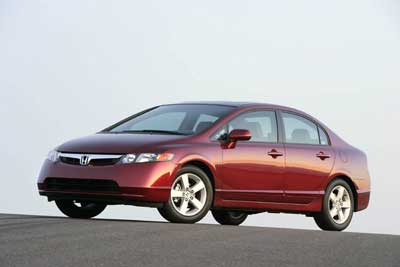
It’s called six degrees of separation, a theory of interconnectedness that first came to light in 1929 from the mind of Frigyes Karinthy. Then, in 1967, Stanley Milgram performed an experiment where Midwesterners had to send a package to a stranger in Massachusetts, knowing the name but not their address. The senders were forced to rely on friends and relatives who they thought would offer the best chance of getting the package delivered to the stranger. On average, six people were involved in delivering the package to its final destination. Though hard to believe, the Milgram experiment seemed to indicate that, despite the widespread population of hundreds of millions, we’re all only a few handshakes away from knowing each other. If the theory holds true for humans, it most certainly has to hold true for a particular car that’s been around for decades, the Honda Civic. Most of us can probably think of a Civic we’ve either owned ourselves or had in the family, but if not, chances are it doesn’t take more than a quick search through friends and their families, co-workers, or that guy you chat with when getting your morning coffee to find a Civic owner. They’re cars akin to a predicament – everyone seems to have been in one at some point. Honda’s little commuter car gained popularity during the gas crisis of the 1970’s when Detroit, still drunk on 1960’s muscle car success, found itself with a glut of guzzlers. The Civic entered the scene as a cute front-driver that motored happily on, requiring relatively few stops for fuel. Since then, the Civic has become a staple in the American family, providing basic yet reliable service, though recent models have been more than a touch bland, and until this year everyone’s favorite Honda had started to blend into the burgeoning compact car segment. However, with a fresh new look, a redesigned and contemporary interior, and a more potent powertrain, the 2006 Honda Civic aims to rise above the pack. Providing the needed momentum is a 1.8-liter, single overhead cam, 16-valve, i-VTEC four-cylinder engine that produces 140 horsepower at 6,300 rpm and 128 lb.-ft. of torque at 4,300 rpm, with power directed to the front wheels through a standard five-speed manual transmission or a five-speed automatic. The Civic sedan weighs about 2,700 pounds, rides on a MacPherson strut front suspension with a double wishbone setup in back, and offers an EPA-rated 38 mpg on the highway with the stick, and up to 40 mpg with the automatic tranny. Four-wheel antilock disc brakes are charged with stopping the Civic, and a variable-assisted rack-and-pinion steering system keeps all on the straight and narrow. All of that hardware comes standard on the most basic 2006 Honda Civic, the DX. Starting at $15,110 (including a $550 destination charge), these models come equipped with 15-inch steel wheels, a 160-watt sound system with a CD player, a tilt and telescopic steering wheel, a height-adjustable driver’s seat, a folding rear seat, power windows, and front-side and side-curtain airbags. A move up to the LX model, starting at $17,060, provides 16-inch steel wheels, body-color door handles and mirrors, air conditioning, an MP3 player, power locks, and cruise control with steering wheel-mounted buttons. EX models lie at the top of the model lineup and start at $18,810. Standard fare here includes 16-inch alloy wheels, a power sunroof, XM satellite radio, an exterior temperature gauge, and more. A navigation system can be had on the EX for $1,500, while all models may be outfitted with the five-speed automatic transmission for $800. For this evaluation, we spent a week covering several hundred miles of twisty canyons, city streets, and open highway in a 2006 Honda Civic EX sedan with the automatic transmission. Our tester stickered for $19,610 including destination, and was fully-loaded, with the exception of the navigation system.
Driving Impressions
Thom Blackett’s 2006 Honda Civic Driving Impressions: Hype, and lots of it. Before I had a chance to put it through its paces for myself, a few of my cohorts returned to the office, fresh from what they described as a thoroughly impressive jaunt in the 2006 Honda Civic sedan. These are “car” guys, and for them to be so enamored with this vehicle, an EX model , said a lot. What were they smoking? Admittedly, the new Civic, with its 140-horsepower four banger, offers more in the name of performance than its predecessor, and yes, this not-so-little-anymore Honda provides a comfortable and predictable ride, be it around town or on the open road. And who can complain about an average fuel economy rating of 33.2 mpg? Few outside of the hybrid arena, that’s who. Impressive as these points are, there are an equal number of quibbles that dull the Civic’s finish, if only a bit. That 1.8-liter engine provides adequate power for most situations, but punching the throttle for sudden highway moves can leave the driver wanting, especially given the five-speed automatic transmission’s sometimes lazy response to input. Equally confused was the steering, which gained heft at higher speeds on the highway, but not at the same speeds on sweeping corners. There’s really nothing like being in the middle of twisty only to find that the car can’t quite decide if it’s time to tighten the buckle or loosen the straps. But, to be fair, this is the EX sedan, not the Si coupe, and as such, stellar handling and a gutsy engine are not required. As a commuter car or everyday runabout, the 2006 Honda Civic provides all a driver needs, and won’t break the bank in the process. Brian Chee’s 2006 Honda Civic Driving Impressions: There’s not much flair. And, depending on the transmission you choose, there’s not much fun. But there’s a load of function, and maybe that’s what you should expect out of a car that goes for less than $20,000. If so, the 2006 Honda Civic delivers nicely, gets you from home to work and back, and accomplishes all the other tasks required of a commuter car. Point in fact, the Civic is a really, really easy car to drive – just get in and go, and your transport will be smooth and uneventful. And that is exactly what the Civic EX sedan is for – not for pitching up and down mountain roads or running autocross courses. If you want fun, buy the Si model. If you want to feel as though you’re alive, get the five-speed manual and stay away from the five-speed automatic transmission. Matched up to a vastly improved 140-horsepower engine, the automatic steamrollers whatever fun lives inside the engine, which is too bad, because Honda’s new motor is more powerful than the previous version. It’s also a shame because the Civic is quite buttoned down when it comes to ride and handling. The Civic handles corners pretty tightly, keeps its poise under hard braking or sudden movement, provides adequate feedback, and offers a decent driving product for the sub-$20,000 market. With the Civic, you get to feel more road in the right places – such as the steering wheel – better visibility and a super-efficient engine. That’s the stuff you want – what you can do without is a transmission that seems to smother the engine and too much wind and noise road on the freeway. Even for an economy car, conversations from back to front seat should not begin with … Ron Perry’s 2006 Honda Civic Driving Impressions: For a car that has received so many prestigious awards since its introduction, I was really disappointed with my drive of the Honda Civic. Maybe my displeasure came from the fact that our Civic was an automatic and not a manual. Granted, most buyers buy the automatic but after driving the Civic I can’t imagine why. The Civic lacks power below 4,000 rpm. On a few occasions while navigating traffic, I mashed the pedal to the floor to pass or make a lane change, and was met with a good second-long delay before the kickdown occurred. I also felt the steering response was too quick, and frequently found myself over-correcting in normal driving. Brakes work great and relay enough information to make any stop comfortable. The ride is firm but not to the point of being irritating. Is the new Civic that great of a car, or did it receive so many awards because it was the newest model in an aging category? I don’t feel as though this new car is that much better than my once treasured 1987 Civic Si hatchback. Christian Wardlaw’s 2006 Honda Civic Driving Impressions: Hundreds of thousands of people will buy the redesigned Honda Civic for no other reason than it has proven dependable over three decades of service to Americans as a transportation appliance. But a treat awaits those who choose this stunningly good little car. The 2006 Honda Civic is genuine fun to drive, even with an automatic transmission, endowed with responsive steering, beautiful brakes, sticky Bridgestone Turanza tires, and a magical suspension. Around town, the Civic is firm yet compliant. It is communicative, but in whispers about what’s happening under the tires rather than vociferous exclamations. You get just enough from the road surface to remain informed, but not so much as to feel pummeled. Take the Civic onto a favorite backroad, and it will play nice if not aggressively. Handling is entertaining and predictable, the Bridgestones emitting nary a squeal as you pitch the car from turn to turn. Steering is well-weighted and linear, but gets light in sweeping turns unless you pay attention at the tiller. Given the Civic’s outstanding performance on my twisty road loop, this is a minor issue – especially for a car that doesn’t bill itself as sport sedan. The 140-horsepower is spunky in around-town driving, can cruise capably at 80 mph on the freeway, but lacks passing power. The transmission is a grade-logic unit, assisting on downhill sections of road with added engine braking and holding gears for hill climbing. The only issue I had was with the selector itself. It’s easy to slide right past “D” and land in “D3.”
Comfort
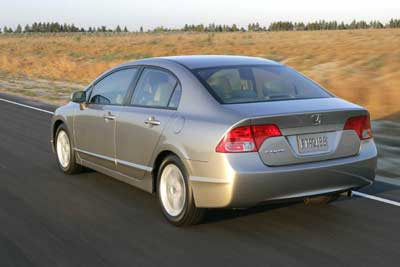
Thom Blackett’s Opinion of the 2006 Honda Civic’s Comfort: Honda obviously takes comfort seriously, as evidenced by firm yet comfortable front buckets that feature sufficient padding and bolsters, as well as a driver’s side manual height adjustment, and a folding rear bench seat that’s a bit softer, offers the same level of lateral support, and provides an ideal backrest position. Front passengers enjoy a padded center armrest that slides fore and aft, while each door includes padded upper sills and armrests. A tilt and telescoping steering wheel allows the driver to get comfy, and the contoured headliner squeezes out some extra headroom for those folks riding in back. Though the 2006 Civic Sedan lacks the power of the sportier Si coupe and the enveloping comfort of a Lincoln Town Car, it doesn’t take long before one feels right at home in this Honda, whether it’s behind the small and well-padded steering wheel or with your feet planted on the flat floor out back. Controls are easy to reach, there’s padding in the right places, the ride is quiet, the seats are supportive, and the suspension does a commendable job of smoothing over the rough patches. A 160-watt sound system helps pass the time and miles, or plug your MP3 player into the auxiliary jack on the lower dash to crank out your own library of tunes. Brian Chee’s Opinion of the 2006 Honda Civic’s Comfort: After about ten miles spent driving the Civic, I noticed a throbbing pain in my leg. Hmmm, I wondered to myself, did I pull something getting out of my chair? Maybe I tweaked something when I stretched to get that last piece of pizza in the fridge. Nope. It had to be the car. Hard to believe, but yes, the 2006 Honda Civic is a pain in the knee cap – if you like to place your right leg against the center console while you drive. If you do so, your knee will bang and rub up against the end of the parking brake, and you’ll be left wondering why it hurts so much to drive a new Civic. For a car so well put together in so many ways, this little problem stands out rather brightly. The easy solution, of course, is to wear a kneepad when you drive the Civic, which eliminates the problem and enables you to appreciate the finer aspects of a small car that feels a lot larger on the inside. No matter what your size, you should fit just fine, sitting on a nice firm seat covered with soft, plush material. There’s a ratchet mechanism to boost the seat up or down, and a recline adjustment. Legroom in the back is surprisingly ample, as is head room and shoulder room. Indeed, except for that nasty little knee bruise, the 2006 Honda Civic gives small cars a big, roomy reputation, and does it for many miles. Ron Perry’s Opinion of the 2006 Honda Civic’s Comfort: When it comes to interior comfort and support, not much has changed since owning my Si hatchback. Honda knows how to build comfort and support into their vehicles. The seats are well bolstered and all of the controls are well placed. The biggest change is the new dash layout. It works great and I really like the instrument panel display. Honda has also moved the e-brake into a very convenient space next to the shifter at the front of the console, keeping it out of the way. The rear seat area feels spacious, with adequate knee and headroom. The only interior fault I found a lack of a rear seatback release inside the car. It is located in the trunk. There should be one on the seat as well for convenience. Christian Wardlaw’s Opinion of the 2006 Honda Civic’s Comfort: The 2006 Honda Civic is a terrific car, but I would never buy one. The reason I would never buy one is simple: the location of the hand brake lever. Situated just to the left of the gear selector, the hand brake lever is a compact design that frees up plenty of space in the center console for a giant storage bin covered by a useful armrest, two American-sized cupholders to hold American-sized drinks, and a small tray perfect for a cell phone. Trouble is, the hard plastic end of the hand brake lever digs into a bone on the side of my knee when I’m driving, and after awhile it hurts. To own a 2006 Honda Civic, for me, would be a constant irritation. Try one on for size. If the hand brake lever doesn’t bother you, there’s nothing to complain about here. The front seat is adjustable for height, the steering wheel tilts and telescopes, the upper door panel is designed to serve as spot to rest your elbow, and the center armrest is softly padded. I could use a little bit more seat track travel for my 33-inch inseam – and this would likely alleviate the parking brake handle issue – but otherwise the Civic will suit most folks just fine. Even the rear seat is roomy enough for tall people, especially with the EX model’s center armrest deployed, though the hard plastic front seatbacks could be unkind to backseat passengers if those in the front insist on rolling gangsta-style.
Quality
Thom Blackett’s Opinion of the 2006 Honda Civic’s Quality: It’s Honda’s own fault. For years, the company has successfully shared the quality crown with Toyota, much to the chagrin of executives at GM, Ford, and countless others. It’s under the shadow of that vaulted bar that the 2006 Honda Civic looks a little rough around the edges. Yes, this is a well-built car, but what’s with the loose A-pillar covers, the inconsistent grains and textures on the dash, the wavy door panels, the misaligned trunk lid, and a front fascia that feels ready to pop off? Factor in the flimsy emergency brake handle, kick panels and rocker panels of differing shades of gray, and the upscale mesh headliner does little to offset the negatives. In any other car, these might be minor if not unexpected issues, but when you’re charged with setting the benchmark, less than 100 percent just doesn’t fly. Brian Chee’s Opinion of the 2006 Honda Civic’s Quality: No other automaker does small car quality like Honda. Practice makes perfect, to be sure, and Honda has sold a ton of Civics to Americans. No surprise there. We Americans who live on a budget like seeing how far George W. will stretch, and the Civic is one great way to make the most of our earnings. The 2006 model takes the concept of quality for less than $20,000 to a higher level, starting with strong basics like fit and finish and capping it off with a nicely appointed interior that features a mesh headliner, superb cloth seats and plastics that look good, fit together nicely, and – most importantly – feel good on the fingertips. When you combine that with Honda’s reliability record and powertrain track record, the quality of the 2006 Civic should remain high for years. After all, it’s not what a car looks like on the showroom floor, but what it drives like 50,000 miles later. Ron Perry’s Opinion of the 2006 Honda Civic’s Quality: This is where Honda shines. After all, it is a Honda. Even the lower level cars in the Honda lineup have a quality feel. The Civic makes good use of cloth and plastic, and even the plastic pieces that are intended to look like metal feel good. I saw no fit and finish flaws, nor did I hear squeaks and rattles. The climate and radio control knobs are done in a faux metal finish as well and their design makes adjusting easy without much visual assistance. Outside it is the same. Good panel fit, smooth paint and no loose trim pieces. Quality is why the Civic has the reputation it has. Christian Wardlaw’s Opinion of the 2006 Honda Civic’s Quality: As soon as you settle in behind the futuristic dashboard, twist the key in the ignition, choose a gear, and set off down the road, the 2006 Honda Civic EX Sedan strikes you as a car you could buy, happily drive for ten years with little out-of-pocket expense, and then sell while the styling is still contemporary. The Civic oozes quality like a teenager does hormones. Inside, the plastics, the fabrics, and the assembly quality are first-rate. Outside, the parts and panels fit together seamlessly. Use the buttons and knobs on the dashboard, and you’d guess the car cost triple what the sticker price says. The Civic is rock solid in all respects, imparting the quality and attention to detail normally bestowed upon luxury automobiles. And check out that luminescent blue tachometer at night, which looks like it came straight out of an Acura. If not for the odd rumbling that came from the rear of our test sample – we suspect a flat-spotted tire – nothing about the 2006 Honda Civic would cause pause before setting off on a cross-country cruise.
Design
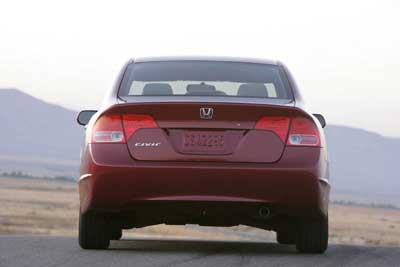
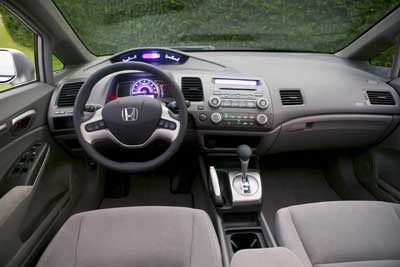
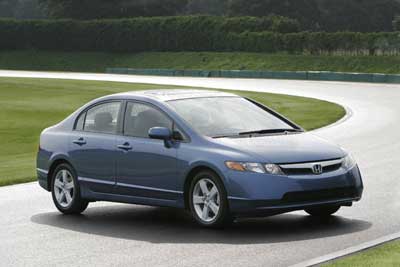
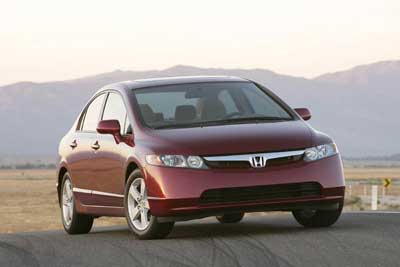
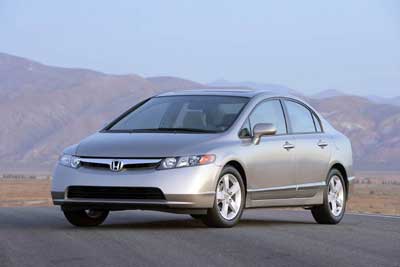
Thom Blackett’s Opinion of the 2006 Honda Civic’s Design: Somebody ought to make beer goggles for car buyers. Back in college, countless inebriated guys and gals found themselves matched up with the hottest bod in that particular establishment, only to sober up and see a hairy lump in the kitchen cooking breakfast, smiling with those three gnarly teeth. Kinda like buying a 2006 Honda Civic at night and rubbing your eyes as you peer into the driveway the next morning. Inside, the look is pleasant, with muted tones, well-placed chrome accents, steering-wheel mounted controls that are illuminated and easy to use, and a split gauge cluster that, after acclimation, proves to be quite handy. But outside, the Civic looks like a Hollywood movie designer’s attempt at creating the funky commuter car of 2025, with nary a sharp edge to be found, thinly wedged headlights, and a rather blunt rear end. Brian Chee’s Opinion of the 2006 Honda Civic’s Design: Call it quirky, futuristic, stylish…whatever you want to say that makes you feel better about buying into a car that, while smartly designed in many ways, takes a little getting used to when it comes to the more practical elements of design. Consider the instrument panel: Completely redesigned, the digital mph readout is on top and centered in front of the driver, while a large round rpm gauge is also centered, and just below the speedo. That’s nice. It’s cute, really it is, but confusing: which one do we use? As we’re not driving a zippy little performance car, and most people will likely buy the Civic with the automatic transmission, the size of the tach seems a bit like wasted space. There is also the green house effect: on a hot day, all that glass surrounding the driver and passenger heats up the car pretty quickly, a problem if you don’t care to run the A/C all the time. For back seat occupants this is especially problematic, as there are no rear vents. The depth of the dash also takes a little getting used to, as it puts you farther away from the nose of the car. That’s a great aspect of the new design, as a matter of fact, but it does take a little getting used to. Ron Perry’s Opinion of the 2006 Honda Civic’s Design: I wasn’t bowled over by the new Honda Civic’s design when it was released and since then it still hasn’t grown on me. The steeply raked windshield looks out of place and creates two issues that definitely bother me. First are the useless little quarter windows at the A-pillar. They are likely a design element put there to reduce the heaviness of the A-pillar, but they look out of place to me because they don’t seem to serve a purpose. The other is the acreage on top of the dash – although Honda has made good use of it with the new instrument panel layout. Honda seems to have intentionally gotten away from conservative design, and for that I praise them, but this Civic might be too far ahead of its time. It may take a while for appreciation of the design to come around. Christian Wardlaw’s Opinion of the 2006 Honda Civic’s Design: With the redesigned 2006 Civic, Honda sheds conservatism and restores its popular little car’s former trend-setting status. In the 1980s, every new Civic pushed the design envelope by marrying simplicity and functionality with a distinctive yet timeless appearance. In the 1990s, redesigned Civics were on the bland side as Honda tried to appeal to a more conservative customer. A glance at the 2006 version makes it clear that this is a game-changing automobile. It will take some time for the general public to accept the new Honda Civic’s styling. It is advanced and purposeful, yet rakish and sporty – especially for a small four-door sedan. The interior is equally off-putting at first, but after using it for hundreds of miles, it is impressively useful. That funky digital gauge cluster at the base of the windshield might not be aesthetically pleasing, but it’s extremely easy to check speed and fuel without looking too far away from the road. That small steering wheel might seem undersized at first, but it’s wonderful to grip for long stints behind the wheel. And the controls are within easy grasp, large and clearly marked for quick reference and ease of use.
Advice
Thom Blackett’s Advice about the 2006 Honda Civic: This scribe is putting money on the idea that most buyers will opt for this car because of its name and where it comes from – a Honda factory. They don’t care that $20,000 buys more driving enjoyment, or more room, or better looks, or a better warranty. It’s a Civic, a model that has been owned by everyone’s family member at least once in the past few decades, and it’s built by Honda, a company synonymous with rock-solid reliability. That fact alone should move tens of thousands of units. If you need more reasons to look at the Civic, consider that it gets 33 mpg in mixed driving (that’s our actual test figure, not one of those pie-in-the-sky EPA numbers), has a comfortable and spacious cabin, comes fully-equipped with a navigation system and a power sunroof for just a hair over $21,000, is backed by a five-year/60,000-mile warranty, and comes standard with front-side and side-curtain airbags. From a practical standpoint, the Civic sedan is a no-brainer, but if driving fun and less funky styling are tops on your list, consider the Civic Si or one of the lesser-known competitors. Brian Chee’s Advice about the 2006 Honda Civic: Few things are as spectacular as an automotive editor on fire for a car. When we get it into our heads that a car is good – nae, great – we will go to great lengths to promote it. The 2006 Honda Civic, with its futuristic style and super-efficiency, is an excellent example of journalistic love run amok: listen to the editors around here and you’ll think that the Civic is going to save the world. Not quite. A good car, yes. Good enough to be Car of the Year. But like that nasty little tick your friends ignore, there are a few issues with this newest darling that creep up on drivers slowly, until the day comes when they look at their pretty little Civic and think to themselves, Okay – maybe not, so much. But buyers of the Civic, while loving the room, the interior layout and the efficiency of the powertrain, will not be thrilled with the environmental chaos of all that glass, a parking brake from hell or the utter lack of fun in the powertrain, courtesy of a killjoy automatic transmission. Overall, however, the value of the Civic is beyond reproach: for less than $20,000, you will hard-pressed to find a better proposition. Sometimes, however, even a masterpiece takes a little getting used to. Ron Perry’s Advice about the 2006 Honda Civic: Come on, it’s a Honda, where can you go wrong? There may be a few nit-picky things I don’t like about the car but as an overall package in this price range it is a contender that is near impossible to top. Quality, reliability, comfort and good fuel economy are all reasons to buy one. If I was restricted to this category, I would most likely be driving a Civic – but it would be a five-speed manual. Christian Wardlaw’s Advice about the 2006 Honda Civic: The 2006 Honda Civic is a smart choice. It’s roomy, fun, comfortable (except for that darned parking brake handle), stylish, fuel efficient, and if history is any indicator, durable. Plus, the Civic is a safe car, getting a Gold Pick rating from the Insurance Institute for Highway Safety. Our EX test car didn’t have navigation and carried a sticker near $20,000, which is high for a small sedan like this. But sometimes you do get what you pay for, and the Honda Civic is well worth the price of admission.
Specifications
Test Vehicle: 2006 Honda Civic EX Sedan Price of Test Vehicle: $19,610 (including a $550 destination charge) Engine Size and Type: 1.8-liter four-cylinder Engine Horsepower: 140 at 6,300 rpm Engine Torque: 128 lb.-ft. at 4,300 rpm Transmission: Five-speed automatic Curb weight, lbs.: 2,804 EPA Fuel Economy (city/highway): 30/40 mpg Observed Fuel Economy: 33.2 mpg Length: 176.7 inches Width: 69 inches Wheelbase: 106.3 inches Height: 56.5 inches Leg room (front/rear): 42.2/34.6 inches Head room (front/rear): 38.1/36.7 inches Max. Seating Capacity: 5 Max. Cargo Volume: 12 cubic feet Competitors: Chevrolet Cobalt, Ford Focus, Hyundai Elantra, Kia Optima, Kia Spectra, Mazda 3, Mitsubishi Lancer, Nissan Sentra, Pontiac Vibe, Saturn Ion, Subaru Impreza, Suzuki Aerio, Suzuki Forenza, Suzuki Verona, Toyota Corolla, Toyota Matrix, Volkswagen Golf, Volkswagen Jetta
Photos courtesy of American Honda