
Recent Articles
Popular Makes
Body Types
2007 GMC Yukon Denali
Get Pricing$47,780 Starting MSRP
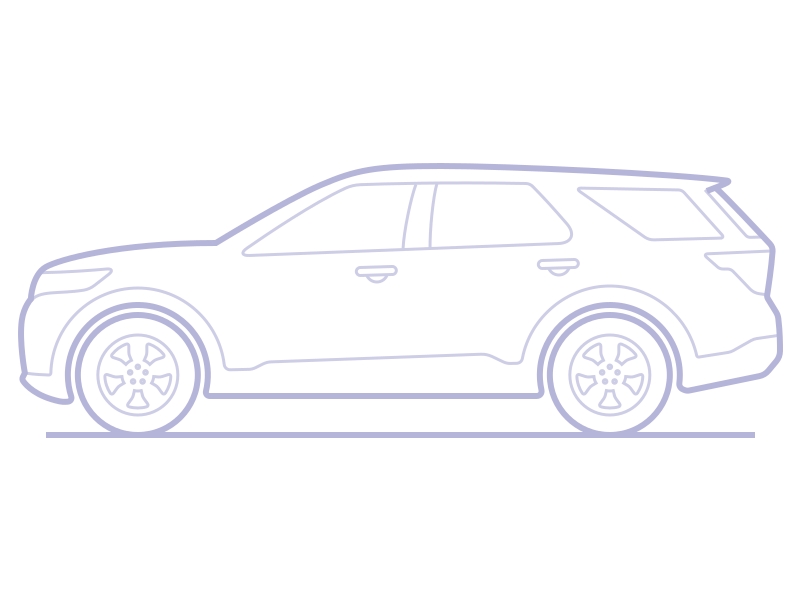
Model Highlights
Body Type
SUV
Transmission
Automatic w/OD
Seatings
7 Seats
`
Get a New Car Quote
Overview
GMC's 2007 Yukon series consists of the half-ton Yukon model, the half- and three-quarter-ton Yukon XL, and a Denali in both Yukon and Yukon XL guises. Both two- and four-wheel drive are available on the Yukon and Yukon XL, and the Denali is an...

Looking for alternatives to the GMC Yukon Denali?
Start Comparing NowSpecs
Mileage
EPA Fuel Economy Est - City (MPG): 13
EPA Fuel Economy Est - Hwy (MPG): 19
Electrical
Cold Cranking Amps @ 0° F (Primary): - TBD -
Cold Cranking Amps @ 0° F (2nd):
Maximum Alternator Capacity (amps): 160
Maximum Alternator Watts: - TBD -
Cooling System
Total Cooling System Capacity (qts): - TBD -
Weight Information
Gross Axle Wt Rating - Front (lbs): 3550
Gross Axle Wt Rating - Rear (lbs): 4100
Curb Weight - Front (lbs): 2872
Curb Weight - Rear (lbs): 2524
Gross Vehicle Weight Rating Cap (lbs): 7100
Gross Combined Wt Rating (lbs): 14000
Trailering
Dead Weight Hitch - Max Trailer Wt. (lbs): 5000
Dead Weight Hitch - Max Tongue Wt. (lbs): 500
Wt Distributing Hitch - Max Trailer Wt. (lbs): 7900
Wt Distributing Hitch - Max Tongue Wt. (lbs): 1185
Fifth Wheel Hitch - Max Trailer Wt. (lbs):
Fifth Wheel Hitch - Max Tongue Wt. (lbs):
Suspension
Suspension Type - Front: Coil-over
Suspension Type - Rear: Multi-Link Coil
Spring Capacity - Front (lbs): 3250
Spring Capacity - Rear (lbs): 4100
Axle Type - Front: Independent
Axle Type - Rear: Semi-floating
Axle Capacity - Front (lbs): 3925
Axle Capacity - Rear (lbs): 4200
Axle Ratio (:1) - Front:
Axle Ratio (:1) - Rear: 3.42
Shock Absorber Diameter - Front (mm): 46
Shock Absorber Diameter - Rear (mm): 46
Stabilizer Bar Diameter - Front (in): 1.41
Stabilizer Bar Diameter - Rear (in):
Brakes
Brake Type: Power
Brake ABS System: 4-Wheel
Brake ABS System (Second Line):
Disc - Front (Yes or ): Yes
Disc - Rear (Yes or ): Yes
Front Brake Rotor Diam x Thickness (in): 13.0 x 1.2
Rear Brake Rotor Diam x Thickness (in): 13.6 x 0.8
Drum - Rear (Yes or ):
Rear Drum Diam x Width (in):
Tires
Front Tire Order Code: QXK
Rear Tire Order Code: QXK
Spare Tire Order Code: ZVL
Front Tire Size: P265/65R18
Rear Tire Size: P265/65R18
Spare Tire Size: P265/70R17
Front Tire Capacity (lbs): 2105
Rear Tire Capacity (lbs): 2105
Spare Tire Capacity (lbs): - TBD -
Revolutions/Mile @ 45 mph - Front: - TBD -
Revolutions/Mile @ 45 mph - Rear: - TBD -
Revolutions/Mile @ 45 mph - Spare: - TBD -
Wheels
Front Wheel Size (in): 18 x 8
Rear Wheel Size (in): 18 x 8
Spare Wheel Size (in): 17 x - TBD -
Front Wheel Material: Aluminum
Rear Wheel Material: Aluminum
Spare Wheel Material: Steel
Steering
Steering Type: Pwr
Steering Ratio (:1), On Center: - TBD -
Steering Ratio (:1), At Lock:
Turning Diameter - Curb to Curb (ft): 39.0
Turning Diameter - Wall to Wall (ft): - TBD -
Frame
Frame Type: Ladder
Fuel Tank
Fuel Tank Capacity, Approx (gal): 26
Aux Fuel Tank Capacity, Approx (gal):
Fuel Tank Location:
Aux Fuel Tank Location:
Doors
Side Door Type:
Exterior Dimensions
Wheelbase (in): 116.0
Length, Overall w/rear bumper (in): 202.0
Width, Max w/o mirrors (in): 79.0
Height, Overall (in): 77.0
Overhang, Front (in): - TBD -
Overhang, Rear w/bumper (in): - TBD -
Ground to Top of Load Floor (in): - TBD -
Ground Clearance, Front (in): - TBD -
Ground Clearance, Rear (in): - TBD -
Rear Door Opening Height (in): - TBD -
Rear Door Opening Width (in): - TBD -
Side Door Opening Height (in):
Side Door Opening Width (in):
Step Up Height - Front (in): - TBD -
Step Up Height - Side (in): - TBD -
Cargo Area Dimensions
Cargo Area Length @ Floor to Console (in):
Cargo Area Length @ Floor to Seat 1 (in): - TBD -
Cargo Area Length @ Floor to Seat 2 (in): - TBD -
Cargo Area Length @ Floor to Seat 3 (in): - TBD -
Cargo Area Length @ Floor to Seat 4 (in):
Cargo Area Width @ Beltline (in): - TBD -
Cargo Box Width @ Wheelhousings (in): - TBD -
Cargo Box (Area) Height (in): - TBD -
Cargo Volume to Seat 1 (ft³): 108.9
Cargo Volume to Seat 2 (ft³): 60.3
Cargo Volume to Seat 3 (ft³): 16.9
Cargo Volume to Seat 4 (ft³):
Interior Dimensions
Passenger Capacity: 7
Front Head Room (in): 40.3
Front Leg Room (in): 41.3
Front Shoulder Room (in): 65.3
Front Hip Room (in): 64.4
Second Head Room (in): 39.2
Second Leg Room (in): 39.0
Second Shoulder Room (in): 65.2
Second Hip Room (in): 60.6
Third Head Room (in): 37.9
Third Leg Room (in): 25.6
Third Shoulder Room (in): 61.7
Third Hip Room (in): 49.1
Summary
Vehicle Name: GMC Yukon Denali
Body Style: 4 Door
Body Code: E61
Pricing
This model has 1 trim.
| MSRP | $47,780 |
|---|---|
| Invoice | $43,718 |
| Description | 6.2L/378, 380 @ 5500, Automatic w/OD |
Fuel Economy
This model has 1 trim.
| City | 13 MPG |
|---|---|
| Hwy | 19 MPG |
| Combined | undefined MPG |
| Description | 6.2L/378, 380 @ 5500, Automatic w/OD |
Trending Related Articles
`
Get a Free Online Car Quote
©2024 AutoWeb, Inc. All Rights Reserved.
Some content provided by and under copyright by Autodata, Inc. dba Chrome Data. © 1986-2024.