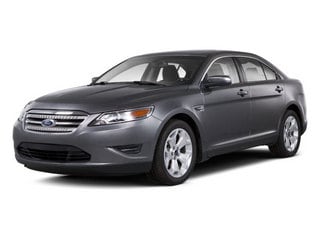
Road Test: 2010 Ford Taurus SHO
Although the redesigned Taurus made its grand debut with us the day before, the highlight of our trip to North Carolina was getting to witness first-hand the rebirth of the legendary Taurus SHO. The fourth generation of the Taurus SHO is very different from the preceding generations in that it is much larger, features standard all-wheel driver and now boasts well over 300 horsepower - previous SHOs, including the V-8-powered 1996-99 model, could only muster up between 220 and 235 horsepower. One area the 2010 SHO is identical to its predecessors is the understated design that makes it a 'sleeper.' Ford couldn't have chosen a better venue to showcase the performance and handling abilities of the 2010 SHO than the historical and scenic Blue Ridge Parkway.
While the standard Taurus is aimed to compete against everyday full-size sedans, the return of the SHO should put some pressure on performance-minded, V-8-powered sedans such as the Pontiac G8 GT, Chevrolet Impala SS and the Chrysler 300C. Compared to the base Taurus SE, the 2010 Taurus SHO's starting MSRP of $37,995 may seem like quite a price hike, but that price includes all-wheel drive, the EcoBoost engine and a host of standard technology features not available on the base Taurus model. The particular car we drove added a few additional options for a total as-tested price of $45, 175.
2010 Ford Taurus SHO Exterior
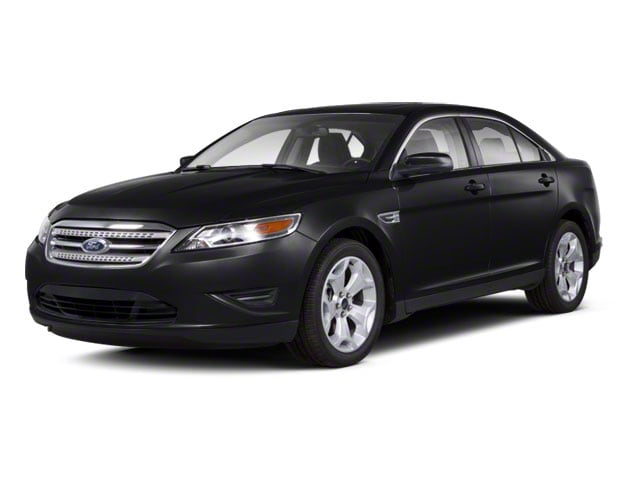
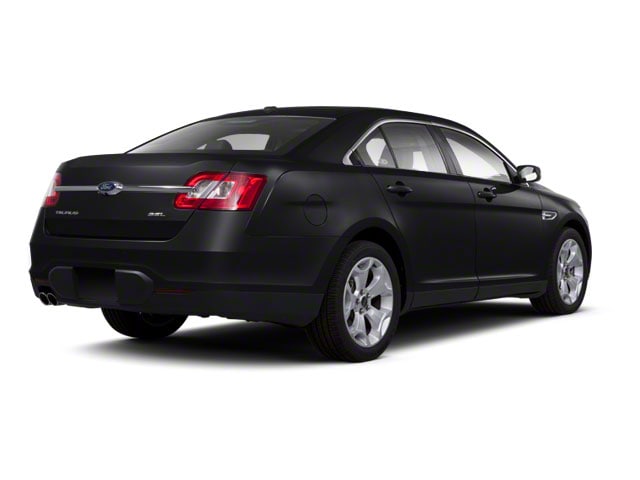
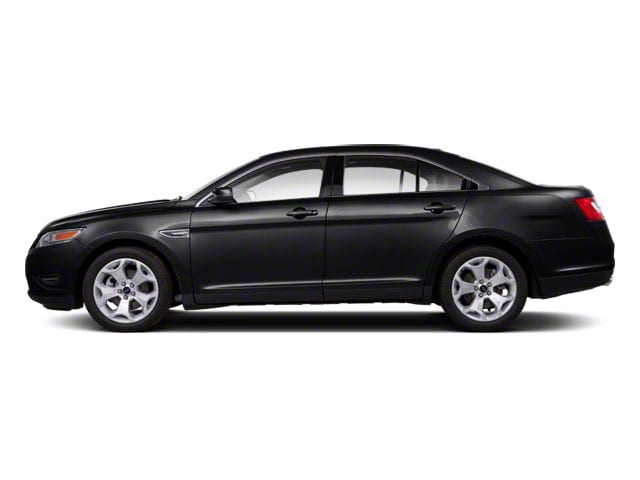
Like the previous three models, the 2010 SHO stays true to the car's sleeper image by adding only subtle changes and relatively small badges compared to the lesser Taurus model. Ford only made minimal changes to the Taurus' muscular, athletic stance such as unique treatments on the grille, lower marker lights and side sills, while the 20-inch, five-spoke wheels, decklid spoiler and chrome-tipped dual exhaust outlets help give away the car's sportier nature. Other high-performance, factory-tuned vehicles usually have large badges to signify their presence, but the 2010 SHO has two small, chrome 'SHO' badges on the lower C-pillar and another on the trunk above the EcoBoost logo. Our test car came in the SHO-exclusive Atlantis Green Metallic which is a nod to the original SHO's exclusive Deep Jewel Green Clearcoat Metallic. In the right light, this color looks about the same as the available Tuxedo Black, but once the sun hits it at the right angle the green hue is instantly apparent. The matching luster-nickel finish on the grille and the optional wheels is less flashy than the chrome accents of the Taurus Limited we had driven the day before. Besides the obvious badging, the easiest way to tell the SHO apart from other Taurus models is the luster-nickel finish of the marker lights and dual exhaust outlets.
2010 Ford Taurus SHO Interior
Compared to understated styling on the SHO's exterior, its cabin couldn't be any different. As would be expected, the layout of the cabin is identical to the other Taurus models, but the appearance of just about all surfaces has changed dramatically. The day before, our Taurus Limited had an elegant interior full of lightly colored leather and rich wood accents, but the SHO had Charcoal Black leather seats with contrasting Umber (orange) leather inserts on the seats and door panels. The wood grain instrument panel accents were replaced by aluminum inserts, while the Limited's aluminum center stack and center console trim was replaced by stylish piano black trim. As a finishing touch, the SHO gets a unique, sport-wrapped steering wheel and SHO embroidered floor mats. One thing we were disappointed about was the fact that all Taurus models feature identical instrument gauges - this would have been a good opportunity to set the SHO apart from the lower Taurus models by using something like sporty, white-faced gauges or at least a higher redline or speedometer.
Either way, the experience behind the wheel was enjoyable during our time behind the wheel. Ford aimed to keep the SHO feeling luxurious despite its sports sedan persona by opting not to equip it with harder sport bucket seats. On our drive with the Taurus Limited, we noted the firmness in the front seats when it came to side bolstering, so apparently Ford engineered all Taurus models to offer the same level of front passenger support. One thing that the 2010 SHO we tested had that the Taurus Limited didn't (although it was available) was the optional multi-contour seats which are said to reduce driver fatigue and discomfort on long trips. Both front seats get seven individual air chambers that automatically inflate and deflate dependant upon the seating position of the driver and front passenger. At first, the changes were obvious, but after a couple hours the changing seats became almost unnoticeable. After about equal drive times and conditions behind the wheel of Taurus models with and without the multi-contour seats, it was easy to see the reduction in discomfort to the legs and back afforded to this new technology.
2010 Ford Taurus SHO Performance & Handling
Since the original SHO focused on a high-output engine, it is fitting that Ford used the 2010 to officially launch the EcoBoost engine to the public. The 1989 Ford Taurus SHO was born after a development program to build mid-engine sports car featuring a Yamaha-built V-6 had been cancelled. Ford decided to use this 220-horsepower engine in the first two generations of the SHO before switching to a 235-horsepower V-8 in 1996. After a 10-year hiatus, the SHO is finally back and now packs the highly-touted, Ford-developed 3.5-liter EcoBoost twin-turbo V-6 tuned specifically for the SHO to produce 365 horsepower and 350 lb-ft of torque - more than the Audi A6 that Ford used as a benchmark for its new flagship sedan. All 2010 SHO models will come standard with a six-speed SelectShift automatic transmission and all-wheel drive.
Ford even brought out a few examples of the 2009 Audi A6 4.2 and 2009 Chrysler 300C AWD for comparative driving impressions. In terms of handling, the SHO was about on par with the $61,000 A6 and outperformed the $40,000 300C AWD by a noticeable margin. Between high-speed runs on North Carolina's Interstate-40 and the sharp corners of the tightly wound Blue Ridge Parkway, the retuned suspension and transmission add impressive performance to this 4,368-pound sedan. At high speeds, the car accelerates quick and smooth with none of the lag usually associated with turbocharged engines, but the true pleasure was testing out the Electronic Power Assisted Steering (EPAS) that required little effort in turning the big sedan in the winding mountainous roads. One factor helping to eliminate the turbo lag was the fact that Ford designed the EcoBoost to deliver the full 350 lb-ft of torque early at 1,500 rpm and lasting up through 5,250 rpm meaning that the torque curve is more like a torque plateau. For improved performance, Ford also retuned the SelectShift transmission for SHO duty to provide quicker shifts and rev-matching downshifts.
In the comparison test drive between the SHO and the A6 4.2, Ford's EPAS steering felt just as responsive and precise as the Audi, although the high-revving V-8 emits a much more imposing exhaust note. Ford did not officially release 0-60 mile per hour times, but claimed that the 2010 SHO is 0.8 seconds faster than the A6 4.2 and 0.3 seconds faster than the 300C. In less than scientific conditions we averaged acceleration to the magical 60 mph mark in the mid five-second range.
As precise and responsive as the SHO's suspension is, Ford says that there will also be an optional Performance Package to tighten things up a bit more. Pricing has yet to be determined for the optional Performance Package, but it will give the SHO a performance brake system, tighter EPAS, 3.16 final drive ration and standard 20-inch wheels. The standard AdvanceTrac® Electronic Stability Control will also be return allowing it to be turned off to have less restriction on the EcoBoost's power during track racing. The Taurus SHO may be the first application of the EcoBoost engine to hit showrooms, but three other cars are planned for the immediate future (Lincoln MKS, Lincoln MKT and Ford Flex) before the technology spreads to 90 percent of the vehicles at Ford Motor Company by 2013.
When it comes to fuel economy, though, the 2010 SHO has a definite edge against Ford's chosen comparative sedans. Both powered by V-8s, the 2009 Audi A6 4.2 is rated at 16 miles per gallon in the city and 24 mpg on the highway, while the 2009 Chrysler 300C AWD gets the same 16 mpg in the city and slightly better on the highway with 24 mpg thanks to cylinder deactivation. Ford says that the Taurus SHO will get 17 mpg city and 25 mpg highway.
2010 Ford Taurus SHO Safety
The 2010 Ford Taurus SHO has yet to be tested by either the National Highway Traffic Safety Administration (NHTSA) or the Insurance Institute for Highway Safety (IIHS), but Ford expects its new flagship sports sedan to exhibit the same class-leading safety that the 2009 Taurus has. The 2010 Taurus SHO comes standard with six airbags and a tire pressure monitoring system in addition to Ford-exclusive features such as SOS Post Safety Crash Alert System and AdvanceTrac® Electronic Stability Control with anti-lock brakes (ABS) and all-speed traction control. Optional safety features will include Adaptive Cruise Control, Collision Warning with Brake Support, Blind Spot Information System with Cross Traffic Alert and rain-sensing windshield wipers.
Summary
Back for a fourth go around, the 2010 Ford Taurus SHO is a true sports sedan offering a powerful engine, impressive performance and enough interior room for five adults. Ford's rebirth of the performance-tuned SHO for 2010 not only shows that it has been listening to fans, but also that it is keen on taking on automakers, such as Audi and BMW, once thought untouchable by any Ford product. Without stepping on the shoes of any Lincoln product, the 2010 Ford Taurus SHO offers enough acceleration, handling and luxury to compete against comparable sedans from the United States and Japan as well as Germany. It has yet to be seen if the new Taurus (including the SHO) can regain its crown as best selling car in North America, but the all-new Taurus SHO should definitely be a top contender for the 2010 North American Car of the Year.