Introduction
Introduction
Ford Focus – 2008 First Drive: A “killer app” is something so useful it makes something else indispensable. For example, in the 70s, computers were just toys for geeks. Then Visicalc came along, a spreadsheet program that gave accountants and bond traders an indispensable tool. Macintosh computers were little more than nifty toys until Aldus PageMaker practically invented the industry of desktop publishing. Today, iPods are the killer app for downloaded music and movies, making entertainment portable and personal in a way never before imagined.
The last brings us to the 2008 Ford Focus. The Focus has its own killer app, one that could, at least for a time, help it rule the small car segment. This isn’t because the car itself is revolutionary. No, the mechanical reality is that it’s a reengineered version of the original 2000 Focus platform. Instead, the true value of the Focus is in a $395 option called Sync. Developed with Microsoft, it pairs up devices such as digital music players, cellular phones and even simple USB “thumb drives” in a way that makes them accessible, easy and actually fun to use with the on-board audio system in a way no other manufacturer does.
Take away Sync and it gets harder to recommend the Focus in the face of newer and better competition. For example, the Honda Civic is bigger and drives nicer, the Hyundai Elantra has a higher quality interior and lower price, and even though it’s long in the tooth, the Toyota Corolla is still an excellent value, and one that’s due for replacement this spring.
Still, if you think the new Focus’s styling is perfect rather than peculiar, and don’t mind some cheap-feeling plastics inside, you’ll find that the Focus is good basic transportation for not too much money. For others, they’ll just have to overlook those shortcomings if they want the Focus’s best feature: Sync.
Origins
The Focus replaced the Escort as Ford’s small car entry way back in 1999 as a 2000 model. Its edgy styling and European-inspired driving dynamics made it a quick hit, and the Focus sold well despite early teething troubles. As the bugs were ironed out, the Focus continued to do well, and was mildly refreshed in 2005 with re-creased sheetmetal and an improved interior, but still didn’t quite measure up to newer competition. The 2008 Focus is still based on this same platform, however Ford has updated it considerably, hoping it will entice enough customers back to showrooms to keep the Focus a player until another world platform debuts in a few years.
Page 2
Page 2 of 8
Model Mix
There are two body styles and three trim levels in the 2008 Ford Focus. The wagon and hatchback versions are long gone, leaving only a sedan and a new coupe in the lineup. All three are available in S, SE and top of the line SES trim. The S features power windows, locks, air conditioning and six airbags, and is likely what you’ll get when you opt for the bargain package at the airport rental counter. SE and SES trim levels up the ante considerably, with a faux chrome fender vent outside and more impressive options packages, including Sync. All models come with the same 140-horsepower 2.0-liter four-cylinder engine, mated to either a five-speed manual or a four-speed automatic transmission; the engine is rated as PZEV in California and other states that have the same emissions regulations. Air conditioning is standard, as are front passenger seat side impact air bags, side curtain air bags and the government-mandated tire pressure monitoring system.
Pricing
Ford is pricing the Focus aggressively, but not at the basement. The base model S coupe starts at $14,695 while S sedans come in at $14,995; those prices include the $620 destination charge. SE coupes and sedans are an additional $1,000 each, and the top-line SES coupe and sedan – with standard Sync – start at $16,695 and $16,995, respectively. In SE models, Sync is a $395 option. Prices for individual options have not yet been released, but our loaded SES sedan with an automatic transmission, Audiophile audio system, moonroof, alarm, anti-lock brakes, traction control, ambient interior lighting and Sirius satellite radio clocked in at a reasonable $20,775.
Page 3
Page 3 of 8
Outside
The new Focus was introduced at the Detroit Auto Show in January of this year to decidedly mixed reviews. Criticism was so harsh that Ford actually went back to the drawing board, restyling the nose slightly and also changing some of the interior trim. The changes are subtle though, and the overall design hasn’t changed much from that Detroit prototype.
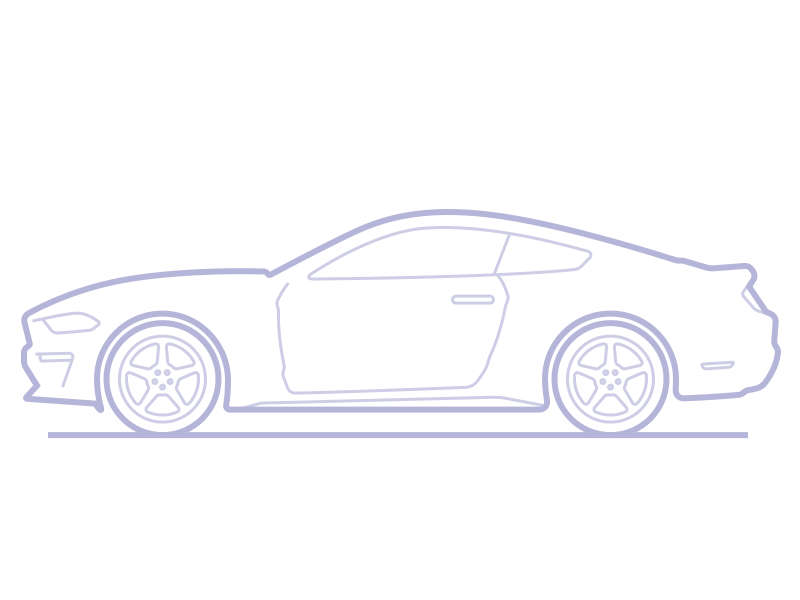
The wagon and hatchback versions are gone, with only the sedan and a new coupe in the lineup. The best angle on the redesigned Focus is probably the profile, which retains the wedgy shape of the original car. The newly scalloped sides are a nice touch, although the chrome faux fender vents behind the front wheels look like a heavy handed afterthought. From pretty much any other angle, however, the Focus is peculiar. The headlights are slits, styled to echo the two-bar chrome grille, but instead look more like those louvered sunglasses that were briefly popular in the 80s. The front bumper protrudes oddly, and the sculpting on the hood is not particularly flattering. The rear isn’t any better. The taillights are too small compared to the rest of the trunk lid, and the rear bumper sports the same odd protruding angle. The “FOCUS” spelled out in oversized lettering in the middle of the trunk lid looks out of place. The 2008 Ford Focus is certainly distinctive, but probably not in the way Ford hoped.
Inside
If you can get past the exterior and sit inside the Focus, you’ll find a neatly styled interior. The new dash uses a minimum of panels for a clean look that’s mostly devoid of cut lines. Large silver-painted panels make up the center of the dash face and much of the center stack in SES models, but it all works well and isn’t as garish as it sounds. A set of control knobs unique to the Focus pokes out from the center stack; they look a little lost in the vast expanse of silver-toned plastic, but it’s a logical layout that works very well. The seats are available in leather in SES models, and feature contrast stitching, a nice touch. The downside is in materials selection. Compared even with the much older Toyota Corolla, the Focus’s plastics feel cheap thanks to their shiny finish and peculiar grain. The cheap headliner and sun visors also reek of cost cutting.
Under the Hood
The only powertrain available in the Focus is a mostly carryover 2.0-liter four-cylinder. The 140 horsepower engine makes three more horsepower thanks to better intake and exhaust tuning, and in California, New York, Vermont, Connecticut, Massachusetts, Rhode Island, Maine and New Jersey, the Focus is certified as a Partial Zero Emissions Vehicle (PZEV), albeit with an eight horsepower penalty. The engine can be mated to a four-speed automatic or five-speed manual transmission. More power wasn’t as important to Ford’s engineers as were sound deadening and fuel economy, and on those fronts the Focus does well. We found the engine to be quiet (for this class at least) during acceleration, getting rough and intrusive only near redline. Fuel economy was also good, with the Focus averaging around 27.4 mpg during our test drive, a slight improvement over the previous generation’s EPA combined and adjusted-for-2008 average of 26 mpg.