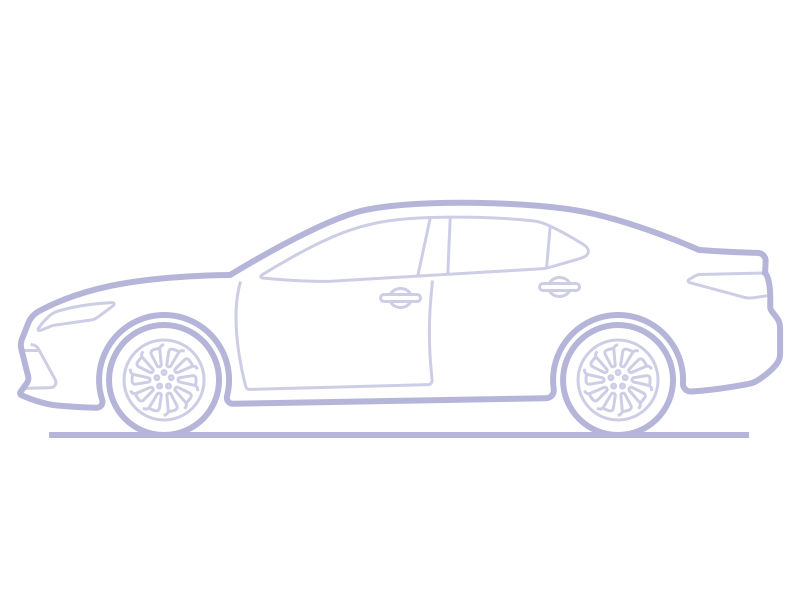
Page 2: Interior SpaceHere's hoping Ford manages to sell the Five Hundred without rebates. This is a good car and deserves better than a discount start and the ultimate fate of fleet sales. The trick behind the Five Hundred is that Ford actually turned things around: whereas in the past,
crossovers were based on existing sedan platforms, the Five Hundred is built on a crossover platform - the result of which equates to cavernous room on the inside, a mammoth trunk and seating positions reminiscent of driving an SUV. Indeed, the 2005 Five Hundred is a significant vehicle for Ford - and not just for sedan market share. The Five Hundred (and the new Freestyle crossover that shares its platform) employs Ford's flexible manufacturing process - the effectiveness of which will mean good things for the automaker. Flexible manufacturing is a system that makes it easier for assembly plants to quickly switch from one vehicle to another on the production line, thus enabling Ford to sell more kinds of cars to more kinds of people. Slotted above the Focus and the upcoming Fusion, the 2005 Ford Five Hundred is three inches longer than the Taurus and a foot shorter than the Crown Victoria. According to Ford, the actual difference in the Five Hundred when compared to other
sedans on the road is the engineering focus on the "H" point - otherwise known as the hip's pivot point. According to Ford engineers, from this point, all things come together or fall apart: Unless the "H" point is considered, for example, massive amounts of legroom could go to waste. For the Five Hundred, front seat passengers get a higher "H point," and, as a result, overall legroom is best in class, and getting into and out of the vehicle is much easier. In other words, Ford built a crossover and realized - shoot - we could make this into one of the most roomy and comfortable sedans on the road.
Mission accomplished. Consider the Ford Five Hundred's trunk: it's bigger than the Crown Vic's, though the car itself is shorter. And the SUV-style driving position, which Ford refers to as "command" seating, provides an excellent, upright view of the road. In the back, shoulder room is plentiful and there's more than enough legroom. As far as control layout, the 2005 Ford Five Hundred has all its fingers and toes, turn signals and knobs - and they are where they should be. It's refreshing to sit inside a vehicle that uses similar textures and plastics throughout the interior, and though a few surfaces were a bit rough to the touch - specifically, the top of the front door panels - for the most part Ford interior designers put the right kind of material in the right spots to maximize comfort and enhance the driving experience.
Page 3: DrivingIf only they had put a more powerful engine in the thing. Then it would truly be a vehicle destined for success. As it is, the 2005 Ford Five Hundred suffers from a lack of power that some will find hard to overlook. The numbers illustrate the lack of oomph: 203 hp is available at 5,750 rpm, and torque registers 207 lb.-ft. at 4,500 rpm. With the weight of the all-wheel drive CVT model at 3,815 lbs., plus the CVT transmission and the 203 horses, the available power and acceleration seems a little neutralized. And though Ford officials say that the car's power is adequate for the target market, you can see it in their eyes - they also wish it had more, at least for the top-shelf Limited version. Surely there's a more powerful engine somewhere in Ford's future, one that would fit a nicely designed sedan. To its credit, the Duratec 30 3.0-liter V6 engine that comes in all Five Hundreds and Freestyles is designed to be efficient - and should meet California Low Emissions Vehicle (LEV) II standards, which calls for 55 percent less smog-forming pollutants than California Ultra Low Emission Vehicle (ULEV) rules. Most people who buy the 2005 Ford Five Hundred will want that kind of efficiency, including fuel economy sure to be rated in the 20s per gallon. Unfortunately, efficiency usually always comes at the cost of performance, and when the dent to performance is noticeable it may get in the way of the sale - especially between 0-30 mph, where the 2005 Ford Five Hundred needs to be at its most sprightly. For urban and suburban driving, acceleration from a stop or slow speeds is critical, and though Ford claims excellent off-the-line acceleration, a drive on the streets and freeways of Chicago provided a different picture - the Five Hundred, when equipped with the Continuously Variable Transmission (CVT), comes off the line more sluggishly than would be ideal. Other aspects of the ride are pleasant: handling is accurate, though steering feel is a bit numb given the fact that the Five Hundred isn't built for sport driving. It's a spacious commuter car, and it handles that assignment with aplomb. In order to get the best possible acceleration, test drive both the CVT and the six-speed automatic.- You may well wind up choosing the six-speed automatic. It's better at doing 0-15, but not quite as quiet or civilized as the CVT. The CVT will likely also deliver better fuel economy - though how much better is not initially clear. Ford engineers claim almost identical fuel savings between CVT and six-speed auto, but the CVT transmission - standard on all-wheel-drive and some front-drive versions of the Five Hundred - will probably offer slightly better fuel economy than the six-speed. Though initial ratings indicate that the six-speed posts a two-mpg fuel efficiency advantage, look for the CVT to do better in real world, mash the accelerator, stop and start type of driving.
Page 4: All-Wheel DriveBut enough whining about the engine. The engineering behind the 2005 Ford Five Hundred includes an all-wheel drive system that's found in the S80. The system employs electronically controlled sensors to distribute power, and the difference in effective all-wheel drive application when compared to mechanical setups is clear. The electronic sensors work by gathering information from, among other things, the Five Hundred's anti-lock braking system. This enables the all-wheel drive to react more quickly. When all-wheel drive is not needed, the Five Hundred operates in front-wheel drive. For most buyers, all-wheel drive is not a critical buy-in. But it's nice to have, and, when needed, can provide a boost to safety and security.
Trim Choices
Of course, not all 2005 Ford Five Hundreds get the all-wheel drive feature. Standard features on all Five Hundreds include a six-way power-adjustable driver's seat, folding power side mirrors, remote keyless entry, air conditioning, one-touch automatic driver's window (up and down), premium AM/FM stereo with single-disc CD, driver's manual lumbar, traction control, electronic speed control and tilt steering column - so it's fair to say that all Five Hundreds come well-equipped. Options include all-wheel drive, power-adjustable pedals with memory, leather seats, power moonroof, reverse sensing system side-impact airbags with rollover air safety canopy. Trim levels start with the base SE, and go to the mid-level SEL, which adds appearance features, dual-zone air conditioning, an electronic message center, a premium sound system and leather-wrap for the steering wheel and shift knob. The top level Limited includes a painted grille and an Audiophile sound system, heated exterior mirrors, leather seating surfaces and heated front seats.
All 2005 Ford Five Hundreds get a broad swath of safety equipment and technology built into the vehicle's architecture. In frontal impacts, energy is expected to be absorbed by the frame rails and bumper plate design. Additional energy is transferred into a high-strength safety cage. According to Ford, this patent-pending design tailors the steering column's collapse to the driver's size and safety-belt use. Ford claims that rear-impact performance is designed to meet proposed future federal crash standards.
Independent crash testing will prove whether the 2005 Ford Five Hundred is as safe as the company claims. Considering the improvement in
2004 Ford F-150 scores from the Insurance Institute of Highway Safety, and considering that the Five Hundred's frame is based on the
Volvo S80, it's a virtual fact that Ford is utilizing their safety knowledge base to significantly enhance and improve safety for their vehicles - including the Five Hundred. Safety equipment offered in the Five Hundred includes dual-stage driver and passenger front airbags, optional seat-deployed side airbags for the driver and front passenger, optional canopy side curtain airbags with rollover sensor, height-adjustable lap and shoulder belts for front outboard seating positions, three-point safety belts for all seating positions and a safety belt reminder for driver and front passenger.
Page 5: WrapTalk about your reminders. Ford is hoping that the 2005 Five Hundred will remind people of the Taurus - not the oval-ized version, but the Taurus that, around 15 years ago, became America's best-selling car - the car "everyman" would like to drive. And though for its weight and size, the Ford Five Hundred does not offer enough horsepower to attract the hordes of Americans it needs to, the Five Hundred is just about there in every other way. From interior comfort and occupant safety to attractive styling and all-wheel drive, the 2005 Ford Five Hundred is a car that almost everyone might love but will surely like alot -- in a must-love year for Ford's
new cars.
Page 6: FAQsHow much does the Five Hundred cost, and what do you get?
Base model is the SE, which has a manufacturer's suggested retail price (MSRP) of $22,795. Major standard equipment includes command seating (four inches higher) in the front, a 3.0-liter V-6 with a six-speed automatic (on most front-wheel drive models) or continuously-variable transmission (on all-wheel drive and some front-drive models). Also offered as standard are four wheel anti-lock disc brakes, 17-inch aluminum wheels with all-season tires, AM/FM stereo with single CD player, power door locks with remote keyless entry and door-mounted keyless entry key pad, power windows with driver's door one-touch up/down, five-passenger seating with a six-way power driver's seat with manual lumber adjustment. The mid-series SEL adds comfort and convenience features including dual-zone temperature control, six-disc CD changer with MP3 capability, leather wrapped steering wheel and shift knob, and a fold-flat front passenger seat with two-way power adjustment. The SEL begins at $24,795 MSRP. The top-of-the line Limited includes features including 18-inch wheels and Pirelli P6 tires, an audiophile sound system with subwoofer and leather seating surfaces with heated front seats. The Limited starts at $26,795.
What is the estimated miles per gallon?
MPG: 29 hwy/21 city (six-speed); 27 hwy/20 city (CVT)
What kind of power does the Five Hundred generate?
The Five Hundred comes standard with the Duratec 30 3.0-liter V6 engine, which churns 203 horsepower and rates 207 lb. ft of torque.
Page 7: NotesTest Vehicle: 2005 Ford Five Hundred
Price Range: $22,795 to $26,795
Engine Size and Type: Duratec 30 3.0-liter V6
Engine Horsepower: 203 hp at 5,750 rpm
Engine Torque: 207 lb.-ft. at 4,500 rpm
Transmission: CVT or six-speed automatic
MPG: 29 hwy/21 city (six-speed); 27 hwy/20 city (CVT)
Competitors:
Buick LeSabre,
Chevrolet Impala, Chrysler 300,
Honda Accord, Hyundai Xg 350,
Kia Amanti,
Mercury Montego,
Mitsubishi Galant,
Nissan Altima,
Nissan Maxima,
Pontiac Bonneville,
Toyota Avalon, Toyota Camry, Volkswagen Passat