Recent Articles
Popular Makes
Body Types
2007 Ford Edge Review
Solid but not outstanding, the Edge offers little advantage over its stiff competition.
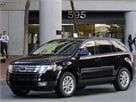
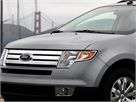
“What a bargain!” I thought, sitting in our 2007 Ford Edge test vehicle. Leather seats, a navigation system, punchy V-6 engine, six-speed automatic and a host of other features, all for only $28,000? That’s a lot of stuff. It’s when I glanced at the sticker to see individual options prices that I realized I had the wrong price in my head. That $28,000 was for a different car; the Edge actually cost just under $35,000. Suddenly the cheap interior trim and so-so build quality couldn’t be ignored, and this Ford quickly lost its…edge.
(Oh, c’mon. You knew a pun was coming.)
By Keith Buglewicz Photo credit: Ford
Page 2
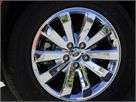
Our test car was a front-wheel drive 2007 Ford Edge SEL Plus. Base price for this model is $29,745 including the $675 destination charge. Options add up quickly: The navigation system is $2,380, the rear entertainment system is $1,295 and the big 18-inch wheels were $395. Other options included the Class-II towing package for $350, a reverse sensing system for $245 and Sirius satellite radio for $195. Add everything together (including the $75 floor mats and $65 cargo management system) and you have $34,745 of Ford crossover.
Page 3
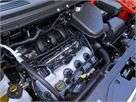
Powering the Edge is Ford’s latest V-6, a 3.5-liter that packs 265horsepower. Mated to a six-speed automatic transmission and all-wheel drive, the drivetrain’s well sorted transmission made the Edge satisfying to drive. The engine’s power is good enough to get it up to speed with reasonable quickness, engine noise is not too intrusive (although it’s not particularly elegant either), and the transmission shifts quickly and smoothly. Note that the supposedly sporty Edge lacks manual shift control for its transmission, a feature standard on many Edge competitors.
Page 4
The Edge features a comfortable and well controlled ride. However, it gives up quickly when pushed, rolling and bouncing on its soft springs, giving lie to the sporty image cultivated by Ford’s ads. The brakes are decent in day-to-day traffic, but fade quickly under heavy use. The tires also give up grip early, although they probably help with the comfy ride. The steering is the biggest dynamic low point. The effort is agreeable, but there is a huge dead spot in the center that requires constant steering adjustments to keep the Edge straight as you cruise down the highway.
Page 5
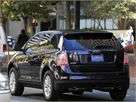
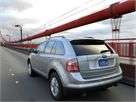
The best view out of the Edge is to the sides, as the front’s high cowl and rear’s small window and thick pillars conspire to obscure your forward and rear vision. Those thick rear pillars leave only a little room for glass. What little view there is to the rear is blocked by the second-row head restraints, and if the folks back there are watching a movie on the flip-down DVD screen, kiss your rear view goodbye. At least the side view is good, with large mirrors. If you prefer a backup camera, you’re out of luck; none is available, just the sensors on our test car.
Page 6
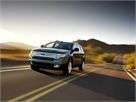
The Edge doesn’t offer a lot of excitement to its driver. Dynamically there are few flaws, but neither is it outstanding compared to its competition. Power from the engine is good, but it has a lot of vehicle to haul around, the suspension offers a comfortable ride but doesn’t offer sporty handling, and if you like to row your own, even with an autobox, you’re out of luck. The Edge isn’t a chore to drive, just not very exciting.
Page 7
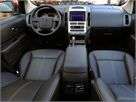
The Edge delivers on comfort. The seat is a little on the small side, but otherwise it’s comfortable, and the controlled ride eliminates one of our major complaints about the wallowing MKX. The wheel adjusts manually for tilt and reach, which helps the driver find a good driving position. The seat offers power cushion and manual seatback adjustments, a configuration common in cars these days and equally frustrating; are power backrests really that expensive? One notable ergonomic quirk is the manual lumbar adjustment, which looks like a manual ratcheting height adjustment.
Page 8
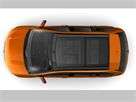
There is no third row in the Edge’s large interior, so rear comfort is maximized to great effect. There is plenty of leg, head, foot and shoulder room, and the seatbacks recline considerably; you could take a nap here. The door opening is quite large, too. Of course, this advantage comes at the expense of a missed opportunity: A third row of seats. Ford’s counterargument is that other crossovers such as the Taurus X do have three rows, which is a little more convincing now that the rebadged Freestyle shares some of the Edge’s styling.
Page 9
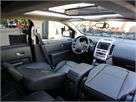
One of the more annoying ads for the Edge (directed by David Mamet) features two Edge drivers talking about how the Ford crossover is quieter than a Lexus RX 350. We think those sound meters should be rechecked. Noise isn’t bad in the Edge, but it’s not Lexus-quiet, either. Wind noise is notable, if not terribly intrusive, and tire noise is more pronounced than we expected. The engine is inaudible at idle or cruise, but it makes itself known under the slightest tickle of the throttle. None of this is too bad for the class and price, but Lexus? C’mon.
Page 10
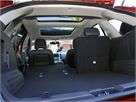
There’s plenty of cargo room in the Edge. The large hatch lifts high for big loads, but the leading edge slopes downward, forcing taller drivers to stoop under it. The liftover is low, but the large protruding bumper is guaranteed to be covered in scratches before long. Our test Edge had Ford’s power folding second row seatbacks, but note they only fold down; you have to put them back up manually. Also, the seatbacks are angled slightly toward the hatch when folded, so cargo will slide to the back. The front passenger seat folds forward for long loads though, a nice touch.
Page 11
The beveled edges on the dash panels in the Edge may have been an homage to the car’s name, or may have been an attempt to get away with lower build quality standards. Either way it backfired, since the result is junky cutlines everywhere. There’s nothing to hide the poor fit of the pillar covers to the cheap mouse fur headliner, or that the door panels have four different textures, or that the navigation screen was slightly crooked in the dash. Exterior panels fit better, although the gaps around the hatch were visibly wider on one side than the other.