Recent Articles
Popular Makes
Body Types
Dodge Stratus Used Car Buying Guide

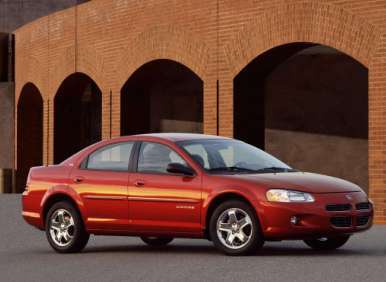
Since the ascendancy of the Japanese holy trinity—Accord, Altima, and Camry—midsize American cars have had a pretty tough row to hoe. In terms of refinement, build quality, and reputation for reliability, the Americans simply haven't quite been capable of living up to the lofty standards established for this segment by Honda, Nissan, and Toyota.
And yes, we realize this is a less than optimal opening to a retrospective for a midsize American sedan. The reality is, many of the American models of the period found themselves with a very short lifespan, simply because they could not compete.
One exception is the Dodge Stratus.
This model enjoyed an 11-year run from 1995 to 2006, over two generations. The Chrysler Corporation hit upon a remarkably effective strategy in the mid-1990s. The company gave its styling department free rein. The result was some of the prettiest cars of the latter part of the 20th century.
Fluidly graceful, the “cab forward” architecture made these cars stand out. For these designs, a short hood was followed closely by a rather longish greenhouse, which in turn was followed by a relatively longish trunk. This layout made the passenger compartment of the car appear literally shoved forward in the design and endowed the front-wheel drive vehicle with considerable interior space as well as a roomy cargo compartment.
The first generation Dodge Stratus was built from 1995 to 2000. It was offered only as a sedan, and in but two trim levels (base and ES). The least expensive model used the 2.0-liter, inline four-cylinder engine capable of developing 132 hp. The middle engine offering was a 2.4-liter, 150 hp in-line four. The big engine was a 168 hp, 2.5-liter V6.
As these models are a bit too advanced in age to recommend as reliable used transportation, this retrospective will focus on the second-generation Dodge Stratus sedans and coupes built between 2001 and 2006.
Dodge Stratus Used Car Buying Guide: 2001–2006
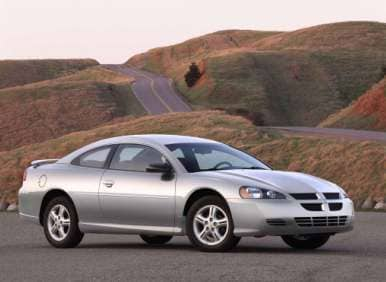
Interestingly, while there were coupe and sedan versions of the second generation Stratus, they were literally two completely different cars. The Stratus sedan was a Chrysler design, while the Stratus Coupe was based on the Mitsubishi Eclipse—leveraging the relationship Chrysler enjoyed with Mitsubishi at the time.
This differentiation extended to the engines as well. The sedans used Chrysler engines, while the coupes employed Mitsubishi engines. The base sedan engine was the same 2.4-liter, 150 hp four from the first generation of the Stratus sedan. The V6 fitted to the sedan benefited from a displacement increase over the previous model year’s offering to 2.7-liters, and a resulting power output increase to 200 hp. A four-speed automatic was the only transmission choice for the 2001 Dodge Stratus sedan.
The 2001 Dodge Stratus coupes used a 147 hp, 2.4-liter in-line four from the base models, and a 200 hp, 3.0-liter V6 for the RT versions. Five-speed manual and four-speed automatic transmissions could be had with either engine for the coupe.
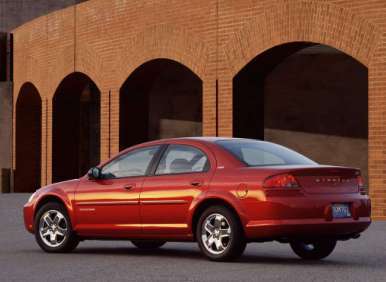
Dodge Stratus Used Car Buying Guide: 2001 Sedans
The 2001 Dodge Stratus sedan was offered in two trim lines; “SE” and “ES”. The standard equipment palette for Stratus SE featured the 2.4-liter four-cylinder engine and was also occupied by a set of 15-inch steel wheels with full wheel covers, a temporary spare tire, variable intermittent windshield wipers, and a rear window defogger.
The front-wheel drive 2001 Stratus SE used an all independent suspension system, cloth upholstery, bucket front seats, a split folding rear seat back, power door locks, power mirrors, and power windows with a one-touch feature for the driver.
Air conditioning, a trunk light, front reading lights, front and rear floor mats, and dual vanity mirrors were also included in the base price. The instrument panel contained a tachometer, and the four-speaker audio system used an AM/FM/CD–changer controller head unit.
The model’s safety and security features included a pair of ventilated front disc brakes along with a pair of rear drum brakes. The rear doors featured child safety locks and the headlamps employed an auto delay off feature. The Stratus SE sedan featured a rear center three-point belt, electronic brake force distribution, and an emergency interior trunk release.
The 2001 Dodge Stratus ES used the 2.7-liter V-6 engine. To the SE trim line’s feature set, the ES added 16-inch alloy wheels, 4 disc brakes, fog lights, a power adjustable driver seat with manually adjustable lumbar support, a universal remote transmitter for garage doors and security gates, leather trim on the shift knob and steering wheel, dual illuminating vanity mirrors, and the ES audio system incorporated an in-dash single disc CD player.
Dodge Stratus Used Car Buying Guide: 2001 Coupes
The front-wheel drive 2001 Dodge Stratus Coupe was also offered in two trim lines; “SE” and “R/T”. The SE coupe used the 2.4-liter engine paired with a five-speed manual transmission as standard equipment. The model used an all-independent suspension system, and a set of 16-inch steel wheels with performance tires and full wheel covers. Variable intermittent wipers, a rear window defogger, a height adjustable driver’s seat, and a split folding rear seat back were also included in the base price.
The coupe also came with power door locks, power mirrors, and power windows with a one-touch feature for the driver. Cruise control, a front console with storage, front cupholders, front door pockets, a remote trunk release, a 12V power outlet, and a tilt adjustable steering wheel communicated the driver’s intentions to the power steering rack.
There was also air-conditioning, a light in the trunk, front and rear reading lights, front and rear floor mats, dual vanity mirrors, a tachometer, and an AM/FM stereo head unit, feeding six speakers.
The safety package incorporated an engine immobilizer; electronic brake force distribution, a rear center three point safety belt, an emergency interior trunk release, and a set of ventilated front disc/rear drum brakes.
The 2001 Dodge Stratus R/T coupe added the 3.0-liter V6, 17-inch alloy wheels, a remote antitheft alarm system, four disc brakes, fog lights, a height adjustable driver’s seat, front and rear reading lights, leather trim for the shift knob and steering wheel, dual illuminating vanity mirrors, an external temperature display, a compass, and a seven-speaker Infinity branded audio system with a single disc CD player in the head unit.
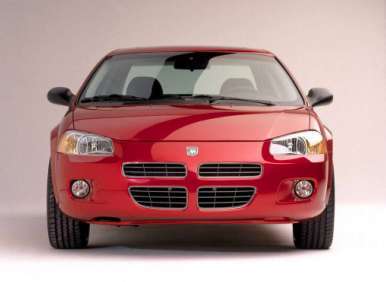
Dodge Stratus Used Car Buying Guide: 2002 Sedans
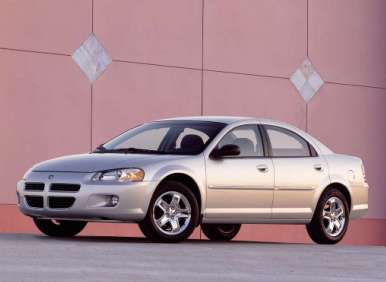
New trim lines were added to the Stratus lineup for 2002; “R/T”, “SE Plus” and “SXT” sedans. The 2002 model year also ushered in an SXT coupe. A four-disc in-dash CD changer was added to the standard equipment list for the R/T and made an option for the other trims. Optional audio systems for the sedan incorporated cassette and CD players.
For 2002, the base Stratus SE Sedan ran the 2.4-liter four-cylinder and a four-speed automatic transmission. The standard features list included air conditioning, power windows and door locks, an AM/FM stereo cassette audio system, four-wheel disc brakes and a fully independent suspension system.
The SE Plus added the V6 engine, keyless entry, power mirrors and a power adjustable driver’s seat. It also got a CD player, cruise control and alloy wheels.
The SXT featured the equipment list of the SE Plus, minus the V6 engine.
The 2002 Stratus ES sedan ran the V6, 16-inch chrome wheels, fog lights, an eight-way adjustable power driver’s seat and leather for the steering wheel and shift knob.
The top of the Stratus sedan’s lineup was the R/T. This model was limited-production and paired the 200-hp, 2.7-liter V6 with a five-speed manual transmission. Its slightly lowered suspension system was equipped with a set of 17-inch performance tires and its four disc brakes were equipped with ABS (making it the only Stratus sedan to be so fitted for 2002)
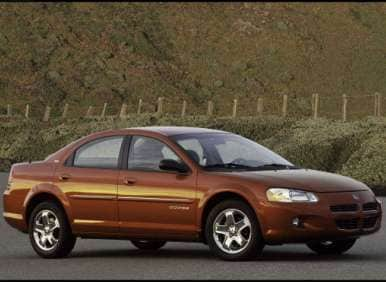
Dodge Stratus Used Car Buying Guide: 2002 Coupes
The 2002 Dodge Stratus Coupes were offered in three trim lines; SE, SXT, and R/T.
Both SE and SXT used the 2.4-liter inline four, mated to either a five-speed manual or a four-speed automatic transmission.
The coupe version of Stratus SE's standard fare included air conditioning, power windows and locks, and cruise control. To that list, the Stratus SXT coupe added 16-inch alloy wheels, a power driver’s seat, a four-disc CD changer, and a keyless entry/security system.
The 2002 Stratus R/T coupe got all of the above, plus the V6 engine, a performance-oriented suspension system, 17-inch tires and wheels, and a choice of manual or automatic transmissions.
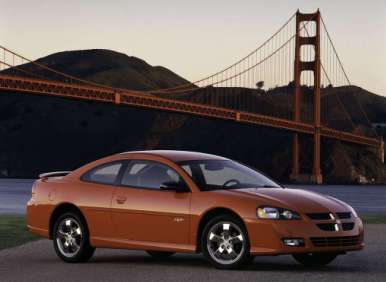
Dodge Stratus Used Car Buying Guide: 2003
While the entire coupe lineup got a cosmetic update, the SE coupe went rental car only and was no longer offered to the general public at the retail level. The SE Plus sedan was dropped.
Stratus sedan got a cosmetic update, similar to the one the coupe got in 2003. Steering wheel-mounted audio controls, an electrochromatic auto-dimming rearview mirror, new door panels, new seat fabric and three new interior choices rounded out the updates to the sedan for MY’04. The manual transmission was dropped. Traction control could be combined with ABS, however only models with four disc brakes got ABS.
The Stratus coupe was largely unchanged.
A sport appearance package was offered for SXT sedan to give it the look of the R/T (but not the engine).
For its last year of production, the Stratus model lost its coupe variant, as well as the SE and ES versions of the sedan. The 2006 R/T got new leather seats, road wheels and a tail spoiler.
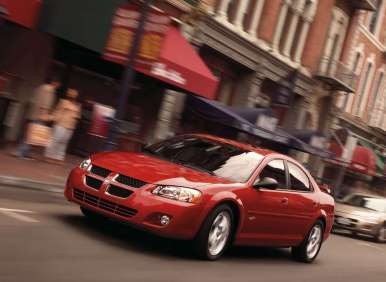
Dodge Stratus Used Car Buying Guide: Summary
If you're looking to pick up a reasonably priced used car, and you're the sort of person that drives it until you need another one (rendering resale value a non-consideration) then the Dodge Stratus might be worth considering. They offered reasonable handling, a fairly generous equipment list (though it should be noted that disc brakes and ABS were only available on the top-of-the-line models).
That said, almost any comparable model from Honda, Nissan, or Toyota will invariably be a better choice. Scanning some of the forums on the ‘Net reveals engine problems to be the most likely source of maladies for the Stratus—particularly sedans from MY’02 for some reason.
Additionally, there have been a number of recalls, so you’ll do well to run an Internet search investigating those. Similarly, a vehicle history report run against the VIN of any particular Stratus of interest would serve you positively in the long run.
And, as always, a very thorough pre-purchase inspection by a trusted professional independent mechanic—one familiar with Dodge’s automobiles is highly recommended.