Recent Articles
Popular Makes
Body Types
2011 Chevy Volt: Everything You Want to Know
The future wears a Chevy badge
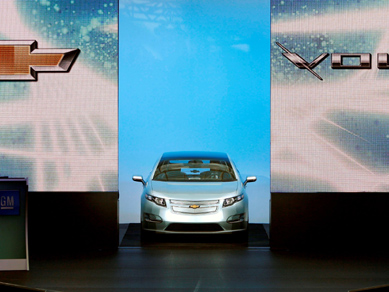
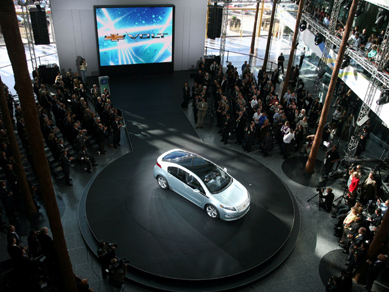
Chevrolet didn't just reveal a future model on the day of its 100th anniversary. It gave us a glimpse into the future of automobiles with our first look at the 2011 Chevy Volt. There's been a lot of anticipation, hype and rumors about the new Chevy Volt, but up until now, few facts have been available. The final production shape, what the interior will be like, and whether Chevrolet will meet its target of 40 miles on a single charge were all open ended questions. At last, we have answers.
Photo Credit: General Motors
Page 2
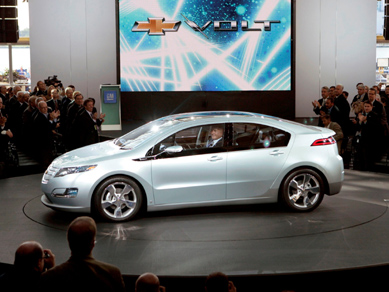
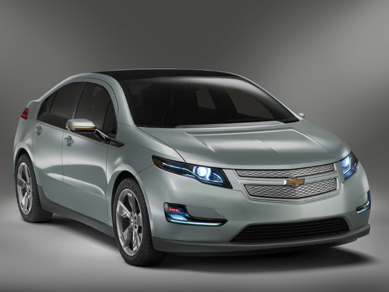
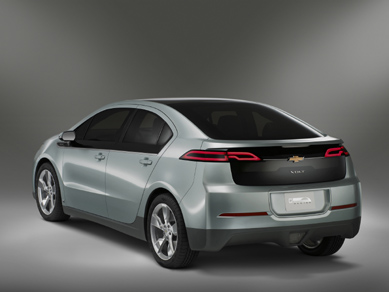
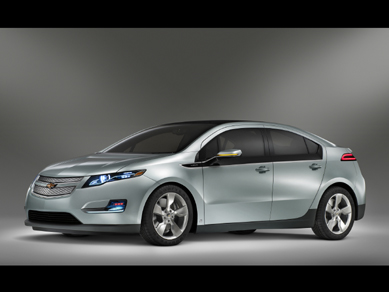
The 2011 Chevy Volt is the production version of the concept car shown at the 2007 Detroit Auto Show. It's a four-door hatchback design, about the same size as a Toyota Prius, and is powered by electric motors with a 220-cell lithium ion battery pack. The batteries can be recharged either by plugging the Chevy Volt in or with an onboard 4-cylinder E85-compatible gasoline engine.
Photo Credit: General Motors
Page 3
Not really. A hybrid uses a gasoline engine and an electric motor working in tandem to move a vehicle. The Volt's system works differently. The electric motors and battery packs supply all the power to move the Chevy Volt from place to place. The onboard engine works strictly as a generator, recharging the batteries when they get too low. The key to the Chevy Volt is the fact that it can run entirely on battery power for extended periods of time; Chevrolet says up to 40 miles.
Photo Credit: General Motors

Page 4
Well, you don't have to do anything. However, you'll significantly increase your range if you plug in the Chevy Volt when you can. Let's say you have a 40 mile round-trip commute. When you get home, you plug the Volt into your regular 120-volt outlet and let it recharge for the night. If that's all you do – and, we assume, you go easy on the accelerator – your gasoline engine would rarely turn on. By contrast, a Toyota Prius doesn't get plugged in, but it relies on its gasoline engine to produce nearly all of the electricity stored in the batteries.
Photo Credit: General Motors
Page 5
According to Chevrolet, no. The Chevy Volt can be plugged in to any standard 120-volt power outlet for recharging, or to a 240 if your house is wired with it. Using 120v, a full recharge takes about eight hours; call it overnight. If you have a 240v in your garage – if you have an electric over, dryer or water heater, you probably have 240 – it takes about three hours. General Motors estimates that recharging the Chevy Volt over the course of a year will cost the same as the average yearly power consumption of a refrigerator.
Photo Credit: General Motors
Page 6
Well, that one depends. Although prices haven't been officially announced, rumor has it that a Chevy Volt will cost somewhere in the neighborhood of $40,000. That's a hefty sum, to be sure, especially when a Toyota Prius costs around $22,000 and the recently announced Honda Insight will retail for less than $19,000. However, Chevrolet estimates that even if you recharge the Chevy Volt at peak hours, it will cost about 1/6 as much to run as a conventional car, saving roughly $1,500 per year. Over five years, that's $7,500.
Photo Credit: General Motors
Page 7
Currently, no, however the House recently passed legislation that grants an incentive on cars like the Chevy Volt. It grants a $3,000 tax credit on cars with a five kilowatt-hour capacity, adding $500 per kilowatt hour until a maximum of $5,000 is reached. The Chevy Volt easily gets the highest credit thanks to its 16 kW hour battery pack. If it becomes law, the Volt's effective price would come down to a more reasonable $35,000.
Photo Credit: General Motors
Page 8
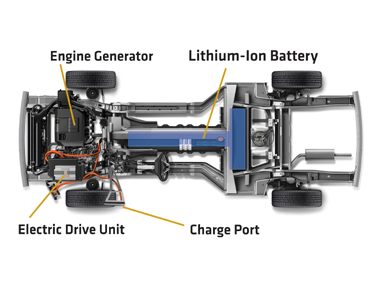
Under the floor is a large T-shaped battery pack consisting of 220 individual lithium-ion cells with 16 kW hours of juice. These power a 111 kW electric motor (that's 150 horsepower) that drives the front wheels. The Volt's battery pack is good for about 40 miles in one charge. That doesn't sound like much, but that's where the gasoline engine kicks in. GM didn't give specifics, but the concept had a 1.0-liter gas engine that ran at a constant 1,850 rpm to operate a generator that would simultaneously recharge the batteries and provide power to the electric motor. Drive fewer than 40 miles between charges and you could stay on battery power the whole time.
Photo Credit: General Motors
Page 9
Chevrolet says that the Chevy Volt eliminates "range anxiety" thanks to its gasoline engine. If a Tesla Roadster – a sports car that uses a lithium-ion battery pack for a claimed 200 mile range – runs out of juice, you have to find an outlet. If the Volt's battery gets low, the gasoline engine simply kicks in, allowing you to keep driving. Not surprisingly, if you figure the average driver puts about 15,000 miles on their car per year, that works out to just slightly more than a 40-mile daily average.
Photo Credit: General Motors
Page 10
Nobody's actually driven the 2011 Chevy Volt yet, of course. However, the electric motor that drives the Volt is rated at 150 horsepower, and GM says the top speed is 100 mph, so it's certainly faster than you'll ever need to go in the U.S. One advantage of electric motors is that they generate 100 percent of their power right off idle, so even if the Chevy Volt isn't a 0-60 mph or quarter-mile king, we're betting that with 273 lb.-ft. of torque that it'll scoot off the line.
Photo Credit: General Motors
Page 11
The Chevy Volt will have to meet all crash-test regulations when it goes on sale in 2011, so it will undoubtedly have all the usual airbags, stability controls and crumple zones we expect in a modern car. Some wonder whether you can drive the Chevy Volt in the rain. Well, unless you plan on using it as a submarine, the Volt should be just fine when it gets wet. Some wonder whether the electromagnetic field (EMF) generated by an electric car will interfere with pacemakers or cause other harm. The chances of this are extremely low since the electrical components are all shielded, and there is no study that shows a direct correlation between EMF and health problems. All told, a Chevy Volt should be as safe as any other car.
Photo Credit: General Motors