The best Tahoe ever arrives just when people are losing interest
Introduction
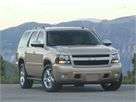
Chevrolet Tahoe – Review: The current generation Chevy Tahoe is so much better than the vehicle it replaces, it’s hard to believe they both came from the same company. Improved dynamically, stylistically, and in virtually every subjective and objective measure, Chevy’s full-size sport ute leaps to the head of the class, outdone only by its GMC and Cadillac stablemates. It’s not perfect, and the faults it has can be glaring, but overall, if you’re a boat-towing, motorcycle-hauling, big family-having, don’t-give-a-damn-about-gas-prices type, it’s hard to find a better overall choice. The biggest shame, of course, is that this best Tahoe ever may be something of a swan song, as the popularity of full-size SUVs is fading in light of politics and gas prices.
Our test vehicle was a loaded 2007 Chevrolet Tahoe LTZ, with few if any options left unchecked. The basic LT costs $39,320 (including a $900 destination charge), for which you get air conditioning, power everything, tilt steering, a 5.3-liter flex-fuel V8 engine connected to a four-speed automatic, and a towing package. The $8,860 LTZ package adds a power rear liftgate, leather upholstery, three-zone automatic climate control, 20-inch wheels and chrome grille and exterior trim among many other features. Our test vehicle also featured the $2,250 navigation system, the $1,295 rear seat DVD entertainment system, a $995 sunroof and the exceptionally helpful $250 rear view camera system. The total came to an eye-popping $52,970.
Performance
The 5.3-liter flex-fuel engine in our test Tahoe musters a respectable 320 horsepower and 340 lb.-ft. of torque. Floor it and you get acceptable acceleration, and there’s enough grunt down low to keep you pretty satisfied, but the problem is the old-school four-speed automatic. Though once four speeds were plenty, today Chevy’s lagging behind the five and six speeds of other manufacturers; a six-speed is coming, and it can’t happen too soon. The transmission is slow to downshift, and when it does, it’s with more lurching than today’s standards allow. Although this V8 features GM’s active cylinder management, which shuts down half the cylinders under light throttle and deceleration, we still recorded lousy economy of only 13.3 mpg.
Handling
Oh, c’mon. You don’t expect a 5,537-lb. body-on-frame sport utility to actually handle, do you? It’s not a backroad brawler, but its freeway and around town ride is excellent, and its relatively small turning circle helps with maneuverability. There’s very little body-on-frame jitter. We took the Tahoe on our favorite fire roads, a death-defying cakewalk for this four-wheel drive truck. Aside from the low-hanging chin spoiler and runningboards, it’s obvious the Tahoe is otherwise equipped for much more ambitious terrain. It easily absorbed the washboards and ruts on our trail, and was so untaxed that it wasn’t until the end of the drive that we realized we had somehow accidentally switched the drivetrain to two-wheel drive.
Visibility
The view out the front of the Tahoe is commanding, and clearly one of the reasons people buy these kinds of vehicles in the first place. The big side mirrors aid in lane changes, although it’s a truck like this where a blind spot indicator like Volvo’s BLIS system would be most helpful. A quick over-the-shoulder gives you a view of thick pillars and headrests blocking the rear view; add people into the mix and you’re suddenly really glad those mirrors are so big. Watching a movie on the ceiling-mounted DVD screen renders the rearview mirror useless. The reverse camera and parking assist sensors simplify reversing, with the rear view duplicated in the navigation screen.
Fun to Drive
Driving the Tahoe at speed on anything twisty isn’t fun, and losing drag races to grannies in Buick Roadmasters isn’t much fun, either. However, if you’re cruising on your way to your favorite camping spot and have to bomb around off the beaten path to get there, or if you’re towing your boat out to the river for a weekend of splashtastic bliss, the Tahoe is fun by extension. And we’ll admit, the big ugly American in us kinda digs the guilty pleasure of driving something this big and thirsty. Then again, we get to expense our fuel bill.
Front Comfort
Something this big had better be comfortable, and the Tahoe doesn’t disappoint. Both front seats offer 12-way power adjustments, and with the adjustable pedals it’s easy to find a good position. Obviously, there’s plenty of head, shoulder, knee and leg room for the driver and front passenger. The primary drawback is the steering column adjustments: The tilt is GM’s anachronistic old-school design, which locks into only a handful of positions. If you don’t like them, you’re out of luck. The Tahoe should offer a modern tilt mechanism, and the lack of a telescope feature is ridiculous. Otherwise, there’s plenty of space for Big Mac butts to spread out and get comfy, even with tall hats on.
Rear Comfort
Despite its size, second row seating in the Tahoe is tight. Head room is limited, and so is knee room, exacerbated by the low seating position. You do get your own set of air conditioning controls, though. Third row comfort isn’t any better; you’re virtually sitting on a floor-mounted padded cushion, knees in the air, but there’s good head and shoulder room. Our test vehicle had two captain’s chairs in the second row, which made getting in back a snap, even without using the power folding feature on the center row seats. Second and third row passengers do benefit from the DVD player, which will hopefully distract them from their otherwise uncomfortable digs.
Interior Noise
Wind doesn’t go quietly around big, square objects, and you hear it in the big, square Tahoe, but not as much as you might expect. The outside mirrors and windshield header are the biggest culprits, but in all fairness the Tahoe is subdued considering its brick-like aerodynamics. The engine only makes itself known when you’re standing on the throttle, where it makes good V8 rumbles. There’s also a good amount of road rumble from the 20-inch tires, but surprisingly little tread slap on small bumps. The interior is gratefully free of rattles and squeaks, even over rough roads.
Loading Cargo
The power liftgate is truly helpful when loading cargo in the Tahoe. Just watch your chin, as it’s a big piece of metal and it has a big sweep when it opens. For smaller and lighter objects, the rear glass opens independently. The load floor is high, and with the third row up, there’s surprisingly little cargo space; buy a Suburban if you need three rows and cargo room. The rear row folds up and away, but if you want a flat load floor you have to remove them, anachronistic in today’s fold-into-the-floor world. The second row seats have a handy power fold/flip feature, but c’mon, how lazy do you have to be to need it?
Build Quality
This is where the Tahoe really separates itself from its predecessor. The interior is not just nice to look at, but put together with care and precision. We found a few slight variances around the fake wood trim on the center console, and we wish the hard plastic on the dash top didn’t flex quite so much, but overall we were very impressed with how the Tahoe was put together inside. The exterior is much the same. Gone are the inch-wide gaps between bumper and body, replaced by a flush mounted piece. Gaps between the doors and hood are also much smaller, and mostly consistent, with only a millimeter or so of variance. Overall, it’s a huge improvement over previous generations.
Materials Quality
It used to be that you had to tolerate the Tahoe’s interior because you otherwise liked the vehicle. Now its interior is a major selling point. Soft touch plastics are on the door tops, with comfortable padded armrests on the door and center console. There’s plentiful hard plastics, but it’s high quality, low gloss stuff, and it’s nice to look at. The fake wood trim is nicely done and used in a mostly convincing way. The mesh headliner isn’t duplicated on the pillar covers, but at least the plastic on the covers is patterned to match. The leather on the seats is soft and comfortable, and overall the Tahoe’s interior is a very good place to spend your driving time.
Styling
The exterior styling of the Tahoe has grown on us, and we definitely approve. Part of the improvement in styling is simply the quality of construction; it’s amazing what tight panel gaps can do for a vehicle’s looks. The nose is distinctive and aggressive, and possibly the best looking of the three big GM SUVs. We also like the 20-inch alloy wheels, although the size of them makes the brakes look puny. The biggest story is inside: this interior is leagues better than the one it replaces. Fit and finish is very good, and the style is modern and right.
Storage
The Tahoe’s interior storage was good, but not great. Big door pockets on all four doors feature bottle holders, and the center console in front is deep, lined and huge; there’s also a rubber-lined recess in the console’s lid for things like pens or cell phones. Two cupholders in the front have a damped cover, and a smaller damped bin in front of them is ideal for small objects. The glovebox is small however, and considering the Tahoe’s size, we expected more storage nooks. There’s a sense of wasted space here: Why no dashtop bin? Why is the glovebox so small? Couldn’t the door pockets be a little bigger?
Infotainment Controls
The Tahoe’s navigation system works well, but the buttons surrounding the screen are small and hard to see at a glance. Same goes for the rubber-gripped knobs; we prefer them to buttons, but c’mon, your fingers have to be eensy to be comfortable gripping these. Another quirk: You must have the radio on for the navigation screen to be on. Why they can’t be on independently is anybody’s guess. Programming the navigation system is an intuitively quick touch-screen affair, and directions are accurate and precise. The sound system’s quality is good, and the redundant controls on the steering wheel were handy, although it was too easy to accidentally change stations when turning the wheel.
Climate Controls
The climate controls use GM’s standard pushbutton layout, which is generally no bad thing. Separate zones for the driver, front, and rear passengers means that nobody complains. It also does a very good job of cooling the Tahoe’s big cabin, and considering our test vehicle’s dark exterior and black interior, that’s quite a feat. The buttons are also too small, meaning you have to commit to muscle memory just about everything if you don’t want to stuff your Tahoe while trying to cool it off. Another GM quirk is the recirculation mode, which defaults back to fresh air every time you shut the vehicle off. It’s really annoying if you prefer to keep outside smells outside.
Secondary Controls
GM has made huge advances in the quality and placement of its secondary controls. Nothing is hard to find, even if some of it is a little oddly placed. For example, the seat heater switches are on the door panel, near the seat memory buttons; most of the time they’re on the center console. However, every button you press and lever you push or pull has a high quality feel to it that used to be the exclusive reserve of makes like Lexus. With such a big center console, though, we think that moving the shift lever from the column to the floor is possible, and definitely advisable.
Competition
The Tahoe has two major competitors – the Ford Expedition and Nissan Armada – and two minor ones – the Dodge Durango and Toyota Sequoia. Compared to all, the Tahoe has more power, more comfort, better styling inside and out and is put together superbly. The Tahoe is larger than the Durango and the Sequoia, and Toyota’s traditional strengths of refinement and build quality are at least equaled by this Chevy. Rear seat comfort is better in the Expedition, but otherwise the Tahoe is a tough act to follow. Of course, the Tahoe competes against itself if you want to throw the GMC Yukon in the mix, and at the GMC store, you can get a six-speed automatic with the Yukon’s Denali package.
2nd Opinion – Perry
Chevrolet Tahoe – Perry Opinion:
The Chevy Tahoe has renewed my faith that GM can build a high-quality vehicle. The Tahoe feels good, from the smooth, quiet ride to the nicely appointed interior and admirable build quality. The Tahoe feels and looks upscale and delivers a wonderful drive experience once elusive to a Chevrolet product. The only major fault I have with the Tahoe is the transmission. Several times I hit the gas expecting to engage passing gear and got nothing but slow acceleration. Rear storage is limited with the third row, even when tilted forward. The dated design still requires removal of the seats for hauling larger items, something Chevy needs to update. Good work, Chevrolet.
Ron Perry
2nd Opinion – Heywood
Chevy Tahoe – Heywood Opinion:
If only it had the acceleration you’d expect from a big V8-powered truck. It isn’t disappointing, it’s merely passable. But I’d think twice before I considered the vehicle in front of me passable. Chevy has done a great job of masking the typical handling characteristics of a truck, narrowing it to a slight vibration in the steering wheel. Except for the large step to get into the Tahoe, passengers won’t be able to tell if they are riding in a truck or a moderately priced luxury vehicle. The leather seats are comfortable and with the entertainment package it’s a great choice for long road trips. Perfect for ski getaways or towing your toys to the river or desert in comfort.
Vernon Heywood
Photography courtesy Ron Perry, Keith Buglewicz