Those days are over.
Starting now, customers can walk into a Chevrolet showroom, plunk down their hard-earned money on a 2008 Malibu, and drive away knowing that not only are they getting a good deal and helping the domestic industry, but they're also getting one of the best cars in its class.
Sure, you're naysaying, especially if you grew up around the likes of the Chevy Corsica, Lumina, Celebrity, or even the previous two generations of Malibu. But the 2008 Malibu not only matches its competition, it beats them in several key areas, such as style, powertrains, and yes, even the holy grail of refinement that has eluded GM for years. It's not flawless, but like the Accord and Camry, its flaws are overshadowed so greatly by its overall goodness that they're reduced to nitpicky minutiae by contrast.
The modern interpretation of the Malibu goes back to the 1997 model year, when a somewhat dumpy little sedan began populating Chevy showrooms. The 2004 model replaced that car with a slightly larger but equally dumpy version which at least had a decent platform underpinning it. The Malibu Maxx was a clever hatchback variant that ultimately went over like a lead balloon. The newest Malibu makes a clean break with its predecessors with a stylish sedan-only design that's bigger, more comfortable, and a car that you'll want to be seen in.
The BasicsModel Mix
The four trim levels of the Malibu are LS, LT, LTZ and Hybrid. Standard on base LS models is the usual array of power windows/mirrors/door locks, along with manual cloth seats and air conditioning. Safety features include front, side
and curtain airbags for a total of six, anti-lock four-wheel disc brakes, traction control and projected five-star crashworthiness in every direction. The only engine in LS trim is the four-banger with the four-speed automatic. Move up to the LT trim and you can get the V-6, along with standard stability control, body-color and chrome exterior trim, floor mats and 17-inch wheels instead of the LS’s 16 inchers. Hybrid models mostly ape the LT trims, with the obvious exception of the hybrid-only powertrain. The LTZ model comes almost fully loaded with 18-inch wheels, even more bright trim, a standard V-6 engine (although that will change in the spring), automatic climate control, special instrumentation and a few other bells and whistles to make big spenders happy. Notable by its absence is a navigation system, something most of the Malibu’s competitors now offer. GM’s OnStar is standard and free for the first year, but we prefer a map-based system, and we imagine we’re not alone. The peculiar thing is that the Malibu uses GM’s standardized center-stack modules, so fitting the nav system shouldn’t be difficult. Don’t be too surprised if one shows up mid-year, or as an upgrade for 2009.
Pricing
Pricing is aggressive on the new Malibu. Base LS models start at $19,995 including the $650 destination charge. Compared to the base prices of the Toyota Camry ($20,280) and Honda Accord ($20,995), it’s pretty good. LT trims start at $20,995, and considering the extra equipment that comes at that price, we think it’s worth the extra $1,000. The LTZ comes in at $26,995, and again is a very well equipped vehicle for the price. Hybrids will cost $22,790, which is a premium of $1,800 over the LT. However, GM is quick to point out that thanks to federal tax credits of $1,300, it works out to a much more modest $500.
Major options packages include the 2LT trim, which adds an automatic dimming rearview mirror, power adjustable brake pedals, a remote starter system and heated front seats. It also includes leather shift knob and a leather-wrapped steering wheel with audio and cruise controls, and a few other goodies. A premium audio package is $550, while LT buyers can throw in the V-6 engine package for $2,060. Also available on the LTZ and LT trims are a rear power package (which includes a 120-volt outlet on the rear of the center console and, curiously, a manual rear shade) is $250 and a $800 sunroof. Check every option box on the LTZ and you’ll roll out with an MSRP of just over $28,000.
What's NewOutside
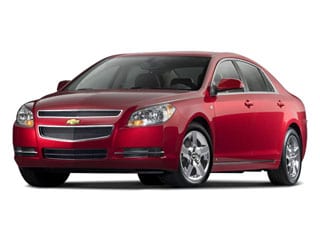
Style is a subjective thing, but it's easy to make the case that the Malibu is the best looking car in its class. It is bold but restrained, sporty but without cartoonishly aggressive cues. The long (112.3 inch) wheelbase pushes the wheels to the outer edges, while the strong arch of the roof flows smoothly from where it crests over the hood, above the passenger compartment, and down again into the trunk in a single arc. Clever details abound: There are Chevy bowties hidden in the taillights, rear side marker lights and headlights. The rear bumper has a notch for the tail pipes; one for the single pipe on the four-cylinder models, and two for V-6 models. Those tailpipes are chromed and large on LT and LTZ trims, regardless of engine choice. The hood is inset between the nose cap and fenders, a difficult execution from a fit-and-finish standpoint, and one that Chevrolet pulled off well even on our preproduction test car. There's just enough chrome, and about the only heavy-handed element is maybe the metallic grille insert on LTZ models. Even then, it’s a matter of taste; people buy the Escalade for the chrome, don’t forget.
Inside
General Motors has built sharp looking sedans before. However, the effect is too often shattered when you open the door, sit inside and are confronted by yards of cheap plastic, fabric and buttons.
Recent GM products are changing that expectation, and the Malibu’s interior makes good on the promise of its exterior. The twin-cowl design looks upscale, the gauge pod is small and stylish, and the center stack manages to look unique even though the switchgear is all standard-issue GM stuff. The gauges are another happy surprise: Turn on the car and the needles glow, sweep across their range and back again, and then the backlighting gradually fades in. Other fun touches are the blue mood lights in the front door handles and above the center console and the thin faux-wood strip in our test car, which arced from the front doors, onto the dash, and back down again to the center console. There’s no black trim to be found, and everything is textured and attractive. It’s also quiet. Chevrolet says it went to great lengths to manage sound, and its use of extra sound deadening, laminated front and side glass and engine noise management have created an exceptionally quiet cabin.
What's New : Under the HoodUnder the Hood
Three drivetrains are available for the new Malibu. The base engine, available in LS and LT trims (LTZ will come later), is a 169 horsepower 2.4-liter four cylinder. For now it is mated exclusively to a four-speed automatic transmission, but by early 2008 a six-speed automatic will be available in four-cylinder versions on the LTZ trim. Either way, Chevrolet has done a remarkable job with its four-banger. Not only is it quiet, but the sound has been managed so that it’s not just a quiet bad noise, but a quiet pleasant one, and maybe one of the quietest four-cylinders in its class.
The upgrade engine is a 252-horsepower version of GM’s 3.6-liter V-6. With twin cams, variable valve timing and all the other bells and whistles of a modern engine, it’s a powertrain that’s the equal of most of its competition. It’s down on power compared to the Accord and Camry, but it has slightly more torque than both: 251 lb.-ft. versus 248 lb.-ft. for the Accord and Camry. It also has a lower torque peak: 3,200 rpm versus 5,000 for the Accord and 4,700 rpm for the Camry. The upshot of all these numbers is that the Malibu feels plenty quick in V-6 guise, and refined thanks to the attention paid to sound management. The V-6 doesn’t have the silky quality of the Accord’s engine, but it’s smoother than the V-6 in a Nissan Altima, and sounds better than the one in the Camry.
The six-speed automatic transmission boasts manual shift control on the steering wheel. Dubbed “TAP-Shift” by GM, the buttons are reasonably quick to respond to inputs, but nowhere near the speed of a true manual or an automated manual like Volkswagen’s DSG system. Still, for enthusiasts who want to row their own – or at least pretend to – we’re glad to see Chevy making an effort, and a pretty good one at that.
Safety
The new Malibu has the usual array of safety equipment. Six airbags are standard; the usual dash-mounted front bags, two seat-mounted thorax bags, and side curtain airbags. The car is also designed to ace federal and insurance-industry crash tests, and anti-lock brakes and traction control are both standard, with full stability control on LT and LTZ models. Tire pressure monitoring is also a standard feature, as required by U.S. regulations. Curiously lacking are ceiling-mounted grab handles for the passengers; unfortunately, GM hasn’t integrated those handles yet with its side-curtain airbags.
Technology
The new Malibu breaks little technological ground, but still offers up some interesting features, mainly in ways that buyers will never see. In the quest for silence, engineers fitted the Malibu with a wide variety of sound deadening measures. The front side glass and windshield glass use laminated panes which are designed to reduce the amount of outside noise penetrating the cabin. The trunk is also fully lined, and the hood has extra padding underneath to help quell noise. The four cylinder’s plastic engine cover does double duty as a silencer as well, with five chambers integrated in order to help quiet the usual thrum, bang and buzz of the large four-banger.
DrivingMalibu LTZ V-6, Memphis, Tenn.
Memphis is a quintessential American city, and thus is a perfect setting for the introduction of a car like the Malibu. The area is seeped in old and new American history, from the riverboats on the Mississippi to Beale Street, home of the blues and barbecue. Our hotel was right near Beale, and the Gibson guitar factory. Somewhere south of downtown is the home of some rockabilly singer who, on occasion, shot his television.
Our drive took us south into the wilds of Tennessee and Mississippi, with some of the most beautiful countryside the region has to offer, even if a lot of it is covered with kudzu vines. The roads were mostly flat and straight, but there were enough curves to give us an idea of what the Malibu’s overall capabilities were. Our test car for the drive was a fully-loaded LTZ model with a V-6 engine.
Performance
Compare the Malibu’s engine output numbers to its Accord and Camry competition, and it falls a little short. But compare their performance and the ‘Bu gives up very little. The extra low-end torque is felt right off the line, and the engine breathes deeply all the way to its redline. On its way it sings a lusty song that encourages you to wind it out. We did note some torque steer under hard acceleration, but it wasn’t annoying or worrisome in the least.
The six-speed automatic shifts quickly and without hunting, although the lack of extended uphill grades didn’t give it much of a workout in that regard. The steering-wheel mounted controls are remarkable not because of the quickness of the manual shifts – which are merely average – but because they actually hold the gear you select. Put it in sixth, coast down to about 1,500 rpm, and the car will stay in gear. It also leaves the car in your selected gear until it bounces against the rev limiter.
A brief ride in the four-cylinder model showed that its performance is about on par with the rest of its class. It’s not a rocket by any stretch, but it has enough power and torque to get out of its own way, and the added refinement that Chevy has managed to squeeze under the hood makes it a compelling choice for budget-minded or fuel-conscious buyers. The Hybrid model uses the same powertrain that’s in the Saturn Aura hybrid, which means you’ll pay about $500 (after $1,300 in federal tax credits) for an extra couple of miles per gallon.
Ride and Handling
Chevrolet is quick to point out that the Malibu is not a sport sedan, and nods toward the Saturn Aura – the ‘Bu’s platform-mate – as filling GM’s role in that corner of the mid-size segment. However, the Chevy is no mushmobile, with a controlled on-road ride that’s firm but compliant. In curves body roll is subdued, and there’s enough grip to keep the driver mildly entertained, if not thrilled. Four-cylinder models use GM’s electrically assisted steering, which is numb and somewhat vague. The V-6 uses a conventional hydraulic assist, which is better, but neither will give the kind of feedback enthusiasts prefer.
Driving: Comfort and ControlsComfort
The Malibu’s front seats are supremely comfortable, with supportive padding and non-slip leather in our test car. Care was taken to ensure that everything the driver is likely to touch feels good, too: the steering wheel, the shifter, the softly padded window sill, and so forth. Even the wheel-mounted shifter buttons have a rubber surface, giving the driver a luxurious tactile sense that would be lacking with just plastic.
Rear passengers aren’t given short shrift, either. There is plenty of leg room even for tall passengers, and the rear seat cushion is comfortable and supportive. The Malibu’s low-slung roofline makes getting in a little difficult, and tall riders will want to watch their heads to avoid smacking themselves on the door opening. Still, once ensconced, there are the same high-quality materials and features, including an optional three-prong 120-volt outlet in the back of the center console. The only demerit is a tiny door pocket that’s barely large enough to hold an empty envelope.
Controls
All the controls in the Malibu feel first-rate. From the window switches to the headlights to the audio system adjustments, it all feels expensive and classy, as if GM had suddenly started shopping at Acura suppliers for its gear. It’s also placed well, with everything in ergonomically acceptable reach, and no obvious faults.
Advice: Selling Points
There is a lot to recommend here. The Malibu has the looks, performance, refinement and subjective quality to make it a serious contender in the mid-size sedan category. No longer a backmarker or a rental-fleet king, the Malibu has the chops to go head to head with the Toyota Camry, Nissan Altima and Honda Accord entirely on its merits as a car, and not because of the amount of money GM has in incentives.
Deal Breakers
None, really. The Accord still has an edge in overall refinement and size, and is clearly the sportier offering. The Nissan Altima has a sport-tuned suspension as well. The Camry and most of the rest of the crowd tends toward a smooth quiet ride, but the Malibu matches them at every turn.
Competition and SpecificationsCompetitors
The Malibu’s primary competitors are the Honda Accord, Toyota Camry and Nissan Altima. Notably absent from the group are cars like the Ford Fusion and Dodge Avenger/Chrysler Sebring, which the Malibu handily outclasses. It makes a strong case for itself at the front of the class, and is good enough that the differences will likely come down to consumer preference rather than objectively measurable advantages in any one direction or the other. The only major advantage any of its competitors has is the Accord’s newfound size, which makes for a notably roomier cabin than the Malibu, and a larger and more usable cargo area.
Specifications
Test Vehicle: 2008 Chevrolet Malibu LTZ
Price Range: $19,995 - $26,995
Engine Size and Type: 3.6-liter V-6
Engine Horsepower: 252 hp
Engine Torque: 251 lb.-ft.
Transmission: six-speed automatic
Curb Weight, lbs.: 3,649
EPA Fuel Economy (city/highway): 17/26
Observed Fuel Economy: 22.4
Length: 191.8 in.
Width: 70.3 in.
Wheelbase: 112.3 in.
Height: 57.1 in.
Leg room (front/rear): 42.2 in./37.6 in.
Head room (front/rear): 39.4 in./37.2 in.
Max. Seating Capacity: 5
Max. Cargo Volume: 15.1
Competitors: Honda Accord, Toyota Camry, Nissan Altima, Ford Fusion, Dodge Avenger, Chrysler Sebring, Hyundai Sonata, Kia Optima, Mercury Milan, Mazda 6, Mitsubishi Galant, Pontiac G6, Saturn Aura, Subaru Legacy, Volkswagen Passat