Wisdom, intelligence, self-confidence, and selflessness on wheels

Introduction
Pull a muscle in your back, and you can know real agony for days, weeks, even months. Sometimes people even collapse to the ground in anguish, unable to move without suffering unbearable misery. And with Americans gaining weight at an alarming rate, it’s clear we’re not hitting the gym to blast our extensor, flexor, and oblique muscles on a regular basis, putting us at great risk for chronic, incapacitating pain.Lifting rear-facing infant carriers and toddlers into sport-utility vehicles doesn’t do our weakened musculature any favors. Especially in parking lots, where clearances between vehicles are tight, we risk debilitating injury every time we swing one of those wide SUV doors open, squeeze into the narrow opening, twist while raising and inserting the child, and struggle to get the seat restraints properly attached to ensure Junior’s safety – all while trying not to ding the bodywork of the car next to ours. And don’t think it’s any easier with a low-slung, entry-luxury sedan, Mom and Dad.
Minivans resolve this problem because of their sliding side doors and ideal height. We know – they’re not cool. Instead of dismissing you as a pathetically vain and insecure person who thinks what you drive is more important than who you are, we’ll provide additional reasoning that shows why, when you’re a new parent or grandparent, a minivan becomes a must-have item in the household – even if it’s just for a little while.
Why Buy a Minivan? To exude intelligence, self-confidence, and selflessness. Plus, they’re less expensive, more comfortable, safer, and get better gas mileage than an SUV.
Why Buy a Minivan? Minivans can save excruciating back pain from loading kids into and out of the car, sure, but generally they’re also the safest modes of transportation on the road. Granted, when it comes to crashworthiness, something heavier like a Chevrolet Suburban or a Hummer H2 might fare better in an accident with another vehicle of similar size and weight, but either of those vehicles is more prone to rolling over in that accident, and if the bambinos aren’t strapped down properly, they could be ejected from the vehicle.
Add to a minivan’s greater stability the benefits of better acceleration, superior steering response, shorter braking distances, and more agile handling, and it’s clear that minivans are not only more fun to drive but make it easier to avoid a wreck in the first place. Plus, if you’re conscious of the welfare of anyone but yourself, a minivan is more compatible with regular passenger cars in a crash, making them safer not only for your family, but also your neighbor’s.
Benefits of minivan ownership go beyond saving back pain and increasing your odds that you’ll prove Darwin’s theory of evolution. Costs associated with minivan ownership are less than what they are for SUV ownership. Minvans are priced lower, they are cheaper to insure, and they get better gas mileage. With fuel rising to almost $3 per gallon in some parts of the country, more miles per tankful can add up over time. And with the savings on purchase price and insurance, think how easy it will be to invest for Junior’s eventually crippling college tuition bills.
Comfort is also a big factor when it comes to minivans. Depending on which model you pick, they can easily seat six people (up to eight if you squeeze in tight) and carry a healthy load of cargo. They’re easy to get into and out of, they’re easy to drive, and they’re relatively easy to park. Plus, when you’re loading strollers and diaper bags and the dog for a family outing, the rear liftover height is low and the cargo space with the third-row seat out of the way is huge. And when out-of-town relatives visit, you won’t have to yank the child seats out of a minivan to get people into the third-row seat.
Minivans might not be cool, but the wisdom, intelligence, self-confidence, and selflessness that minivan ownership projects is sexier than any chrome-dipped Cadillac Escalade.
The Players
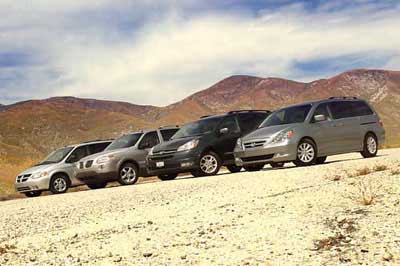
The Players We compared the Dodge Grand Caravan, Honda Odyssey, Pontiac Montana SV6, and Toyota Sienna.
Congratulations, evolved man or woman. You have chosen to learn more about minivans.
With the recent introductions of new models and technologies, combined with the arrival of the summer road-trip season, we wanted to compare the four newest, best selling, and compelling minivans on the market. We chose two American nameplates and two imported nameplates, and then spent three days driving, evaluating, discussing, and ranking them to help you figure out which dealership sells the model that will best meet your needs.
Briefly, let’s review the minivans we selected for this comparison test:
2005 Dodge Grand Caravan
With the addition of Dodge’s slick Stow-‘n-Go seating system for 2005, which folds all of the rear seats into the floor to maximize cargo capacity, the Grand Caravan is once again a contender for best minivan. Add impressive safety scores, appealing design, and relatively low prices, and the Dodge Grand Caravan was a must-have vehicle for this test. The 2005 Chrysler Town & Country is essentially identical.
We tested the 2005 Dodge Grand Caravan SXT with the Premium Group package (triple-zone automatic climate control, rear sonar park assist, overhead storage bins and rail system, overhead console with trip computer and vehicle information system), a power liftgate, power adjustable pedals, an in-dash CD/DVD changer with rear entertainment screen, tire pressure warning system, and side curtain airbags. The sticker price of our test vehicle was $31,930 including the $680 destination charge.
2005 Honda Odyssey
Redesigned from the rubber to the roof for 2005, the Honda Odyssey has been the choice of consumers and critics for years thanks to stylish design, impressive safety scores, and the increasingly ubiquitous foldaway third-row seat. Now, it’s even better, with more power, more features, and more style.
We tested the top-of-the-line Touring model, but without the optional navigation and DVD entertainment systems. The sticker price of our test vehicle was $35,010 including the $515 destination charge.
2005 Pontiac Montana SV6
General Motors has overhauled its minivan lineup for 2005, and we selected the Pontiac version of its so-called “sport crossover vans” to test against the best. Among the significant changes is a larger front end that is designed both to improve crashworthiness and look more like an SUV to minimize the geek-factor. GM also sells this van as the Buick Terraza, Chevrolet Uplander, and Saturn Relay.
We tested the front-wheel-drive model (all-wheel-drive is optional) with a Premium Convenience package (power sliding driver’s side door, rear park assist, driver information center, theft deterrent alarm, programmable garage door opener), and seven-passenger seating with second-row captain’s chairs. Other options included Stabilitrak stability control, traction control, side-impact airbags, remote vehicle starting, 115-volt power outlet, first-aid kit, wireless headphones for the standard DVD entertainment system, brushed silver rooftop luggage rails, and an engine block heater. The sticker price of our test vehicle was $31,825 including the $715 destination charge.
2005 Toyota Sienna
All new for 2004, the Toyota Sienna trumped the old Honda Odyssey thanks to more modern design, a larger and more comfortable interior, and a new luxury trim level with lots of fancy doo-dads. Question is: With a new Honda Odyssey on the market and substantially revised domestic competitors arriving for 2005, can Toyota hang onto the Best Minivan crown?
We tested the priciest Sienna that Toyota has to offer; the XLE Limited with all-wheel-drive. Options on our minivan included the Limited Package #2 (rear DVD entertainment system, two 115-volt power outlets, navigation system with touch screen and back-up camera, JBL Symphony audio system with 10 speakers), carpeted floor mats, and a rear spoiler. The sticker price of our test vehicle was $42,296 including the $540 destination charge.
Powertrain
Powertrain Performance might be defined differently for minivans, but everyone loves a powerful, smooth, refined engine. Only two of the four vans offered this – the Honda and the Toyota.
Performance is defined differently for minivans than it is for other types of vehicles. With a minivan, you need enough horsepower and torque to haul a seven-passenger load up a hill and over a dale, to carry a dorm room’s worth of detritus across the state, and to handle unexpected finds at country antique shops. Just because acceleration is a secondary concern, however, there’s no need to settle for an agrarian powertrain. The engine should be refined and quiet, and the transmission should shift smoothly and quickly. As we discovered during our test, General Motors and DaimlerChrysler are behind the times on this front.
4th Place – 2005 Pontiac Montana SV6
Thrashing under the hood of the 2005 Pontiac Montana SV6 is a 3.5-liter V6 engine. Equipped with an archaic overhead valve design as opposed to modern overhead cam construction, this motor is more powerful than the V6 that propelled Pontiac’s minivan last year, but is distinctly lacking compared to the other models in this test. It musters 200 horsepower and 220 lb.-ft. of torque, making it the weakest engine of the bunch. However, the Pontiac Montana SV6 did boast the lightest curb weight of our quartet of family haulers, and returned the best average fuel economy of the test, at 16.6 mpg. Our test drivers agreed that the Pontiac’s V6 was lackluster, noting that the driver really needed to get a foot into the throttle to spark a downshift for more power, and that what power the engine could deliver was elusive. We also commented on how the four-speed transmission was constantly hunting for gears to make the best of the meager powerband, and that in traffic, the Montana SV6 sometimes produced unexpected bursts of acceleration because of the tranny’s indecisive nature.
3rd Place – 2005 Dodge Grand Caravan
Scoring a few notches better than the Pontiac, the 2005 Dodge Grand Caravan’s rapidly aging 3.8-liter V6 is getting close to retirement age. Like the Montana’s V6, this Dodge motor is an overhead valve design, making it less sophisticated than the hearts of the Honda and Toyota. With 215 horsepower and 245 lb.-ft. of torque made at lower engine speeds than the Pontiac, the Dodge feels more lively, despite its slight weight penalty. Nevertheless, the Grand Caravan’s V6 possesses a grainy, coarse character and the transmission is slow to downshift, making lane changes in traffic or passing on the highway a challenge. When plodding along in traffic, the four-speed transmission also clunks when shifting, which doesn’t inspire much confidence despite the standard seven-year/70,000-mile powertrain warranty – the best of the group. What helps the Grand Caravan’s engine rank higher than the Pontiac is strong mid-range response. On the highway, the Dodge is more fleet of foot. But, according to our testing, fuel economy is lower than the Montana SV6. We averaged just 16.2 mpg.
2nd Place – 2005 Toyota Sienna
More power would have tied the 2005 Toyota Sienna with the stronger Honda Odyssey, or perhaps even have clinched a lead. Toyota’s 3.3-liter dual overhead cam V6 is a paragon of refinement, making a respectable 230 horsepower in a minivan that weighs within 100 pounds of the Dodge and Pontiac. But where the motor really shines is low-end torque, providing 242 lb.-ft. at just 3,600 rpm. However, our test van, a well-equipped all-wheel-drive model, scored the worst fuel economy rating of the test at an unimpressive 15.2 mpg. Regardless, the Sienna’s V6 is quiet when cruising and emits a sporty note when revved, while the five-speed automatic transmission – with one extra cog over the Dodge and Pontiac – is responsive and refined in operation. We all agreed that the Toyota Sienna had plenty of power for a minivan.
1st Place – 2005 Honda Odyssey
Honda’s new Variable Cylinder Management (VCM) technology did not affect the voting for best minivan powertrain. Designed to improve fuel economy by shutting off half the V6 engine’s cylinders when cruising on the highway, VCM helped our Odyssey return an average of just 16.2 mpg during testing, tying the Dodge and coming in lower than the Pontiac. Plus, one of our test drivers didn’t like VCM because he could feel it working. Rather, gobs of seamless power, a smooth shifting five-speed automatic transmission, and a pleasing engine note at high engine revs contributed to the somewhat portly 4,634-pound Honda Odyssey’s one-point win over the Toyota. Indeed, the Odyssey will please even those who enjoy driving, which might explain the poor fuel economy showing – we had a good time driving this van.
Driving
Driving Honda builds the best driving minivan, but if a cushy ride is your priority, try the Toyota or Dodge on for size.
Every car should be able to stop, steer, and ride comfortably – even minivans. And usually, capable brakes, responsive steering, and a smooth but communicative ride not only contribute to safety but also make a vehicle fun to drive. Hey, even people who aren’t looking for fun like it when they find it.
4th Place – 2005 Pontiac Montana SV6
Driving excitement, fuel for the soul, action – these are just a few of the slogans that Pontiac has used to convey its stature within the General Motors hierarchy as GM’s performance division. Unfortunately, nobody has bothered to let these marketing whizzes drive the competition, which means truth-in-advertising laws are bending like cattails in a tropical storm. However, the 2005 Pontiac Montana SV6 is not without merits. Our test drivers agreed that it features excellent brake pedal feel, but that pedal is hooked up to a four-wheel-disc ABS system that feels the least capable of the group. We also blasted the Montana SV6’s handling for slow steering response, P225/60R17 Continental TouringContact tires that lose grip and reach limits too quickly, a touchy stability control system that activates when trouble is not yet looming, and poor weight transition coupled with lots of body roll. All of these negative handling characteristics directly impact the Montana SV6’s behavior in emergency maneuvering, such as when a soccer ball followed by a distracted kid flies into the road in front of you. Plus, the Montana’s ride quality was busy on the rumpled and rippled freeways of Los Angeles, and the independent front/twist-beam axle rear suspension pounds hard over bumps and broken pavement. Over dips, the Pontiac suffers excessive wallow. In short, driving the 2005 Pontiac Montana SV6 is more work than pleasure.
3rd Place – 2005 Dodge Grand Caravan
When the Dodge Grand Caravan was last redesigned, for the 2001 model year, it became the most fun, responsive minivan on the market. Times have changed. Today, the Grand Caravan’s strength is ride quality, and even then bumps can produce a rubbery, jittery response from the independent front/twist-beam axle rear suspension, making it feel like the tires aren’t connected to the pavement. With a soft ride comes bob, float and lower handling limits, but the Dodge tracks well in corners despite 215/65R16 Bridgestone Turanza tires that fold over and play dead when the Grand Caravan is pushed. Lots of weight transitions from side to side in S-turns, but the Dodge exhibits only moderate body roll, and though the steering is both slow and numb, the Grand Caravan feels surefooted from the helm. Everyone complained about the brakes on the Grand Caravan. They work fine, but the pedal lacks responsiveness, travel, and feel, making it very hard to apply proper amounts of pressure for any given situation. In the end, we judged the Dodge Grand Caravan to be little more than Point A to Point B transportation, lacking the verve of the Honda and the nimbleness of the Toyota.
2nd Place – 2005 Toyota Sienna
Where the Dodge and Pontiac suffered significant hardware flaws, the Toyota Sienna gave us little reason to criticize, even if it didn’t stand out in any particular way. Refinement goes a long way toward making everything OK, and after driving the Sienna we agreed that, in XLE Limited trim like our test vehicle, it could easily wear a Lexus badge. The steering offers that same overboosted, leaden feel as a Lexus. The suspension features a more taut ride quality than the Dodge and Pontiac, but also feels better connected to the road and more responsive in the event of an emergency. The four-wheel-disc brakes feature brake assist technology for panic stops. When driven hard, the Sienna’s weight transitions smoothly from side to side, and the 225/60R17 Bridgestone tires provide good grip for secure handling. The closest we came to disparaging the driving character of the Toyota was in discussion of brake pedal feel. Two test drivers felt that the pedal was a little touchy in town, and one reported that the pedal sank to the floor during a lengthy wait at a long traffic light. We also felt that the front suspension transmitted an unexpected amount of impact harshness through the steering column and into the cabin. Otherwise, the 2005 Toyota Sienna was a rock solid daily driver.
1st Place – 2005 Honda Odyssey
Tautly tuned, the 2005 Honda Odyssey’s unyielding ride quality is the primary deal-breaker when it comes to driving character. We tested the Odyssey Touring, which is equipped with special run-flat Michelin tires that have stiffer sidewalls than regular rubber. Certainly, part of this Odyssey’s rather harsh ride is due to the Touring’s special treads, but Hondas generally ride stiffer than competitors. If a soft, cushy, isolated cruise down the highway is what you seek, give the Toyota or Dodge a try, because the Honda drives more like a sport sedan than a minivan. The tires feel glued to the ground at all times, the four-wheel-independent suspension capably controlling body motions like dive, squat, and lean. The four-wheel-disc brakes with ABS and brake assist are excellent, providing excellent feel and modulation at all times. This is one buttoned-down vehicle, and it communicates what’s happening under the tires through the quick and direct steering. One of our test drivers called the 2005 Honda Odyssey “the sports car of minivans.” That explains it all, right there. But that stiff ride quality is enough to make two of our test drivers recommend the Toyota Sienna as the better vehicle for most consumers.
Comfort
Comfort
Minivans are American inventions in name only, and it seems that Honda and Toyota have not only discovered but also improved upon the recipe.
Comfort is a key ingredient of a minivan, which is designed to move lots of people over long distances. Seat shape and padding, the amount of legroom, the ease of entering and exiting, and how quiet the passenger cabin is on the freeway all contribute to a sense of comfort, allowing occupants to emerge from a lengthy trip fresh and ready to go. The point spread between the domestics and the imports in this category wasn’t as wide as some others, but it seems that the Japanese manufacturers have not only distilled the essence of a uniquely American vehicle type, but have improved upon the recipe – leaving the Dodge and Pontiac tied in last place.
3rd Place – 2005 Pontiac Montana SV6 (tie)
A decade ago, GM worked together with Europe’s Opel division to create a minivan that would serve the needs of both geographic regions, to disastrous results. The Opel version wound up being too large for Europe’s narrow streets and tight parking areas, while the American models were too narrow and small for overfed bodies and weekend do-it-yourselfers. Unfortunately, the 2005 Pontiac Montana SV6 is a reskinned version of that old model, and so it retains its narrow width, crowding occupants onto small seats, and cramming them in with little space for legs in front of hard plastic seatback storage bins. Comfort is better in the rear seats than up front. Odd, bubbled front seat bottom bolsters make you feel like you’re sitting on the van instead of in it. To GM’s credit, the seat fabric looks rugged and feels durable, like it came out of a Nissan Xterra. And the front door windowsills are padded in a plush vinyl that is supposed to simulate leather. But the Montana SV6’s inboard armrests aren’t height-adjustable, the pedals cannot be adjusted, and the steering wheel is too close even for people with short limbs, which means that many drivers are likely to find themselves uncomfortably intimate with the driver’s airbag cover. Plus, the Montana SV6 is loud inside, where wind and road noise are strongly evident on the highway. Finally, riders relegated to the third row of seats won’t be happy about contorting their bodies to get in and out, even with the tilt-and-slide second row seats.
3rd Place – 2005 Dodge Grand Caravan (tie)
Space-saving, super high-density foam padding originally developed for NASA is used in the 2005 Dodge Grand Caravan’s seats so that they can tightly collapse for storage in the floor wells. Unfortunately, the result is an oddly shaped bottom cushion equipped with extreme thigh support. One test driver said that sitting in the rear seats felt like lounging in a beach chair with the rear legs buried in the sand. This reclined body positioning makes it harder for rear occupants to climb in and out, and also places the head restraint too far away in a rear impact crash. Furthermore, there’s no foot space under the seats. But hey, the seats fold into the floor, so shut-yer-piehole. Up front, the captain’s chairs are plush and supportive but lack lumbar adjustment. The windowsills are hard plastic – unfriendly to elbows that might rest there – and the steering wheel rim is shaped in a way that can be uncomfortable to hold. The single-setting armrest worked for our group of test drivers, so we didn’t miss an adjustment feature here, and optional power adjustable pedals improve legroom for the driver. Rear passengers get decent legroom, but little foot room, and clearance space to get into and out of the third-row seat was the best of the bunch. Wind, engine, and road noise are clearly evident inside the Grand Caravan, but our test van suffered no rattles or squeaks.
2nd Place – 2005 Honda Odyssey
Rattles and squeaks were the 2005 Honda Odyssey’s undoing in this category. When underway, our sample van sounded like a family of rodents had moved in. Add the din from the run-flat Michelin tires coupled with excessive suspension noise, and the Honda was the second most aurally annoying van in the test. That could get tiring on a long road trip. Fortunately for Honda, occupant comfort makes up for lost ground, the only other complaints being hard plastic front windowsills where people might rest an elbow, slightly tight clearance to the third-row of seats, and second-row seats that sit too low and don’t offer enough thigh support. Maybe Dodge could trim some of that high-density foam out of the Grand Caravan and send it to the Honda plant in Alabama. Our test van came equipped with power adjustable pedals, but lacked a telescoping steering wheel that would have helped to create an optimum seating position. Every chair in the house is firm but comfortable, providing good support over the long haul. Legroom, headroom, shoulder room, hip room, foot room – it’s all good. Everybody is comfortable in a 2005 Honda Odyssey, it’s just that they might not be able to have a conversation with all the racket inside the cabin.
1st Place – 2005 Toyota Sienna
Toyota stacked the deck by sending us a fully loaded, $42,000 Sienna XLE Limited AWD for this test. Soft, supple leather seats complemented by fake wood trim lent the Toyota a decidedly luxurious and upscale feel, but the bottom line is that even with a cloth interior and fewer bells-and-whistles, the Sienna is the most comfortable minivan on the market today – for everyone but the driver. Though a huge improvement over the original Sienna, today’s version still lacks adequate seat track travel. And while our van did have a telescopic steering wheel, power adjustable foot pedals were not on the menu and they could have helped our lankiest drivers get more comfortable behind the wheel. Speaking of which, the wood-and-leather steering wheel rim on our test van gets extremely hot in sunshine, so be forewarned. At least you can rest your left elbow on the nicely padded windowsill and your right arm on the adjustable inboard armrest while waiting for the wheel rim to cool off. In the second-row captain’s chairs, passengers ride in first-class comfort with lots of leg, head, foot, shoulder, and hip room. The seats are wide and plush, like those in front, but prove supportive for long trips. Our test model even had side window shades to keep glare to a minimum. With those second-row seats moved all the way back in the track, third-row leg space suffers, but it’s relatively simple to climb aboard even if the side doors don’t create as large a portal as expected. But one of our favorite things about the Toyota Sienna was how quiet the interior was when riding down the highway. There’s barely any wind noise, and though the suspension delivers a bit of racket on larger bumps and the engine is audible when introduced to the region approaching redline, the Sienna is silent in comparison to the Dodge, Honda, and Pontiac. And everybody knows silence is golden.
Quality
Quality
Auto critics must base evaluations on tangible measures of quality, not theories about what could happen in the future based on reporting from the past. As it turns out, Honda is beaten by a Pontiac, but Toyota is still tops.
Quality pertains to two things when it comes to evaluating a brand-new automobile: materials and assembly. From the standpoint of a car critic, it’s unfair to award quality points to a Toyota just because Toyotas have historically proven durable, just as it is unfair to deduct quality points from a Dodge because past models have suffered numerous recalls and part failures. The critic must base evaluations on tangible measures of quality, not theories about what could happen in the future. In this particular contest, the Dodge and Toyota landed in predictable slots based on their merits as new vehicles, but what surprised us was how the Honda Odyssey and Pontiac Montana SV6 slotted into the mix.
4th Place – 2005 Dodge Grand Caravan
Stacked up against the more upscale cabins of the Honda, Pontiac, and Toyota, the 2005 Dodge Grand Caravan’s interior came off as a dour mix of low-rent plastics, cheap fabrics, and monotone color schemes that together made it as hospitable as Iraq’s Abu Ghraib prison. No, the allegedly sporty white-faced gauges didn’t help. Strangely, the Grand Caravan’s dashboard is covered by a plush, soft-touch surface that should be coating the windowsills on the tops of the door panels, but isn’t. At least the Dodge’s interior bits and pieces were assembled decently, as evidenced by the lack of rattles and squeaks in our test sample. Outside, however, sloppy UAW-style part and panel fit was the rule. Shut-lines for the hood and the tailgate were grossly inconsistent, and neither fit flush to adjoining body panels. Both fascias were slightly crooked, the headlights didn’t feature consistent fit, and the side doors exhibited slight variances in panel gaps. Panel gaps wide enough to stick a finger in, by the way.
3rd Place – 2005 Honda Odyssey
Ouch. If Nissan’s head honcho Carlos Ghosn were running the show, a squadron of quality control freaks would descend upon Honda’s Alabama assembly plant and get the Odyssey’s fit and finish up to standards, pronto. The minivan with the most interior rattles and squeaks, perhaps not surprisingly, also displayed the worst interior assembly quality. Many of the Honda’s bits and pieces didn’t fit together well, and some exhibited excessively rough edges from the production process at the factory. Our test van’s driver’s seat squeaked, the doors on both gloveboxes fit poorly, and the lower dash panel on the passenger’s side was loose. On the outside, the Honda’s tailgate was tweaked off-center as severely as the Dodge’s, and while the hood was on straight it didn’t rest flush with the front fenders. What saved the Honda Odyssey from a last place ranking in our quality category were the materials used to construct the interior. The headliner is a lovely mesh cloth; the hard plastics are all coated with a low-gloss, rubberized finish; and every button, stalk, and knob operates with luxury levels of dampening and refinement. The leather upholstery could be softer, more like the Toyota’s, and the hard door panel windowsills are aggravating, but otherwise the Odyssey’s innards exude quality. Too bad it proves to be only skin deep.
2nd Place – 2005 Pontiac Montana
Don’t bother taking off your glasses and rubbing your eyes – you’ve got it right. In terms of quality, a Pontiac is taking second place over a Honda. But, like the Honda, in many ways that quality is skin deep, in this case a veneer designed to fool the buyer during the test drive but that peels away over time. GM managed this by properly matching color tones and patterns, but the old way of cutting costs to the bone means that the Montana’s interior quality is sleight-of-hand. Rap a fingernail on that matte-finished dash, and you’ll hear what we mean. Open the glovebox door, and you’ll feel it. That’s thin plastic, not at all like the sturdy materials used in the Honda. The brushed aluminum trim is also plastic, but it looks nice, along with the chrome-dipped door handles. The mesh headliner looks like what you’d find inside an Audi, and the seat fabric feels particularly durable while looking upscale at the same time. Though our test Montana SV6 had just one barely audible rattle coming from someplace in the back, many parts wiggled when pressured, and the hard plastic dash had a dimple molded right in during the manufacturing process. We also spotted a warped piece of fake aluminum on the lower part of the dashboard. Outside, the Montana was less impressive. Exposed side molding adhesives that looked like they would fail at about the same time that the warranty expires were off-putting, and Pontiac uses plastic door-track covers where Honda employs real metal. The roof rack looks sturdy but doesn’t feel it, and we noted that both the hood and tailgate suffered minor fit problems.
1st Place – 2005 Toyota Sienna
Though not as dependable as death or taxes, quality from Toyota has almost become a given. Our sample Toyota Sienna, after having been examined more closely than a Beverly Hills plastic surgery candidate, suffered a single exterior assembly flaw. The tailgate was mounted slightly off-center. Otherwise, we couldn’t find one thing out of place. Inside, the results were not as conclusive, thanks to a warped plastic glovebox door, minor gap variances between panels, and some exposed rough plastic edges on the lower door panels. Plus, our Sienna rattled and squeaked more than the Dodge and Pontiac, but less than the Honda. The materials used in construction, however, were excellent. Aside from the fuzzy headliner, only the busy appearance caused by multiple grain patterns, wood trim, chrome décor, sparkly silver plastic accents, and glossy radio and climate control displays put us off. But that’s a design issue. The materials are top-notch, soft where people are likely to touch and hard where they aren’t. The leather upholstery was soft, smooth, and could easily pass muster for use in a Lexus.
Design
Design
We ranked our quartet of family haulers based on more than aesthetics, also taking into consideration outward visibility, control layout, and feature operation. But style is not entirely elusive, as the Honda proves.
Slap two boxes together, round off the edges for the sake of aerodynamics, add four wheels, and you’ve got a minivan, a vehicle that emphasizes function over form like few others. Likewise, the interior is designed to serve the goal of utility first, appearances second. That’s why, when it came to design, we ranked our quartet of family haulers based on more than aesthetics, taking into consideration outward visibility, control layout, and feature operation. But style is not entirely elusive, as our clear winner proves.
4th Place – 2005 Dodge Grand Caravan
Plain inside and out, regardless of the white-faced gauge cluster and unconvincing fake carbon fiber dash trim, the 2005 Dodge Grand Caravan is a handsome but nondescript conveyance that is incredibly easy to see out of thanks to rear seat headrests that collapse to provide an unobstructed view to the back. That would be fine given a minivan’s mission in life, but the DGC’s rental car ambience, combined with funky stereo and climate control system designs, ultimately puts it at the back of the pack in this category.
3rd Place – 2005 Pontiac Montana SV6
In the names of safety and vanity, Pontiac has added a gigantic snout to the Montana for 2005. The result is better crash-test scores, styling that’s more like an SUV than a minivan, and an ungainly amount of front overhang. The best design element on the outside is the handsome brushed aluminum wheels. Inside, it’s clear that Pontiac ripped a page out of the German luxury playbook; from the chrome-trimmed air vents and aluminum dash trim to the red-and-white gauge lighting and mesh cloth headliner. Stereo and climate controls have buttons that are a little too small, but everything is easy to find and use. Pontiac even cribbed Toyota’s brilliant design for the cruise control system. The main design flaw, aside from subjective judgments of style, is outward visibility. All rear seats get huge head restraints that severely cut the view to the rear and the sides. Good thing a rear sonar parking system is optional.
2nd Place – 2005 Toyota Sienna
Like the Dodge Grand Caravan, the Toyota Sienna is generically handsome, with one staff member complaining loudly about nonsense he termed “the vacuum cleaner front end and flowery wheel design.” Whatever. This same dude also griped about the multitude of materials and textures inside the Sienna while the rest of us likened the cabin to a Lexus. Let him have the Dodge if simplicity is his style. What kept the Sienna to just a one-point lead over the Montana was the optional navigation system, which bundles secondary stereo functions along with several other features, accessed through a mix of tiny dashboard buttons and touch-screen commands. Other than this flaw – one that can be avoided by skipping the navigation system – the Sienna’s control layout is simple and clearly marked, with functions located exactly where you expect them to be. Visibility is also excellent, thanks to thin front pillars, large side mirrors, low rear headrests, and sonar park assist front and rear.
1st Place – 2005 Honda Odyssey
Honda mounts the Odyssey’s gear selector high on the center of the dashboard, next to the radio and climate control systems. Toyota does the same thing, but places the stick lower on the dash where it cannot block access to the controls. Underway in the Odyssey, we found that it’s possible to bump the shifter from Drive into Neutral when reaching for the volume control. Our other design complaints were also related to control placements. The power sunroof controls are on the lower left side of the dash, stereo tuning controls are mounted so far away that they’re hard to reach, and the seat heater switches are too low on the center of the dashboard. Otherwise, we had no complaints about the design of the 2005 Honda Odyssey. Clearly the most stylish on the outside, the Odyssey also exhibits a balanced aesthetic in the cabin, where the dash flows seamlessly across the van, punctuated with an electroluminescent gauge cluster that reads “welcome” when you enter and “goodbye” when you leave. Visibility is on par with the Toyota, and like the Sienna, the Odyssey can be equipped with front and rear sonar parking assist.
Utility
Utility
Utility is defined not only by people and cargo toting capability, but also by how well a vehicle swallows the knicks and knacks of daily life. Turns out that Stow ‘n Go is the only trick the Grand Caravan knows.
People buy minivans because they offer unsurpassed utility in the form of seven-passenger seating and cavernous cargo capacity. We measured utility by comparing how easy it was to convert each minivan from a people carrier to a cargo toter. We also examined each van’s talent at swallowing the knicks and knacks of daily life, from cell phones and Frapucchinos to Gameboys and Barbie dolls. Turns out, Stow ‘n Go is the only trick the Grand Caravan knows.
4th Place – 2005 Pontiac Montana
Because the 2005 Pontiac Montana SV6 is based on a decade-old platform, engineers couldn’t design a system to tuck the third-row seats down into the floor. So instead, they faked it. Fold the third-row seat in half, and it looks like it disappears into the floor. But in reality the rear seatbacks simply line up with a raised platform attached to the rear cargo floor that serves as a useful trunk organizer. Trouble is, the resulting load floor sits high, increasing the liftover height, and robbing the Montana of useful cargo space. To maximize room, the trunk organizer needs to be unscrewed and removed from the van, and the third-row seats must be dragged out of the tailgate and stored in the garage. The second row seats fold in half, exposing their plastic seatback storage compartments to scuffs, or they can be removed as well. But even with all the seats and the organizer yanked out of the Montana, it offers a meager 136.5 cubic feet of total cargo room, the least of any van in the test. Reinstalling everything is a back-breaking hassle, and the third-row seatbacks don’t have a strap attached to them so you’ve gotta climb inside on top of the trunk organizer and yank on the seat to get it flipped up for use. Ugh.
We also found that cabin storage areas could be more plentiful and better designed. For instance, the folding trays between the first- and second-row seats need rubberized surfaces to keep items placed upon them from sliding off when accelerating, braking, or turning. And aside from the large glovebox, the Montana SV6 lacks usefully sized storage areas.
3rd Place – 2005 Dodge Grand Caravan
Stow ‘n Go is Dodge’s system of second- and third-row seats that tumble and fold into the floor. The Grand Caravan, and its corporate cousin, the Chrysler Town & Country, are the only minivans on the market with such a feature. The Nissan Quest comes close – the second-row seats in the Quest collapse onto the floor to create a flat cargo area – but the Dodge’s bins can be used for 12 cubic feet of covered storage when the seats are in use. Stow ‘n Go is ingenious, and for minivan buyers who spend lots of time carrying both people and cargo, it might be the only selling point worth caring about. It’s not quite as easy to use as Dodge claims, though. To access the storage wells for the second-row seats, the front seats need to be moved forward or the lids won’t open all the way. But the third-row seats can be dropped with one hand, and Dodge provides clearly marked, three-step instructions on straps attached to the seats. Once the Grand Caravan is converted and ready to swallow a load measuring as much as 167.9 cubic feet, your back will appreciate the ultra-low liftover height and power liftgate feature. When you’re ready to haul the soccer team again, flipping the seats back into position is just as simple as it is to stow them.
Our main complaint with the Dodge’s utility had to do with the utter lack of useful storage spots for stuff. The glovebox is small. The overhead storage compartments are small. The door bins are small, and there aren’t any in the sliding doors. There’s a single seatback pocket for the second row, and in our test van it was stuffed with headphones for the DVD entertainment system. A single net could be stretched between the front buckets or the second-row captain’s chairs, but small items wind up on the floor. There is exactly one cupholder for each seating position. The most impressive storage solution in the 2005 Dodge Grand Caravan, aside from Stow ‘n Go, was a card clip. In our opinion, the Grand Caravan is a one-trick pony…but it’s a hell of a trick.
2nd Place – 2005 Toyota Sienna
A single point separated the 2005 Toyota Sienna from the Honda Odyssey in this category, and the difference could have been one of these three things: 1.) It takes two hands to get the Sienna’s third-row seat folded flat into the floor, compared to one hand with the Honda; 2.) Like the Odyssey, the Sienna’s second-row seats can be arranged so that they’re together like a bench seat or apart like captain’s chairs. The difference is that, in the Honda, they slide together without being removed and re-installed; 3.) The Toyota’s second-row seats were a little more difficult to remove than the Honda’s, though they were easier to re-install once you knew what to do. Otherwise, the two excellent vans were neck-and-neck in terms of utility. The Toyota’s cargo well with all three seats in use is bigger than the Honda’s, and the Sienna offers more maximum cargo space, too, at 148.9 cubic feet. Our test van came with a power tailgate that made it easier to load with arms full, and it included handy 115-volt power outlets in both the second- and third-row areas.
Nooks and crannies include bins under the front door armrests, dual gloveboxes, bins in the front and the sliding doors, and large covered bins in the third-row of seats. There’s also a good-sized covered cubby in the dash, and our Sienna was equipped with a large center console bin that could be unclipped from between the front seats and moved to a new location between the second-row seats. Additionally, the Toyota offered the most intelligently designed cupholders of any van, totaling 11. Plus, and this is a big deal for new parents, the Sienna can be had with eight-passenger seating that includes a second-row center seat that slides forward so that a baby is placed both in the center of the Sienna for safety and close to parents riding up front. Thanks to Toyota’s thoughtful attention to detail, the Sienna is an easy van to live with every day.
1st Place – 2005 Honda Odyssey
Watch your noggin on the Odyssey’s tailgate if you’re six-feet-tall, because Honda inexplicably designed it so that six-footers can catch their scalps on the latch when it’s open. It was the only van in the test that didn’t pass our head clearance test. Otherwise, we have no complaints other than that the second-row seats still require removal and storage in the garage to create maximum storage space – just like the Pontiac and Toyota. The Odyssey’s folding third-row seat flips and drops into the floor with one hand, and raises just as easily. The second-row seats tip up and slide over to create a bench seat, and in the Odyssey EX or EX-L buyers can get eight-passenger seating with the PlusOne removable seat. New parents will appreciate that the PlusOne seat can be set to place a baby safely in the center of the Odyssey and within doting distance of Mommy and Daddy.
Our Honda Odyssey Touring test van had a humongous center console bin between the second row seats, which can be removed to create a flat load area totaling 147.4 cubic feet. The Honda also included dual front gloveboxes, twin covered dash bins, two bins in each front door panel, slots in the sliding side doors, seatback pockets for both rear rows of seats, zippered mesh compartments for the second-row of seats, and covered bins on either side of the third-row bench. It even had a ticket flap in the driver’s side visor, a pen clip molded into the rear edge of the rubberized center folding tray, and 17 freakin’ cupholders. And let’s not forget the lazy susan under the floor in the center of the van, accessible from the front and second-row seats. Righteous.
Final Rankings
Final Rankings
Dynamically, the best from the domestics can’t come close to delivering the comfort, utility, and sophistication that the 2005 Honda Odyssey and 2005 Toyota Sienna can.
Huge price advantages, especially after rebates, are the main reasons to consider the 2005 Pontiac Montana SV6 or the 2005 Dodge Grand Caravan. Another selling point for the Dodge is Stow-‘n-Go seating, a must-have feature for anyone who needs to switch from passenger hauler to cargo carrier on a regular basis. But dynamically, the best from the domestics can’t come close to delivering the comfort, utility, and sophistication that the 2005 Honda Odyssey and 2005 Toyota Sienna can. At the end of the day, the Pontiac scored just below the Dodge, and the Toyota ranked just under the Honda – but a huge gulf separated the American minivans from the Japanese models.
4th Place – 2005 Pontiac Montana SV6 (5.5 GPA)
Minivans should be easy to use, easy to drive, and comfortable to passengers. The Pontiac Montana SV6 is none of these things. Plus, it’s based on a decade-old platform, plagued by sloppy handling, and endowed with an unrefined powertrain. Surprisingly, quality is a Montana SV6 strong point, inside and out. And the materials used in the cabin resemble, if not duplicate, those used in high-end German luxury sedans. Plus, it got the best fuel economy of our test group, though that’s usually what comes with low power ratings, and can be equipped with all-wheel drive. But used as a minivan, and compared to the driving dynamics of some competitors, the Montana SV6 is the least worthy vehicle in this group.
3rd Place – 2005 Dodge Grand Caravan (5.6 GPA)
Four reasons exist to choose the 2005 Dodge Grand Caravan: Stow-‘n-Go, safety crash scores, rebates, and a great powertrain warranty. Whoops! Dodge is canceling that warranty for 2006, removing one great reason to choose the Grand Caravan. Bad move. Nevertheless, the Dodge features the biggest maximum cargo capacity, simple and quick conversion from passenger toting to parcel holding, and a low price. It’s not terribly comfortable, quick, or equipped with quality materials or construction. We’d rather own this over the Pontiac, but just barely.
2nd Place – 2005 Toyota Sienna (7.2 GPA)
When it comes to choosing a new minivan, you can’t go wrong with the Toyota Sienna, even if it did lose out to the Honda Odyssey by the thinnest of margins. What the score boils down to is simply this: the Honda is more fun to drive, and we like the way it looks. That’s why, if having a good time while driving your minivan is low on your priority list and you prefer the design of the Sienna, the Toyota makes a great choice. It is assembled with the utmost care, constructed with exceptionally high quality materials, and is very comfortable for any passengers that climb aboard. Add in great safety scores, a reputation for reliability, available all-wheel drive, and Lexus levels of luxury equipment and refinement, and the 2005 Toyota Sienna can still set the standard for modern minivans.
1st Place – 2005 Honda Odyssey (7.3 GPA)
Quality, both in terms of materials and construction, is the single most disappointing thing about the 2005 Honda Odyssey. Otherwise, we ranked the Honda tops in nearly every category. Honda has turned out a stylish, comfortable, utilitarian, and fun-to-drive family conveyance that works just as any minivan should, at prices that fit just about any budget. And while some staff members drove our test Odyssey like they stole it, our test model’s Variable Cylinder Management system does work to produce highway fuel economy in the low 20-mpg range. If Honda can reduce the rattles and squeaks inside while improving fit and finish, there won’t be any reason to consider the Sienna.
Safety
Safety
An unsafe minivan is about as useful as a surfboard in Topeka.
An unsafe minivan is about as useful as a surfboard in Topeka. These vehicles are designed to transport families, and nothing is more important than the safety of your spouse, your children, your relatives, or your friends. Therefore, it’s no surprise that any of these four minivans is likely to protect loved ones in the event of a crash with a vehicle of similar size and weight.
But what about other features that help to promote safety, items like OnStar concierge service, sonar parking assist, run-flat tires, and rear back-up cameras? Here’s a handy chart to help you see which vans include the latest safety technology as standard or optional equipment, and which vans don’t offer these features at all. Data is based on a comparison of base trim levels with no options, not the vans as they were tested.
| Dodge | Honda | Pontiac | Toyota | |
| Adjustable Pedals | Optional | Optional | N/A | N/A |
| Airbag Deployment Notification | N/A | N/A | Standard | N/A |
| Airbags, Side-Curtain | Optional | Standard | N/A | Optional |
| Airbags, Side-Impact | N/A | Standard | Optional | Optional |
| All-Wheel Drive | N/A | N/A | Optional | Optional |
| Backup Camera | N/A | Optional | N/A | Optional |
| Brake Assist | N/A | Standard | N/A | Standard |
| Conversation Mirror | N/A | Optional | N/A | Standard |
| Cruise Control, Laser-Guided | N/A | N/A | N/A | Optional |
| Daytime Running Lights | N/A | N/A | Standard | Optional |
| Heated Outside Mirrors | Optional | Optional | Optional | Optional |
| Parking Assist, Front | N/A | Optional | N/A | Optional |
| Parking Assist, Rear | Optional | Optional | Optional | Optional |
| Stability Control | N/A | Standard | Optional | Optional |
| Three-point Seatbelts for All | n/a | Standard | N/A | N/A |
| Tire Pressure Monitor | Optional | Standard | N/A | Standard |
| Tires, Run-Flat | N/A | Optional | N/A | Optional |
| Wiper De-icer Grid | N/A | N/A | N/A | Optional |
| NHTSA Driver | 5-stars | 5-stars | 5-stars | 4-stars |
| NHTSA Front Passenger | 5-stars | 5-stars | 5-stars | 5-stars |
| NHTSA Front Side | 5-stars | 5-stars* | 4-stars | 5-stars |
| NHTSA Rear Side | 5-stars | 5-stars | 5-stars | 5-stars |
| NHTSA Rollover | 4-stars | 4-stars | Not tested | 4-stars |
| IIHS Frontal Offset | Acceptable | Good -- Best Pick | Good | Good -- Best Pick |
| IIHS Side Impact | Not tested | Not tested | Not tested | Not tested |
* The NHTSA has a safety concern about this crash score for the 2005 Honda Odyssey. According to the NHTSA: “During the side impact test, the driver door became unlatched and opened. A door opening during a side impact crash increases the likelihood of occupant ejection.”
Specifications
Specifications Clearly, Honda and Toyota know how to design a proper minivan.
We test drove the 2005 Dodge Grand Caravan SXT, the 2005 Honday Odyssey Touring, the 2005 Pontiac Montana SV6, and the 2005 Toyota Sienna XLE Limited AWD.
| Dodge | Honda | Pontiac | Toyota | |
| Engine Size/Type | 3.8-liter OHV V6 | 3.5-liter V6 with VCM and variable valve timing | 3.5-liter OHV V6 | 3.3-liter DOHC V6 with variable valve timing |
| Horsepower | 215 @ 5,000 | 255 @ 5,750 | 200 @ 5,200 | 230 @ 5,600 |
| Torque | 245 @ 4,000 | 250 @ 5,000 | 220 @ 4,400 | 242 @ 3,600 |
| Transmission | Four-speed AT | Five-speed AT | Four-speed AT | Five-speed AT |
| Curb Weight | 4,325 lbs. | 4,634 lbs. | 4,307 lbs. | 4,365 |
| EPA MPG (city/highway) | 18/25 | 19/25 | 18/24 | 18/24 |
| Observed MPG | 16.2 mpg | 16.2 mpg | 16.6 mpg | 15.2 mpg |
| Length | 200.5 in. | 201 in. | 205.6 | 200 in. |
| Width | 78.6 in. | 77.1 in. | 72 in. | 77.4 in. |
| Wheelbase | 119.3 in. | 118.1 in. | 121.1 in. | 119.3 in. |
| Height | 68.8 in. | 70 in. | 72 in. (without roof rack) | 68.9 in. |
| Legroom (1/2/3 – in.) | 40.6/34.7/38.9 | 40.8/40/41.1 | 39.9/38.9/36.2 | 42.9/39.6/39.5 |
| Headroom (1/2/3 – in.) | 39.6/39.1/38.5 | 39.2/39.6/38.4 | 39.8/38.9/38.1 | 39.5/38.6/38.1 (with sunroof) |
| Max. Seating | 7 | 7 | 7 | 7 |
| Max. Cargo (3/2/1 – cu. ft.) | 19.8/54.2/167.9 | 38.4/91.1/147.4 | 26.9/74/136.5 | 43.6/94.5/148.9 |
| Max. Towing | 3,800 lbs. | 3,500 lbs. | 3,500 lbs. | 3,500 lbs. |
| NHTSA – Driver | 5-stars | 5-stars | 5-stars | 4-stars |
| NHTSA – Front Passenger | 5-stars | 5-stars | 5-stars | 5-stars |
| NHTSA – Front Side | 5-stars | 5-stars* | 4-stars | 5-stars |
| NHTSA – Rear Side | 5-stars | 5-stars | 5-stars | 5-stars |
| NHTSA -- Rollover | 4-stars | 4-stars | Not tested | 4-stars |
| IIHS – Frontal Offset | Acceptable | Good – Best Pick | Good | Good – Best Pick |
| IIHS – Side Impact | Not tested | Not tested | Not tested | Not tested |
* The NHTSA has a safety concern about this crash score for the 2005 Honda Odyssey. According to the NHTSA: “During the side impact test, the driver door became unlatched and opened. A door opening during a side impact crash increases the likelihood of occupant ejection.”
Cool Stuff
Cool Stuff Ironically, minivans are all about cool stuff. Our staff voted the following twelve standard or optional items as the coolest, and most critical, features on our test vehicles.
Ironically, minivans are all about cool stuff. Among the most feature-laden vehicles sold in the U.S., minivans can be equipped with a wide range of equipment designed to entertain and comfort your family while keeping everyone safe. Our staff voted the following twelve standard or optional items as the coolest, and most critical, features on any minivan.
Adjustable Pedals – Power adjustable pedals allow the driver to find an optimum seating position, one that keeps all controls comfortably within reach while reducing proximity to an airbag deployment. Dodge and Honda offer these pedals as optional equipment.
DVD Entertainment – Are we there yet? Are we there yet? Are we there yet? I’m hungry. I’m bored. Are we there yet? Poof! Young mouths go silent when SpongeBob SquarePants is serving up the grub to patrons of the Crusty Crab for the umpteen millionth time. All four of our vans had this pacifier on board, which works equally well for Paris Hilton videos during guys’ weekends in Vegas.
OnStar with Airbag Deployment Notification – Over the years, OnStar has not impressed us much as a system for helping to find addresses, or to get directions. However, the telematics service’s airbag deployment notification system, which detects when the airbags have deployed and notifies rescue personnel of the vehicle’s exact location, is terrific technology. Pontiac’s got it on the Montana SV6, with a free one-year subscription.
Power Outlets – It is a sign of our technological times that high-powered, 115-volt electrical outlets would land on our cool stuff list. With the Honda Odyssey and Toyota Sienna, there’s no more need for converter cords to power laptop computers, video game consoles, portable DVD players, camera equipment, or the like.
Power Tailgate – Seemingly useless, the power tailgate earns its keep the first time you stumble up to your vehicle with plastic handled grocery bags digging into the soft flesh of your fingers – as long as the remote keyless entry fob is easy to access. Pontiac does not make a power tailgate available to buyers of the Montana SV6.
Roll-down Glass in Sliding Doors – Mazda was first to market with this handy feature in the MPV minivan, but Honda and Toyota bring roll-down windows in the sliding side doors to the masses. Yes, the driver gets lockout control to keep errant sippy cups from hurtling into traffic.
Run-flat Tires – The last thing you want to do in a desolate area, in a sketchy part of town, or on a rainy freeway late at night is change a tire. The Honda Odyssey Touring’s Michelin PAX run-flats let you drive 125 miles at 50 mph before getting new rubber installed.
Shades for Side Window Glass – East/west road trips mean somebody’s getting the sun blazing into their eyes for a good part of the day, and if that somebody is under five years of age, Mom and Dad are gonna hear about it. Honda and Toyota offer shades for the side window glass, even though it’s already dark tinted.
Slide-together Second-row Seats – Only Honda and Toyota give the customer second-row captain’s chairs that can be reconfigured to create a bench seat. In the Toyota, the right seat must be unclipped, lifted, and re-installed in the new location. In the Honda, only the rear latches must be released, and the seat will slide laterally to become one with the chair next to it.
Sonar Park Assist – Sonar park assist serves two functions. First, it helps to identify objects that are blocking the van’s path, like the neighbor kid’s bicycle, or the neighbor kid himself. Second, it keeps the van’s bumpers from damage during parking and reversing maneuvers. All four of our minivans offered this as an option, but only the Honda and Toyota included sensors in the front bumper as well as the rear.
Stability Control – Stability control is a critical safety feature that uses the antilock braking system and yaw sensors to detect a skid and automatically take action to correct the skid before the driver loses control of the vehicle. Dodge doesn’t offer stability control on the Grand Caravan, but the Pontiac and Toyota feature the technology as an option. Honda makes it standard on all Odysseys.
Stow-‘n-Go – Dodge’s brilliant – and exclusive – Stow-‘n-Go seating system allows both rear rows of seats to be folded and stuffed into wells in the Grand Caravan’s floor, turning the van into a spacious cargo hauler. The procedure takes a minute or two, and erases the need to lift heavy, back-breaking seats out of the van to carry large items.
Opinion – Blackett
Opinion – Blackett Prescription for the perfect minivan: Toyota Sienna’s comfort, Honda Odyssey’s performance, Dodge Grand Caravan’s Stow-‘n-Go seats, and Pontiac Montana SV6’s standard rear DVD system.
4th Place – 2005 Pontiac Montana SV6
After the benefit of comparison, the Pontiac’s deficiencies stand out clearly. The 200-horsepower V6 is underpowered, the automatic transmission no doubt wears orange during deer season, and the stability control system is too sensitive. The interior materials were better than the Dodge, but behind the Honda and Toyota in terms of quality. Worst among the Pontiac Montana SV6’s offenses was its rear seat configuration. The Montana SV6 was the only van in our test without hideaway third-row seats, and featured what felt like the heaviest removable second-row buckets. Our tester included a rear plastic bin that offered some utility, but had to be removed for maximum cargo space. Third-row seats don’t truly fold flat and the second-row seats slide forward, but there isn’t a lot of room for access to the tight third row seat. Overall, the Pontiac Montana SV6 offers an aged platform with a few visual and superficial tweaks in an attempt to bring it up to code. However, in the end, it is undone by its chief nemesis, competition.
3rd Place – 2005 Dodge Grand Caravan
As the only van with hideaway second- and third-row seats, the Dodge Grand Caravan may seem like the logical winner for a minivan comparison test. However, package that phenomenal Stow-‘n-Go system into a vehicle with a thrashy engine, sloppy handling, and inferior build quality, and watch that supposed winner fall to mid-pack. The power and handling of the 215-horsepower Grand Caravan marginally bettered the Pontiac Montana SV6, and that’s not saying a lot. Kudos to Dodge for including a smooth, padded cap on the dashboard; those trick seats; and offering a design that, despite its age, still appears somewhat stylish. But demerits go out for vague steering, touchy brakes, tailgate gaps as wide as my finger, and interior plastics that rival a yoga instructor for flexibility.
2nd Place – 2005 Honda Odyssey
If performance and handling were the only criteria by which the best minivan was judged, the Honda Odyssey would be the hands-down winner. With 255 horsepower, the Odyssey beats its closest competitor by 25 ponies, and smokes the Pontiac Montana SV6 by 55 horsepower. Backing up that gusto is a taut suspension that makes driving the Odyssey through corners and on freeway ramps akin to pounding out the twisties in a Honda Accord. And with its aggressive-for-a-minivan styling, this would be the perfect family vehicle for any Andretti or Earnhardt wannabe. Unfortunately, in exchange for performance the Odyssey sacrifices a smooth and quiet ride (likely worsened by our Touring’s run-flat Michelin PAX tires). Perhaps miles of stiffly pounding pavement, combined with an abundance of plastic bits, led to our tester’s tendency to squeak and rattle. Also proving to be a bit annoying to this driver was the Odyssey’s VCM (Variable Cylinder Management), which, in the name of efficiency, shuts down engine cylinders when less power is needed. The system is almost seamless, but had just enough of that regenerative braking feel to make me look for the “ECO” light on the dash. That dash, by the way, was hard plastic, as were all of the panels in the Odyssey. Granted, everything fit well, but some soft-touch or padded surfaces would’ve been nice.
1st Place – 2005 Toyota Sienna
After tabulating the final scores, I awarded the Toyota Sienna a total of 130 points and the Honda Odyssey 128 points. Obviously, I believe these vans are closely matched. But, while the Honda offered admirable engine performance and a surprisingly capable suspension, it fell a bit shy of the Toyota Sienna’s benchmark for overall comfort and functionality. With 230 horses at the driver’s disposal, the Sienna offers plenty of power for all driving conditions, and the entire powertrain operates quietly and seamlessly. Inside, our XLE Limited tester offered soft hides on the seats, which proved to be extremely comfortable in all three rows. Also decorating the interior were plentiful soft and padded plastics, from the dash to the window sills (resting elbows appreciate that bit of cushion). Like the Honda and Dodge Grand Caravan, the Sienna’s third row seat easily folded into the floor, though the Toyota did require a bit more effort than either of the others. While the heavy second row seats must be removed from the van for maximum cargo space, they do spring forward easily to allow generous access to the third row split bench. Like the Honda, but unlike the Dodge and the Pontiac, the sliding side doors include windows that open. Finally, what pushed the Toyota into the winners circle was its compliant ride. The Sienna’s not quite as agile as the Honda, but it is a compliant and predictable hauler that soaks up miles of pavement with ease.
Opinion – Wardlaw
Opinion – Wardlaw Prescription for the perfect minivan: Blend the Pontiac Montana’s Germanic design décor and OnStar with airbag deployment notification with the Dodge Grand Caravan’s Stow ‘n Go seating and ride comfort. Add the Toyota’s refinement, quality, and all-wheel-drive. Dump this mixture into the Honda Odyssey. Done.
4th Place – 2005 Pontiac Montana SV6
Admittedly, the substantially updated and revised Montana SV6 represents a big improvement over the outgoing Montana, but compared to modern minivans like the Dodge, Honda, and Toyota, the Pontiac is clearly lacking utility, comfort, and drivability. I rated the Montana highly in interior design, and that’s it. On every other major evaluation point, the Pontiac failed to impress. In fact, it’s more a competitor to the Chrysler Pacifica and Ford Freestyle than other minivans, but even in this so-called “sport-tourer” class the Montana SV6 would thud into last place. Once again, as happens too many times, General Motors has created a vehicle likely to appeal only to those few remaining die-hard GM loyalists.
3rd Place – 2005 Dodge Grand Caravan
Stow ‘n Go is a brilliant concept, and kudos to DaimlerChrysler for solving the problem of removing heavy seats to maximize cargo capacity. Any minivan buyer who needs to switch back and forth between maximum passenger capacity and maximum cargo volume will want to give the Dodge Grand Caravan, or its corporate twin, the Chrysler Town & Country, serious consideration. The trade-off for this ultimate in minivan utility is a lack of refinement, from the way the interior looks, feels, and operates, to the powertrain, handling, and assembly quality. Plus, and this is the main reason Stow ‘n Go cannot overpower the Grand Caravan’s flaws, there are precious few nooks and crannies in which the detritus of daily life can be stored.
2nd Place – 2005 Toyota Sienna
Subjectively, I’d skip the Sienna in favor of the Odyssey for one reason: design. Inside and out, the Honda is far more stylish to my eye. Otherwise, anyone shopping for a minivan would do well to visit the Toyota dealer, where a refined, high quality, thoughtfully designed, and safe family vehicle awaits your test drive. The Sienna’s ride is softer than the stiff Odyssey, and though the Toyota is not as powerful as the Honda, neither is it as heavy. In my opinion, comfort levels could still use improvement, and Toyota needs to address the grabby brake pedal response, but otherwise this is a tough machine to fault. You won’t go wrong selecting the Sienna over the Odyssey.
1st Place – 2005 Honda Odyssey
Because it’s more stylish to my eye, because it’s more comfortable to my bum, because it’s lots of fun to drive, the Honda Odyssey is the minivan I’d buy. Interior noise is disappointingly high, and the build quality of the cabin was appalling for a Honda, but I could complain about little otherwise. The best parts of the Honda Odyssey – the driving dynamics, the comfort of all three rows of seats, the design of the interior, the layout of the controls – are the things that minivan buyers can appreciate every single day. Yeah, you’ve gotta yank the second-row seats out and toss ‘em in the garage, but if that’s rarely necessary, don’t sweat it.
Photos courtesy of Erik Hanson