
Three mainstream hybrids battle for the title of best hybrid buy
Introduction
Just two years ago, the idea of a hybrid comparison was laughable. There was the Prius, the Prius, and oh yeah, that little Honda Insight popular with MIT professors, IT nerds and Caltech alumni. You had no practical choice: if you wanted a hybrid, you sacrificed driving pleasure and cargo room and bought either a Honda Insight or an old-style Toyota Prius. If you wanted to be cool, conserve fuel and reduce our dependence on foreign oil, you could drill for oil up in the Arctic –- or just get in line outside the nearest Toyota or Honda dealer. Get in that line, boy, and get ready with your checkbook. You’re doing God’s work, so smile for the camera when the ink you scratch comes out to a thousand over sticker.
At least some things have changed.
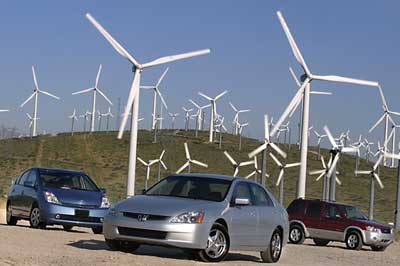
Two years of oily water under the bridge, and now shoppers can choose between a new Prius, an SUV hybrid and a sedan hybrid, with more on the way. Now the idea of a comparison –- albeit across vehicle types –- is a credible one, as people who are shopping for a hybrid need to know which vehicle provides the best all-around value. That’s a good question, and one we endeavor to answer with our first-ever hybrid comparison. This is a unique and challenging test, as it pits different types of vehicles with a common technology that has become the nation’s center of attention. People don’t talk about the Ford Escape. They talk about the Ford Escape Hybrid. And the Toyota Prius is just a funky hatchback without its Synergy Drive. Of course, the very idea of a hybrid world without a Prius in it is like talking about baseball without the bean ball.
And here it comes, high and tight: Toyota, doing what Toyota does, put a sack of money –- a big sack –- in the hands of their own MIT professors and told them to keep the Prius credible in a changing market, to keep the competition either gasping to catch up, or, as with General Motors, sitting on the sidelines.
Ford chose a different path.
Not content to sit and watch like its Detroit brethren, Ford struggled to build its own landmark hybrid, and came out with an SUV –- the Ford Escape Hybrid, to be exact. Honda, as the only car company really playing on the same field as Toyota, added the Honda Accord Hybrid to a lineup that already included the Civic Hybrid and the Insight.
Both of these new cars from Ford and Honda offer benefits beyond the considerable charms of the Prius. There’s more room. And more power, along with a more traditional style, all of it in the same price neighborhood. For people who want to buy a hybrid, that choice is excellent news. Shoppers are no longer restricted to the impractical Honda Insight, too-expensive-for-what-you-get Honda Civic Hybrid, or the Prius –- now there’s a different hybrid for different lifestyles, one to fit what you do and how you get there. Because all are priced at or under $30,000 for a well-equipped model, they represent what is most likely on the shopping list of those in the Great Gray Middle Class who want to shed the dinosaur –- and must have a practical, fairly-priced car to do so. A luxury hybrid, such as the Lexus RX 400h, probably doesn’t make it to this list, so it was not tested.
So there you go –- those of you who want to save the planet, you finally have a choice. Be sure to choose wisely.
VALUE Hybrids are required to do more with less fuel – and while a typical hybrid gets a break on drivability, that’s changing – and fast.
Figure out a universal definition of “value” and take your place among the world’s great thinkers.
Or get yourself committed for trying.
And though value means something different to everyone, there are a few qualities that serve as a baseline for all things of value. In the automotive world, value starts with a well-built car, priced right and capable of doing the things it is supposed to do. If it’s a convertible, the top should go up and down quickly and the seals should keep water out of the cabin. If it’s an SUV, it should offer command seating and lots of cargo/passenger space, on a sliding scale with fuel economy. All cars should drive decently, and provide a comfortable interior.
Then there’s the hybrid factor. Hybrids are required to do more with less fuel –- and while in the old days a typical hybrid would get a break on drivability, that’s changing –- and fast. According to Autobytel Reader Polls, car buyers want to buy hybrids, and don’t feel they should sacrifice much –- if anything. The long and the short of it is, when evaluating the three primary hybrid vehicles available for sale, the test was based first on commonly applied standards of value that consumers should expect from all cars in their respective segments. A second criteria was added, gauging how these vehicles fulfilled their promise as hybrid vehicles in delivering less fuel expense, lower pollutants and requiring fewer gas station trips -- all the while maintaining a threshold of performance and convenience. As a result of these two standards, the Toyota Prius continues to provide the most value – this time, against two of it’s own, the Ford Escape Hybrid and the Honda Accord Hybrid were no match for the value offered by the Toyota Prius.
First, Value:
2005 Toyota Prius
1. VALUE: PRIUS At $20,875 for the bare bones Prius, it’s the most affordable – and most pure practical hybrid – available. Standard equipment includes fabric upholstery, along with power windows, door locks and heated outside mirrors.
It’s hard to beat the 2005 Toyota Prius for hybrid value. As a second-generation car with a powertrain planned for practically every Toyota vehicle, the Prius avoids carrying the full brunt of hybrid development cost. At $20,875 for the bare bones model, it’s the most affordable –- and most purely practical -- hybrid available. Standard equipment includes Toyota-grade fabric upholstery and automatic air conditioning with a micron filter, along with power windows, door locks and heated outside mirrors. Remote keyless entry, cruise control, a tilt steering wheel, intermittent front and rear wipers, and a six-speaker AM/FM/CD stereo are also standard. Options are available as packages. The least expensive, at $920, includes a security alarm, Homelink garage door opener, and a Smart Key keyless locking and ignition system. The $1,100 package couples the Smart Key System with a side airbag package. The $5,065 package includes the equipment listed above and adds GPS navigation with voice recognition, Bluetooth wireless communications capability, a nine-speaker JBL stereo with six-disc CD changer, electronic Vehicle Skid Control (VSC), fog lamps, and HID headlights.
Must-have options are limited to the side airbag package with Smart Key system for $1,100, bringing the on-paper price of a Prius to just under $22,000. Pretty nice, considering that with the mid-sized hatch design of the Prius, cargo and passenger space is not much less than that of the 2005 Ford Escape Hybrid and fuel tank capacity, at 11.9 gallons, is a mere three gallons less than the Ford Escape Hybrid. Fuel economy is significantly better than its competitors, and while there is nary a driving enthusiast out there who will smile at the performance, there are hordes of commuters who will fall in love with the Prius because it offers plenty of room, a quality finish, an adequate tank -- along with miles and miles of fuel savings. With gas approaching $3 a gallon in metro areas across the nation, that combination adds up to a great value. Now -- just try to find a dealership that has a Prius equipped like that selling for sticker. That’s a whole new twist on the meaning of value.
Second, Value:
2005 Ford Escape Hybrid
2. VALUE: ESCAPE Option packages include the Energy, Audiophile and Navigation system package for $1,850, which features an Audiophile audio system, CD-based satellite navigation and a display on the nav system. The same inflation that afflicts the Prius also hampers the 2005 Ford Escape Hybrid. Simply put, it’s hard to talk about value when people are waiting for months to drive home their beauties -– and paying thousands over sticker to do so. Even with that, however, the Escape Hybrid is a solid value -- once a little air is released from the hybrid market –- because it is the only hybrid SUV available for purchase. That will change when the Toyota Highlander Hybrid and its third-row seat shows up in June, but even then –- count on a starting price north of $30,000 for Toyota’s hybrid SUV. That’s a lot of green for seven-passenger seating, and the Ford Escape Hybrid will continue to serve as a solid buy after the debut of the Toyota, depending on what you put in the thing. At its base level, the 2005 Ford Escape Hybrid with front-wheel drive comes in at $26,380, and with all-wheel-drive at $28,005. It comes in one trim level, with options such as leather seating, upgraded stereo, side-curtain airbags, and a navigation system. That’s not far off the $26,365 it costs for the non-hybrid, all-wheel-drive Escape. Standard equipment is the same as that of a regular Escape, including four-wheel antilock brakes, cruise control, carpeted floor mats, front dual vanity mirrors, and rear heating ducts. On the exterior, standard equipment includes molded-in-color front and rear fascias and body side cladding, halogen headlights and step-up bumper, front foglights, and a roof rack with 100-lb. capacity. Other standard equipment includes power windows with driver one-touch down, cloth seats, six-way front driver's seat, manual air conditioning, flip-up liftgate window, front variable intermittent windshield wipers, intermittent rear window wiper/washer, rear window defroster, and tilt steering wheel.
Option packages include the Energy, Audiophile and Navigation system package for $1,850, which features an Audiophile audio system, CD-based satellite navigation and a display on the nav system that shows fuel economy, and how the hybrid powertrain manages the power. There’s also a safety package for $595 that includes side-curtain airbags covering front and rear seating areas. There’s a leather comfort package for $575, an appearance package for $625 (front and side fascias), a MACH audio with 6-disc changer for $565, a 110-volt AC power outlet at $110, a retractable rear cargo cover for $75 and rear carpeted floor mats for $25. Must-have options for the Ford Escape Hybrid include the Energy package for $1,850 and the safety package for $595. That’s an additional $2,445 dollars tacked onto the sticker – making the front-wheel Escape Hybrid’s cost close to $29,000, around $6,000 more than the Prius with side curtain airbags and much better fuel economy. Where the Escape Hybrid is really penalized, however, is in the construction of the vehicle. Exposed screws, clumsy switches and a general level of refinement lacked the sophistication of the Prius and the Accord.
Third, Value:
2005 Honda Accord Hybrid
3. VALUE: ACCORD As pleasurable and practical as Honda’s popular sedan is known to be, at more than $30,000 there’s a high price for hybrid practicality. And the fact is that any sedan would have trouble competing in terms of convenience with the likes of a mid-sized hatch and an SUV.
Amazing as it seems, there is a Honda other than the S2000 that has little practical value -- and it’s the 2005 Accord Hybrid. Sure, there is something to be said in going fast and saving a little at the pump, but compared to the hybrid competition, this is a car for people who sorta want hybrid technology but really require a fast ride. This is not an error; the Accord Hybrid is not designed to sell to people who come to dealerships with a calculator. Offered only as a top-tier EX model, the Accord Hybrid comes with leather upholstery, heated front seats, and power windows, locks, mirrors, and driver's seat. There’s also dual-zone climate control, AM/FM/six-CD stereo with XM satellite radio, cruise control, remote-control door locks, and a tilting/telescoping steering column. For all of that, you pay $30,140. The lone option is a navigation system for which you will pay an extra $2,000.
But wait: this is an Accord, and there is a lot of value in buying a car that is widely viewed as one of the best made on the planet. In that regard, the Accord doesn’t disappoint: it is indeed an Accord, right down to the tight fit and comfortable finish. This sedan is simply a pleasure to drive. Yet as pleasurable and practical as Honda’s popular sedan is known to be, at more than $30,000 there’s a high price for hybrid practicality. And the fact is that any sedan would have trouble competing in terms of convenience with the likes of a mid-sized hatch and an SUV. But at that price, and with rated fuel economy at 30 city and 37 highway, there’s not much value to be had from the cabin of the 2005 Honda Accord Hybrid. Of course, going fast has value too –- but if your buying decision is based solely on going fast, there are other cars out there that will go as fast or faster, for around the same price –- and with more style.
Conclusion
Like Casey at the plate, it’s hard to fathom how the 2005 Ford Escape Hybrid whiffed in the value game. As an SUV with great fuel economy, it was a no-brainer –- until parked next to the 2005 Toyota Prius. Where it counts, the Prius was as good, really close or flat-out better. Differences in cargo and carry room failed to offset the Ford's $6,000 price premium, and reduced quality in terms of fabrics, materials, and construction sealed the deal.
Powertrain
POWERTRAIN There are two basic types of hybrid systems. A “partial hybrid” uses electric motors to provide power to the engine to aid in acceleration. A “full hybrid” can operate solely on electric power, which significantly reduces pollution and improves fuel economy.
It’s what you’re buying when you buy hybrid, the place where the premium lives and the thing you better be happy with after you get the car home. When push meets shove, a hybrid is all about powertrain –- the rest is all sugar frosting and happy faces. These complicated systems work more or less the same way: By connecting electric motors to an internal combustion engine, automakers can put smaller, more efficient engines in larger vehicles –- thus reducing fuel consumption, and, as a result, pollution. There are two basic types of hybrid systems. The “partial hybrid” uses electric motors to provide power to the engine to aid in acceleration. With a partial hybrid, the internal combustion engine must always be in operation when the vehicle is moving. Partial hybrids provide a better driving experience for less fuel expense and lower pollution, though the pollution side of that argument can be argued.
There’s also the so-called “full hybrid,” which significantly reduces pollution and improves fuel economy because it can operate solely on electric power. When a full hybrid vehicle is at a stoplight or stuck in traffic, for example, the internal combustion engine will click off and the car will run exclusively on electric power. When red goes green or traffic speeds pick up, the driver steps on the accelerator, the engine comes to life –- courtesy of a powerful starter motor -- and off you go. The benefit to a full hybrid is as obvious as the brown crud that hovers over our major cities. No idling engine equals far less pollution and much improved gas mileage.
Based on what it does, what it is and how well it delivers on the hybrid promise of lower fuel bills and reduced emissions, the winner was clear: the 2005 Toyota Prius.
First, Powertrain:
2005 Toyota Prius
1. POWERTRAIN: PRIUS Handing the 2005 Toyota Prius an award for its powertrain is sure to make many a gearhead grimace, but here’s the thing: this car does exactly what it is supposed to do, and does it better than anything else on the road.
Handing the 2005 Toyota Prius an award for its powertrain is sure to make many a gearhead grimace, but here’s the thing: this car does exactly what it is supposed to do, and does it better than anything else on the road. Its Hybrid Synergy Drive delivers enough front-drive power –- 143 combined horsepower and 377 lb.-ft. of torque -- for what this vehicle needs. The hybrid powertrain is comprised of a 76-horsepower, 1.5-liter inline four-cylinder engine and a 67-horsepower, 50-kw, 500-volt permanent magnet electric motor. It returned an acceptable 42 mpg during hard testing –- your results will probably rise closer to the 48-mpg average we achieved over a week of driving the Prius.
That’s exactly why you buy a hybrid.
Seriously: if you are racing a stock Prius on the streets, consider acquiring a life. Mated to a continuously variable transmission (CVT), the Prius is a smooth cruising vessel that has passing power when needed but specializes in saving gas and lowering pollutants. It does its job with admirable efficiency. Now, if the White Jacket Brain Power at Toyota could only add a pinch more fun…
Second, Powertrain:
2005 Honda Accord Hybrid
2. POWERTRAIN: ACCORDAs the only hybrid with a V6, a 3.0-liter job that produces a combined 255 horsepower and 232 lb.-ft. of torque, the 2005 Honda Accord Hybrid has by far the most power.
This one hurts. If the world were a good and just place, the 2005 Honda Accord Hybrid would win the award for best powertrain -- such is the fun awaiting you in that slender pedal. But here’s the thing: it’s not a full hybrid. As a partial hybrid, it doesn’t do the things it is supposed to do nearly as good as the others. In fact, it really is a fun-to-drive niche vehicle -- and while that’s just wonderful, a hybrid powertrain must provide buyers with a strong helping of practicality. With a test average of 26 mpg, that’s just not enough of what a hybrid is supposed to do: lower pollutants and save fuel expense.
But it sure is a fun ride.
As the only hybrid with a V6, a 3.0-liter job that produces a combined 255 horsepower and 232 lb.-ft. of torque, it has by far the most power. Added into the mix is Honda’s Integrated Motor Assist hybrid system, or IMA, a third-generation version of Honda’s hybrid technology, which accounts for 10 percent of the total horsepower rating and 26 percent of the torque. According to Honda, the Accord’s IMA does a better job of capturing and sharing energy than the previous version of IMA found in the Civic Hybrid. Mated to a modified five-speed automatic transmission, this is the front-drive vehicle with the most ‘fun’ transmission, as the Toyota Prius and the Ford Escape Hybrid are equipped with fuel-sipping CVTs. Fun does count for something, as does a fuel rating that is at least a little better than what you might find elsewhere for a similar performance experience.
Third, Powertrain:
2005 Ford Escape Hybrid
3. POWERTRAIN: ESCAPE On the road, the 2005 Ford Escape Hybrid delivers 25 miles per gallon, lower than should be expected for a small SUV that will cost people $30,000 to buy. But yes – it is a great idea, and the future for hybrid technology.
On paper, it is the ideal hybrid scenario: use this new kind of powertrain in a gas-guzzling SUV, and bring clear skies and low fuel cost to thousands of families living in suburbia.
If only theory matched reality.
On the road, the 2005 Ford Escape Hybrid delivers 25 miles per gallon, lower than should be expected for a hybrid SUV that will cost people $30,000 to buy. Yes –- it is a great idea, and the future for hybrid technology. Yet there are other, slightly smaller SUVs costing far less that deliver as-good or better fuel economy, and as far as the environment goes, here’s the thing: the farther you can drive on a gallon, the better it is for the trees. The Ford Escape Hybrid is, indeed, a capable driver with enough power. But without the fun-to-drive element of the Accord Hybrid or the higher fuel savings of the Prius, the Ford Escape Hybrid’s powertrain simply doesn’t provide the same kind of value. Powered by a 133-horsepower, 2.3-liter inline four-cylinder engine and a 94-horsepower electric motor, the Ford Escape Hybrid puts a combined 155 horsepower on the road. Get-up-and-go is rated at 129 lb.-ft. of torque. Power is managed by a continuously variable transmission, designed to save more fuel than a traditional five-speed transmission. Ford’s own testing during Ford Five Hundred development showed, however, that a six-speed automatic transmission might offer similar levels of efficiency. Like the Toyota Prius, the Ford Escape Hybrid is a full hybrid and can actually motor to about 15 mph on electric power only –- a great benefit for commuters who must slog through traffic on a daily basis. On the road, all of this equipment comes together and creates a nice freeway cruising experience and more than enough power –- but sloppy handling, plenty of understeer and body roll.
Conclusion
Fun is worth something, it’s true. It's just no longer as valuable as 40-plus miles to the gallon. Blame the government, or the Oil Barons. Sadly for the Ford Escape Hybrid, it doesn't matter for a hybrid that is neither really fun nor really fuel-efficient. It just lands it with a thud down into last place.
Hardware
HARDWAREToday’s new hybrids must perform close to the standard of expectations set by their internal combustion brothers, and they must achieve the results expected of a hybrid. If not – then why buy? It’s a tough goal, but it is what it is: Hybrids must do the thing they do and must perform on the road.
The tricky thing about hybrids –- aside from all the gears and spinners –- is how the rest of the car handles it all. There are motors, gears, batteries and more, and all of it must be accounted for with minimal intrusion to passengers in ride quality, safety or convenience. For example, virtually all hybrids regenerate and store energy from the act of braking –- an act that changes how it feels when you put your foot on the pedal. There is also extra weight to be managed, and the design must also include battery storage and cooling. Put it all together, and the development of a hybrid vehicle is much more complicated than simply bolting an electric motor onto a four-cylinder engine. If you are shopping hybrid, it comes down to how effectively you save gasoline and lower your emissions. If that’s the only criteria, however the best hybrid on the market is clearly the Honda Insight. But you’ve grown up since the Insight was the new boy in town, and now you want that same kind of powertrain result without the sacrifice.
Well – maybe not so much of the sacrifice.
Today’s new hybrids must perform close to the standard of expectations set by their internal combustion brothers, and they must achieve the results expected of a hybrid. If not –- then why buy? It’s a tough goal, but it is what it is: Hybrids must do the thing they do and must perform on the road. The goal –- to make the technology transparent –- is an ambitious endeavor. Few make it. Most fail in one way or another, with the key differentiator being how, what, and where the technology weasel pops up and says hello to an unsuspecting driver. Between these three hybrids, that little weasel popped most often in the Ford Escape Hybrid, while the Toyota Prius performed competently and the Honda Accord –- well, let’s just say that this particular technology weasel has got some mighty sharp teeth.
First, Hardware:
2005 Honda Accord Hybrid
1. HARDWARE: ACCORD Obviously, the engineers at Honda, already having mastered the art of saving gas and lowering pollution with the Insight and Civic Hybrid, turned their attention to other worthwhile goals, namely: make a really quick sedan that gets compact-range gas mileage.
It’s the strangest sensation: you get behind the wheel of the 2005 Honda Accord Hybrid, fire up the engine, and the next thing you know…there’s a smile on your face, your foot is to the floor and one single, persistent thought runs through your brain: no way this is a hybrid.
It’s true: the Accord Hybrid is a hoot to drive -- the un-hybrid hybrid -- a disguised assassin on the road just waiting to eat the next performance car it encounters. Whoo-haa! Obviously, the engineers at Honda, already having mastered the art of saving gas and lowering pollution with the Insight and Civic Hybrid, turned their attention to other worthwhile goals, namely: make a really quick sedan that gets compact-range gas mileage.
Someone will enjoy his or her bonus checks this year. This car is so much more fun to drive, it almost got booted from the test. It’s just not fair to compare this with a commuter like the Prius, or an SUV like the Ford Escape Hybrid. Based on the Accord EX sedan, what’s notable about the driving experience are the brakes and the powertrain. More than just a hybrid, the Accord also uses cylinder deactivation to help improve fuel economy -- three cylinders shut down during, say, freeway driving. Braking is also much more sophisticated. As part of the Integrated Motor Assist (IMA) system, there’s an IPU that stores energy that comes from deceleration and braking. Ninety-five percent of the energy is retrieved and stored. All this technology led to some nice performance on twisty roads and off-the-line grunt, but there were a few rocky spots – some drivers could feel the regeneration working when they applied the brakes. And then there’s the price: $30,000 and counting for what amounts to a very conservative-looking performance sedan. With that price, our tested fuel economy of 25 miles per gallon from the partial hybrid system and an emissions rating of ULEV instead of SULEV, this is not the kind of car your typical hybrid buyer is shopping for. It’s for the guy who loves Honda, and wants the fastest Accord sedan on the road.
And there sure ain’t anything wrong with that. If you’re shopping for driving prowess, would like to save a little gas, and don’t really care about turning heads on the road, check out the 2005 Honda Accord Hybrid. And do yourself a favor –- stop reading hybrid stories.
Second, Hardware:
2005 Toyota Prius
2. HARDWARE: PRIUS The Prius saves fuel and reduces emissions by scavenging energy that most cars waste. Regenerative braking links the brakes to a generator, helping use the car's kinetic energy to recharge the battery whenever the brakes are applied.
Whoa. Talk about driving over a cliff. After tooling around in the Accord Hybrid, getting into the 2005 Toyota Prius was like riding a ten-speed down a rock quarry. To compare the Prius to a machine like the Accord Hybrid is nuts -- but still, most people will cross-shop these vehicles if they are searching for the right hybrid. And actually, the Prius did quite well: we were able to reach decent cruising speeds on the freeway, and the car handled tight cornering with enough competence so as not to frighten small children. Acceleration was a bit of a challenge, however – the Prius, as with all full hybrids, is designed to glide into action. More of a jump would be ideal, but in order to get an emissions rating of SULEV and a test average of 42 mpg, the Prius must make a sacrifice or two. The 2005 Toyota Prius does well to make that sacrifice almost painless. A front-wheel-driver, the Prius rides on independent MacPherson struts up front and a rear torsion beam axle. The ride is commuter-smooth, though compromised by the vehicle’s stiff, high-mileage tires. The Prius is a second-generation car, so integrating a hybrid powertrain has already been accomplished and fine-tuned. Toyota engineers were able to make significant improvements to the drivability of the Prius, from improving the aerodynamics to adding several key features for ride, economy and safety. Like all hybrids, the 2005 Toyota Prius gets energy from energy expended while braking, and while it gives a slightly different feel to the pedal upon mashification, the brakes put an end to your trip promptly and smoothly. Toyota also added some of their newest safety technology to the Prius, including Brake Assist and Electronic Brake Force Distribution, which does as their monikers imply.
The Prius saves fuel and reduces emissions by scavenging energy that most cars waste. Regenerative braking links the brakes to a generator, helping use the car's kinetic energy to recharge the battery whenever the brakes are applied. Along the same lines, the transmission offers a setting that helps recharge the battery when the driver merely lifts off the accelerator and lets the car coast downhill. In sum, with all these regenerative methodologies, there's no need (and no way, for that matter) to plug the car into an electrical outlet to charge the battery.
Third, Hardware:
2005 Ford Escape Hybrid
3. HARDWARE: ESCAPEIt’s a bit like rowing a canoe with a chubby boy eating chocolate candies in the back. Given its tested miles per gallon (25) and a price tag of close to $30,000, the Ford Escape Hybrid is a decent ride, but should do a better job of handling the daily chore of stoplights, corners, and traffic.
The 2005 Ford Escape Hybrid is a painless car to drive. But when compared to its direct hybrid competition, it’s the mind-numbing Novocain variety of painless. This SUV, thanks to its weight and stance, was at an instant disadvantage. As such, it is a great straight-ahead cruiser that betters the Prius when it comes to freeway driving. But get the Escape Hybrid on a winding road and you experience far too much body roll and understeer –- hints that perhaps that weight makes the ride worse than it would be in a regular Escape, or other small SUVs. Located under the floor of the cargo area, the heavy battery pack seems to have an adverse impact on performance –- especially going up or downhill, and taking corners. It’s a bit like rowing a canoe with a chubby boy eating chocolate candies in the back.
Stopping a canoe like that is a challenge, and if that boy can’t swim –- look out. The Escape Hybrid has no such problem, with four-wheel antilock disc brakes. As with the other hybrids, the Ford Escape Hybrid has regenerative braking baked right in, to capture energy expended when the vehicle is coming to a stop. Keeping the car on the road are a MacPherson strut front suspension, rack-and-pinion steering, and an independent rear suspension. Ford claims that the suspension was dialed in specifically for the hybrid –- and if so –- Ford should know that tree huggers like to drive with their hair on fire too. The independent rear suspension surely also limits the possible tow rating for the Escape Hybrid, though the amount of air intake needed to keep electric motors from meltdown and accomplish serious (more than the Escape Hybrid's rated 1,500 lbs.) towing might have something to do with it as well.
What the Ford Escape Hybrid has going for it is a choice of drives –- front-wheel or four-wheel. And while Ford people tout the off-road capability of this vehicle, it would seem to be mocking Mother Nature to carve up a canyon with a green SUV. Other than off-road application, the Escape Hybrid’s four-wheel-drive system is especially handy in rain or snow.
Given its test average of 25 mpg and a price tag of close to $30,000, the Ford Escape Hybrid is a decent ride, but should do a better job of handling the daily chore of stoplights, corners, and stop-'n-start driving when compared what is available on the market –- hybrid or otherwise.
Conclusion
“Hardware” sounds like a hammer and nails, and in a way it means much the same thing: the hardware on your car should make it fun to put the hammer down, the ride should never feel as though you’re driving on nails. With these three vehicles as the subjects, a thorough testing on winding roads, freeways, and in city traffic made the pecking order clear. The 2005 Honda Accord Hybrid is more fun to drive than most cars on the road, hybrid or otherwise. The 2005 Toyota Prius makes for a nice ride –- nicer still when you notice that the gas gauge rarely ever moves. And the Ford Escape Hybrid, while the first SUV to adopt hybrid technology, just can’t shake the chubby, grubby boy swinging on its tail.
Interior/Design
INTERIOR & DESIGN The hot bright light of a side-by-side comparison, however, reveals enough of a difference that the Toyota Prius was able to sneak a win, thanks to the quality of its interior and the spaciousness of its large hatch design.
It’s all about where you put your keister.
Shiny metal, miles-per-gallon and 0-60 acceleration times will rot if a car is not a comfortable fit, a pleasure to drive, and easy to load. Even hybrids count here: sure you want to save the planet, but few people are willing to suffer a numb bum while doing it. It all goes to the perception of quality, a factor that weighs heavily on hybrids given their swollen sticker prices and dealer markup. If you insist on paying for the latest and greatest, you at least want it to be something like what you pay for, or pretty soon you will just feel ripped off, get bitter, and sell the thing for a Camry. Frankly, all three of these vehicles do an admirable job of making driving –- and using -- a car a pleasant experience. All are easy to climb into and out of, all make the act of loading up stuff a breeze, and two of the three have exemplary fit-and-finish. Guess which two.
It is a shame that Ford has not yet reached the point of bettering, let alone matching, Honda and Toyota in putting things together. Had it improved the gaps and quality of the cabin, this would have been an easy win for the Ford Escape Hybrid. The hot bright light of a side-by-side comparison, however, revealed enough of a difference that the Toyota Prius was able to sneak a win, thanks to the quality of its interior and the spaciousness of its large hatch design. Fact is, the Prius doesn’t give up much on the Escape in terms of actual, usable room. The good thing about the Honda Accord Hybrid is also its weakness: it’s a good –- nae, great –- thing to be an Accord when it comes to convenience and comfort, but it is also not so great when the price trips on $30,000. The reality is that while the Accord is the best car tested in terms of comfort and quality, it gets soundly thumped when put up against the likes of a roomy hatchback and an SUV. Layer on top of that obvious fact its price tag, and you have the surprise of an Accord where convenience is, at best, a secondary selling point.
First, Interior/Design:
2005 Toyota Prius
1. INTERIOR/DESIGN: PRIUSOverall, the Prius comes in first, based on its commodious cabin, rear hatch and fold-down rear seats. There are also numerous cargo areas throughout the cabin, and the quality of the interior is first-rate.
Next time someone shouts bad things about a hatchback, kick 'em in the shins and point out a Prius. Here is a car –- a car –- that offers SUV-like space. You can cram so much stuff in the back of a Prius that dorm movers across the nation ought to go on strike. The combination of a pleasant ride and usable spaciousness, plus the expected Toyota dedication to quality materials and construction, puts the 2005 Toyota Prius on the top pedestal. This car, redesigned for the 2004 model year, is such a landmark winner that many elements of its construction are being carried over into Toyota’s new wave of vehicles. See the proof: check out the new Lexus GS models, the Scion tC and the new Toyota Avalon. That’s a smart move, because the design of the car makes living with the car a pleasure. There’s plenty of room –- usable room –- not the kind of cargo space that winds up over your head. Seats front and rear are comfortable with good-enough bolstering, and the materials used throughout is of a high, durable quality. It’s a don’t-need-leather cabin, to be sure, but one possible fear is that the composition of the material will result in a dingy appearance as years go by and people climb in and out.
Rumor has it that Toyota makes all engineers and factory workers change their names to FitnFinish. Meet Joe FitnFinish, he designed the Toyota Prius. And here’s Beth FitnFinish; they aren’t related but she works on the Prius assembly line. All the FitnFinishes are dedicated to the single goal of building some of the best-made cars in the world, and the Prius is one of them. Things fit together well inside and out; the only noticeable negative being intrusive road noise and some unwanted chatter from its high mileage tires. It’s pretty clear that sound dampening materials were one of the few things Toyota sacrificed in order to build a hybrid for a real-world price of $25,000. That’s a great deal, and worth a little noise inside the cabin. Fact is, what stands for a noisy Toyota cabin probably equals a quiet ride from another maker. In addition to interior quality, the design is smart and the result is an easy car to live with. It’s easy to get into and out of, start, drive, and use to go shopping. Thanks to the design of the hatchback, there are some extra blind spots, but remember what the PE instructor told you: look twice and don’t use just your mirrors. Overall, the Prius comes in first, based on its commodious cabin, rear hatch and fold-down rear seats. There are also numerous storage areas throughout the interior, and the quality of the interior is first-rate. The styling of the vehicle is effective because it’s polarizing, not boring, and because it facilitates one of the best interior designs on the road.
Second, Interior/Design:
2005 Ford Escape Hybrid
2. INTERIOR/DESIGN: ESCAPELike the Los Angeles Lakers without Shaq, the Ford Escape Hybrid was missing that one critical piece to puzzle when the whistle blew and the game began: quality, at least when compared to the Prius and the Accord Hybrid.
Wow. Looks like the so-called experts had it wrong -- an SUV isn’t a shoe-in when it comes to interior comfort and convenience, not when you factor in the quality of its construction. Like the Los Angeles Lakers without Shaq, the Ford Escape Hybrid was missing that one critical piece to puzzle when the whistle blew and the game began: quality, at least when compared to the Prius and the Accord Hybrid. Exposed screws, ill-fitting construction, and a general lack of refinement plague the Ford Escape Hybrid. It was also the least comfortable of the three, with front seat bottoms that were too short and too hard, hard plastic armrests on the doors, and tight accommodations for rear seat passengers. There seems to be more people room in the back of the Prius. Worse, cargo room looks to be slightly less than the regular Escape –- perhaps the battery on the back cargo floor, or the vented rear windows contribute to the difference. As far as design is concerned, the Escape is virtually identical to the regular Escape, except for a cool leafy insignia and those rear window vents. There is excellent command seating, and driver controls are easy to use. Putting cargo into the Escape Hybrid is also easy, thanks to a liftover height on an equal plane with carried items, a cube-shaped cargo area, and a rear door that’s easy to close and open. And despite the Escape Hybrid's greater ground clearance, getting in and out is easy on the legs and back. On the road, the whirring and wheezing of the hybrid powertrain was noticeable, but not annoying. Hard acceleration, however, elicits a screaming whine sure to be heard by all drivers.
With a little more practice at building good interiors, with a little more investment in quality materials, with a little more innovation in the area where people put their fannies as well as the innovation under the hood, Ford and its Escape Hybrid would have easily won this category. The Escape has a reputation, after all, as a capable SUV that meets the needs of thousands of drivers. The point revealed in this test is, perhaps, two-fold. First, you can’t underestimate the interior experience, and second –- hybrid or not –- people really ought to look at hatchbacks as a credible replacement to gas-guzzling SUVs.
Third, Interior/Design:
2005 Honda Accord Hybrid
3. INTERIOR/DESIGN: ACCORDThe problem is, well, why? Again, the Accord Hybrid is hurt by its price and ability to do the things a hybrid ought not do, namely gulp gas when driven hard and pollute like most other cars on the road.
There is nothing wrong with the 2005 Honda Accord Hybrid, beyond what, if anything, is wrong with the interior and design of the Honda Accord. As the same vehicle, it brings with it Honda’s landmark penchant for quality.
But it’s just a sedan matched up against a large hatchback and a –- gulp –- SUV. If you’re in the market for a sedan only, and want a hybrid, this is the car for you.
Kind of.
The problem is, well, why? Again, the Accord Hybrid is hurt by its price and ability to do the things a hybrid ought not do, namely gulp gas when driven hard and pollute like most other cars on the road. But at least you can say you drive a hybrid, and at least you’ll be comfortable, as will your friends in the rear, thanks to nicely bolstered leather seats. Interior panels are quality and pleasant to the touch. There are well-placed armrests, and a soft leather steering wheel. Hard seatbacks usually pose a danger for rear passengers’ knees, so the Accord’s front seatbacks have a thin layer of padding. It is also the only tested vehicle that provides drivers with a telescopic steering wheel. Cargo capability is limited by fixed rear seats with no folding feature or center pass-through. But then you don’t buy an Accord Hybrid –- or any Accord for that matter –- because it can pack away a campground. Despite this, passenger space is intelligently done, with room for tall and wide passengers.
Conclusion
So the Prius –- yet again –- shows that it’s hard to beat the front-runner. Even an SUV, one with a solid reputation, was unable to beat it when it came to a category natural for SUV dominance. The reason is actually more obvious than it seems: When it comes to interior space and design, the 2005 Toyota Prius does everything right and leaves nothing to chance. The embarrassed SUV, meanwhile, should take a look in the parts drawer for some screw tops and better interior material, while the Accord Hybrid –- well, it doesn’t really give two hoots and a gallon about cargo, but the interior is a golden definition of refinement. But then, with a design like the Accord and an engine much better, are there enough humble people in the world to make Honda a profit selling this car?
OVERALL RATING
AND THE WINNER IS... First: 2005 Toyota Prius
Second: 2005 Ford Escape Hybrid
Third: 2005 Honda Accord Hybrid
Unlike most apples-to-apples comparisons, comparing the three most accessible hybrids available was a little more complicated. As an overlay onto standard comparison categories, the use and value of hybrid technology as applied to each vehicle had to be considered in each category. As a result, and based on value, powertrain, hardware, interior quality and functionality, our winner is the 2005 Toyota Prius.
First Place: 2005 Toyota Prius
It is good to be the King, especially when there are challengers that would love nothing more than to knock you off your throne.
No chance of that -- at least not now.
As a smartly-designed car, the Prius offers up a solid value, good fuel savings –- though not nearly what the EPA claims –- and wraps it in Toyota quality. For those shopping for a the best value in a hybrid, it’s still the car that delivers.
Second Place:
2005 Ford Escape Hybrid
As the odds-on favorite to win this competition, the 2005 Ford Escape Hybrid is a landmark idea, one a whisker’s width away from being lauded as the most notable vehicle of the new decade. Some will argue that it is, but it seems that such an honor still belongs to the Prius. Still, the Escape Hybrid has a lot going for it, namely good fuel mileage, near zero emissions, and SUV convenience. However, the Ford Escape Hybrid could not match the Prius when it came to value. For a sticker price nearing $30,000, fuel economy just wasn’t good enough, and usable space wasn’t significantly more useful than that of the Prius hatchback. At close to $30,000, one also expects a more refined interior and a better ride.
Third Place:
2005 Honda Accord Hybrid
Well. That was fun. And while this was clearly the most popular vehicle in the test, it was also the most impractical, thanks in large part to its one critical difference: the 2005 Honda Accord Hybrid is not a full hybrid, so the core benefits of buying into this technology –- great fuel economy and zero emissions –- are lost on the car. The question is, perhaps, why Honda went with a V6 powerplant for the Accord, instead of bolting an electric motor onto the Accord’s impressive four-cylinder. Top to bottom, of course, the Accord is virtually flawless, offering up a comfortable ride and an expertly calibrated driving experience. But still –- not enough usable space, no significant gas savings, and a $30,000 price tag separates hybrid shoppers from Accord shoppers, and doomed the Accord Hybrid in our test. Fast and fun may be, well, fast and fun, but it’s not at the top of the hybrid shopper’s most wanted list.
Specifications
AND THE WINNER IS...First: 2005 Toyota Prius
Second: 2005 Ford Escape Hybrid
Third: 2005 Honda Accord Hybrid
2005 Ford Escape Hybrid
Price as Tested: $28,455
Engine Size & Type: 2.3-liter, 16-valve, DOHC, inline four-cylinder gasoline engine; permanent magnet electric motor
Engine Horsepower: 133 hp at 6,000 rpm (gas); 94 at 5,000 rpm (electric) -- combined rating of 155 net horsepower
Engine Torque: 124 lb.-ft. at 4,250 rpm (gas)
Transmission: Continuously variable
Curb weight, lbs.: 3,792 lbs.
EPA Fuel Economy (city/highway): 33/29
Observed Fuel Economy: 25
Length: 174.9 in.
Width: 70.1 in.
Wheelbase: 103.1 in.
Height: 70.4 in.
Front Leg room: 41.6 in.
Rear Leg room: 36.3 in.
Head room: 40.4 in.
Max. Seating Capacity: 5
Max. Cargo Volume: 65.5 cu. ft.
Max. Payload:
Max. Towing Capacity:
Ground Clearance: 8 in.
2005 Honda Accord Hybrid
Price as Tested: $30,140
Engine Size & Type: 3.0-liter, VTEC, SOHC, 24-valve, V6 engine; Integrated Motor Assist (IMA) permanent magnet electric motor
Engine Horsepower: 240 hp at 6,250 rpm (gas);
Engine Torque: 212 at 5,000 rpm (gas);
Transmission: 5-Speed Adaptive Automatic Transmission
Curb weight, lbs.: 3,501 lbs.
EPA Fuel Economy (city/highway): 29/37
Observed Fuel Economy: 26
Length: 189.5 in.
Width: 71.5 in.
Wheelbase: 107.9 in.
Height: 57.1 in.
Front leg room: 42.6 in.
Rear leg room: 36.8 in.
Head room: 40.4 in.
Max. Seating Capacity: 5
Max. Cargo Volume: 14.0 cu. ft.
2005 Toyota Prius
Price as Tested: $26,480
Engine Size & Type: 1.5-liter, DOHC, 16-valve, inline-four cylinder; 50-kW, 500-volt, permanent magnet electric motor
Engine Horsepower: 76 at 5,000 rpm (gas); 67 at 1,200-1,540 rpm (electric)
Engine Torque: 82 lb.-ft. at 4,200; 295 lb.-ft. at 0-1,200 rpm (electric)
Transmission: Continuously variable
Curb weight, lbs.: 2,890 lbs.
EPA Fuel Economy (city/highway): 60/51
Observed Fuel Economy: 42
Length: 175.0 in.
Width: 67.9 in.
Wheelbase: 106.3 in.
Height: 58.1 in.
Front leg room: 41.9 in.
Rear leg room: 38.6 in.
Head room: 39.1 in.
Max. Seating Capacity: 5
Max. Cargo Volume: 16.1 cu. ft.