Recent Articles
Popular Makes
Body Types
Ten Safe, Affordable Family Vehicles
Protecting you and your family for less than $30,000

Nutty drivers litter our nation’s roads. Every highway in America sees its share of aggressive road ragers, drunks meandering home from the bar, inexperienced teenage drivers in powerful imports, stubborn grandfathers who forgot their glasses, annoyed girlfriends on cell phones, and overworked middle managers going over the details of that presentation one more time. Factor in how incredibly easy it is to get a driver’s license in this country, and you’ve got a pretty good argument for staying home 24/7. Unfortunately, few of us have that luxury and must place ourselves, and our families, into the madness that is modern day traffic. You need to get to the office. The kids need to go to school. That being the case, it’s imperative that safety ranks right up there with style and comfort when shopping for the family car. Of course, most families are on a tight budget, so safety has to be weighed against affordability. Thankfully, you don’t have to spend a fortune to secure a safe ride for the kids. With that in mind, we’ve analyzed current crash test data* to determine the safest family vehicles currently on the market for $30,000 or less. If you’re concerned about your safety, and that of those you love, take a minute to familiarize yourself with the vehicles listed on the following pages. But, whatever ride you find yourself in, drive safely. And watch out for the other guy. * Data current as of June 20, 2005
Safety Testing
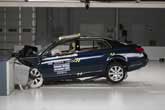
All cars built for U.S. sale must meet certain government-mandated safety standards that regulate everything from windshield defrosters to brake lights. Taking safety several steps further are the National Highway Traffic Safety Administration (NHTSA), an agency within the U.S. Department of Transportation, and the Insurance Institute for Highway Safety (IIHS), a non-profit group that is supported by insurance companies. Each of these organizations performs different types of crash testing on new cars and trucks. NHTSA performs full frontal crash tests, where vehicles are fitted with crash dummies and driven into a wall at 35 mph, and side impact tests, where a 3,015-pound sled is driven into the side of a parked test car at 38.5 mph. Scores for crash worthiness are awarded with one to five stars, with one star for a frontal crash suggesting at least a 46 percent chance of serious injury, while five stars suggests an injury risk of 10 percent or less. Ratings for the side impact test are slightly different: one star represents at least a twenty-six percent chance of injury and five stars represents a risk of five percent or less. NHTSA also provides rollover ratings, combining a calculation of the vehicle’s center of gravity and its track width with the vehicle’s performance in a quick maneuver driving test. Instead of NHTSA’s full frontal test, IIHS performs offset frontal crashes. After being fitted with crash dummies, the test vehicle reaches 40 mph and strikes a deformable barrier. However, only the front driver’s side takes the hit, so all of the crash energy must be absorbed by a smaller area of the vehicle’s structure – the result is a tougher test. The IIHS ranks each vehicle from Poor to Good, with exceptional vehicles labeled a Best Pick. To make our top ten list, a vehicle must have received at least four stars in all NHTSA categories (front driver, front passenger, front side, rear side, and rollover) and be labeled a Best Pick in the IIHS’s frontal-offset crash test. Since IIHS only offers side-impact ratings for a limited number of vehicles at this time, we did not include this parameter in our ranking criteria. After researching all of the vehicles that matched our criteria, overall rankings were based on the total number of five-star ratings from NHTSA. However, it is important to understand that, in the case of a head-on collision with a Hummer, a heavier vehicle that scores three stars may provide more protection than a compact car scoring five stars. Curb weight matters, and we used it as the deciding factor in the event of a tie between vehicles that don’t share a common platform. Finally, this list includes vehicles tested by NHTSA and IIHS. Other vehicles may be equally as safe, yet without verifiable crash test data, it would irresponsible to list them here.
10th Place
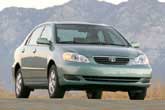
Individuals and families interested in safety on a budget should focus on the 2005 Toyota Corolla. Passenger room measures 90.3 cubic feet and cargo volume is 13.6 cubic feet, so there’s enough space for the kids and gear for a weekend trip. But, if you want to prevent those wild youngsters from fighting with each other the whole way, you might want to opt for one of the larger vehicles on the list…one that will give those little cherubs some extra elbow room. Prices for the 2005 Toyota Corolla start at $13,780 (plus a $540 destination charge) for the base 2,530-lb. CE model and climb to $17,555 for the sporty Corolla XRS. Standard on all models are front dual airbags, a rear three-point center seatbelt, and a front passenger airbag cutoff sensor. Optional safety features include antilock brakes with electronic brake force distribution, side airbags, side curtain airbags, stability control with traction control, and electronic brake assistance. In NHTSA testing, the 2005 Toyota Corolla without side or side-curtain airbags received five stars for the driver and front passenger in a frontal crash, four stars for the front and rear occupants in a side crash, and four stars for its rollover rating. In IIHS testing, the 2005 Toyota Corolla received a Best Pick ranking for its offset frontal crash test performance.
9th Place
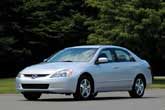
With so many on the road, you might’ve picked up on the 2005 Honda Accord sedan’s popularity as a family car. It shouldn’t be surprising – Honda has a reputation for building reliable, durable vehicles that offer a commendable balance of functionality and sportiness. With 14 cubic feet of cargo room and 102.7 cubic feet of passenger room, a family of four can travel comfortably inside the Accord. And for solo runs, drivers may enjoy the optional 240-horsepower V6. In base trim, the 2,989-lb. 2005 Honda Accord DX sedan sells for $16,295 (plus a $515 destination charge). A top-of-the-line EX model, complete with a V6, leather seats, a navigation system, and XM satellite radio starts at $28,850. All models come standard with front side airbags, a front passenger airbag cutoff sensor, side curtain airbags, and antilock brakes. Also standard on LX V6 and EX models is electronic brake force distribution, with traction control being reserved for V6 models only. In NHTSA testing, the 2005 Honda Accord sedan received five stars for the driver and front passenger in a frontal crash, four stars for the front and rear occupants in a side crash, and four stars for its rollover rating. In IIHS testing, the 2005 Honda Accord sedan received a Best Pick ranking for its offset frontal crash test performance.
8th Place
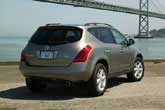
Those who prefer the style and size of sport utility vehicles will be glad to know that there are two SUVs on our list, starting with the 2005 Nissan Murano. Thanks to 109.9 cubic feet of passenger room, driver and passengers alike will be able to spread out a bit. Kick the back-seat occupants out, fold down the split rear seat, and create up to 81.6 cubic feet of room for whatever you want to toss in. This midsize SUV comes with either front- or all-wheel drive. Prices for the front-wheel drive, 3,835-lb. 2005 Nissan Murano S start at $27,150 (plus a $580 destination charge), and run up to $31,200 for the all-wheel-drive SE model. Standard safety features include a front passenger airbag cutoff sensor, front side airbags, side curtain airbags, front active head restraints, and a rollover sensor. Also standard are antilock brakes with electronic brake assistance and electronic brake force distribution. Optional is a stability and traction control package. In NHTSA testing, the 2005 Nissan Murano received four stars for the driver and front passenger in a frontal crash, five stars for the front and rear occupants in a side crash, and four stars for its rollover rating. In IIHS testing, the 2005 Nissan Murano received a Best Pick ranking for its offset frontal crash test performance.
7th Place
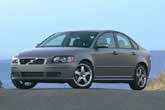
Coming in at number seven is one of our favorite small sedans, the 2005 Volvo S40. Entertaining in base 2.4i trim, this sweet Swede is downright grin-inducing when wearing a T5 badge. Competitors may offer a bit more interior room (passenger volume is 92 cubic feet), but with 14.3 cubic feet of volume, the S40 offers decent cargo space. Those facts, along with the impressive safety ratings, will sell this Volvo to your mate, the one who couldn’t care less about cars. However, you, the enthusiast, will be sold on the T5’s handling and lively 218 horsepower. The base 2005 Volvo S40 2.4i, weighing in at 3,084-lbs., starts at $23,560 (plus a $695 destination charge) and features standard front side airbags, side curtain airbags, a front passenger airbag cutoff sensor, front active headrests, antilock brakes, electronic brake force distribution, and electronic brake assistance. The T5, available with front- or all-wheel drive, provides the same standard safety equipment and starts at $26,395. Available on all models is a stability control system. In NHTSA testing, the 2005 Volvo S40 received four stars for the driver and five stars for the front passenger in a frontal crash, five stars for the front and rear occupants in a side crash, and four stars for its rollover rating. In IIHS testing, the 2005 Volvo S40 received a Best Pick ranking for its offset frontal crash test performance.
6th Place (tie)
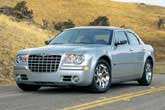
The automotive press has heaped accolades upon the 2005 Chrysler 300’s aggressive styling and optional Hemi powerplant. We like it so much that we named it our Car of the Year, and now it makes our Top Ten Safe Family Vehicles list. Pricing starts at $23,405 (plus a $675 destination charge), which will get you into a base, 3,700-lb., rear-wheel-drive 300 with a 190-horsepower, 2.7-liter V6. Juicing up your game with the remarkable 2005 Chrysler 300 SRT-8 requires a bit more coin – $39,370 to be exact. All models are built with standard dual front airbags with a front passenger airbag cutoff sensor. Touring, Limited and C models add antilock brakes, electronic brake-force distribution, electronic brake assistance, stability control, and traction control. All except the SRT-8 are available with all-wheel drive, and the Base model can be equipped with antilock brakes, stability control, traction control, and electronic brake assistance for an extra charge. Side and side-curtain airbags are optional on all models.
In NHTSA testing, a 2005 Chrysler 300 without the optional side or side-curtain airbags received five stars for the driver and front passenger in a frontal crash, four stars for the front and five stars for the rear occupants in a side crash, and four stars for its rollover rating. In IIHS testing, the 2005 Chrysler 300 received a Best Pick ranking for its offset frontal crash test performance.
6th Place (tie)
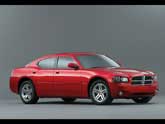
All of the praise for the 2005 Chrysler 300 led DaimlerChrysler to add the 2006 Dodge Charger to its lineup. Under the skin, these two vehicles are virtually identical, but with the Dodge badge comes a more everyday-man character, a sinister looking front fascia, and a lower price. Offered in three trims – Base, SXT, and RT – the 2006 Dodge Charger starts at $22,320 (plus a $675 destination charge) and reaches $29,320 for the Hemi-powered RT. A limited number of 2006 Dodge Charger Daytona R/T models will also be available in late 2005. Safety comes standard via dual front airbags with a front passenger airbag cutoff sensor, antilock brakes, electronic brake assistance, traction control, and stability control. Side and side-impact airbags are optional. In NHTSA testing, a 2006 Dodge Charger without the optional side or side-curtain airbags received five stars for the driver and front passenger in a frontal crash, four stars for the front and five stars for the rear occupants in a side crash, and four stars for its rollover rating. In IIHS testing, the 2006 Dodge Charger received a Best Pick ranking for its offset frontal crash test performance.
5th Place
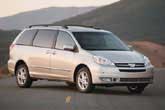
We’re talking about safe, affordable family transportation. Of course this list is going to include minivans. Duh. We recently ranked the 2005 Toyota Sienna as one of our favorite minivans, so it’s good to know that this people-mover is also plenty safe. There are lots of things to praise about the Sienna, but most of all is its comfort. Passenger volume comes in at 177.4 cubic feet (176.5 cubic feet for eight-passenger models), and when all of the seats are removed there’s up to 148.9 cubic feet of cargo volume. In exchange for $23,425 (plus a $565 destination charge) buyers can get into the 4,120-lb., front-wheel-drive 2005 Toyota Sienna CE. The premium Limited AWD model will drain $37,695 from the ol’ savings account. Standard safety features include dual front airbags with a passenger airbag cutoff sensor, antilock brakes, electronic brake-force distribution, and electronic brake assistance. Limited models add front and rear electronic parking sensors, front side airbags, and side curtain airbags. Available on LE, XLE and Limited models is an all-wheel-drive system that includes stability control and traction control. LE and XLE models can be optioned with front side airbags, side curtain airbags, stability control, and traction control. In NHTSA testing, a 2005 Toyota Sienna without side or side-curtain airbags received four stars for the driver and five stars for the front passenger in a frontal crash, five stars for the front and rear occupants in a side crash, and four stars for its rollover rating. In IIHS testing, the 2005 Toyota Sienna received a Best Pick ranking for its offset frontal crash test performance.
4th Place (tie)
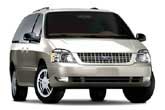
For family vacations, trips to the lake, runs to the nearest mega grocery store, or getting eight members of the junior high football team to the game, nothing beats a minivan. Whatever your cargo, Ford aims to make sure that the 2005 Freestar reaches its destination safely. The base Freestar S weighs in at 4,275-lbs. and starts the bidding at $23,930 (plus a $710 destination charge). The decked-out Limited model will set you back $32,755. All Ford Freestars offer 134.3 cubic feet of cargo room and a list of safety features including dual front airbags with a front passenger airbag cutoff sensor and antilock brakes. For an extra charge, the 2005 Ford Freestar can be outfitted with electronic brake assistance, traction control, stability control, a rear parking sensor, front side airbags, and side curtain airbags. In NHTSA testing, a 2005 Ford Freestar without side or side-curtain airbags received five stars for the driver and front passenger in a frontal crash, four stars for the front and five stars for the rear occupants in a side crash, and four stars for its rollover rating. In IIHS testing, the 2005 Ford Freestar received a Best Pick ranking for its offset frontal crash test performance.
4th Place (tie)
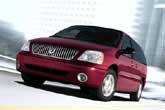
If the 2005 Ford Freestar is a little too vanilla for your tastes, consider the 2005 Mercury Monterey, a nearly identical model that adds a few styling tweaks and premium features. Starting at $29,030 (plus a $710 destination charge) is the 4,340-lb. 2005 Mercury Monterey Convenience model, with the loaded Premier model coming in at $34,955. Measuring 134.3 cubic feet, cargo room mirrors that of the Monterey’s corporate cousin, the 2005 Ford Freestar. Standard safety equipment includes a dual front airbags with a passenger airbag cutoff sensor, front and rear parking sensors, antilock brakes, and electronic brake force distribution. Side airbags and side curtain airbags are optional on the Convenience model and standard on upper-level models. Stability control, traction control and electronic brake assistance can be added for an additional charge. In NHTSA testing, a 2005 Mercury Monterey without side or side-impact airbags received five stars for the driver and front passenger in a frontal crash, four stars for the front and five stars for the rear occupants in a side crash, and four stars for its rollover rating. In IIHS testing, the 2005 Mercury Monterey received a Best Pick ranking for its offset frontal crash test performance.