
Recent Articles
Popular Makes
Body Types
10 Things You Should Know About the 2011 Buick Regal
A better Buick…courtesy of Opel
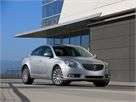
As any politician will tell you, it’s hard to satisfy everyone all of the time. Invariably, there’s someone who’s particular needs won’t be met, but at the end of the day, it’s the candidate that connects with the greatest number of voters who finds herself elected to office. A similar relationship exists between mainstream carmakers and car buyers, where the former does its best to attract as many of the latter as possible, or at least more than its competition. Case in point: the 2011 Buick Regal. In an effort to jumpstart the brand and broaden appeal beyond its older fan base, General Motors’ upscale marque looked to Europe and found just what it was looking for in the Opel Insignia. With a few styling tweaks and the unfortunate loss of more desirable powertrains, the all-new Regal was born, destined to take on the best of America’s premium sedans. After a weeklong test drive, we’d say the results are mixed.
#10. Regal pricing starts at about $26,000, or $3,000 less than the Acura TSX.
Buick offers Regal buyers a choice between two models, the CXL and the CXL Turbo. With a base price of just over $26,000, the CXL is technically the entry-level version, but you wouldn’t know that considering a list of standard features that includes dual-zone climate control, USB and iPod connectors, Bluetooth connectivity, and heated front seats. There’s more, like leather upholstery, a power driver’s seat, and the safety of OnStar, stability control, as well as front-side and side-curtain airbags.
Move up to the 2011 Buick Regal CXL Turbo and you’ll not only avail yourself to a more powerful engine but also niceties such as a power-adjustable front passenger’s seat, a 120-volt outlet for plugging various games and electronic devices into, and a rear parking sensor system. Pricing starts at just under $29,000 and doesn’t include options such as a Harman/Kardon sound system, a navigation unit with a 40gb hard drive, or Buick’s Interactive Drive Control System.
Page 3
It may be hard for some to believe, but the fastest production car in 1987 wore – you guessed it – a Buick badge. It was the GNX (Grand National), and it used a turbocharged V-6 to beat everything on the street. For 2012, Buick is launching the Regal GS, and while it won’t go down in history alongside the GNX, it does offer some noteworthy features, not the least of which is a 255-horsepower, turbocharged four-banger. The Interactive Drive Control System (IDCS) is standard, allowing drivers to choose between Standard, Sport and GS chassis settings (the CXL Turbo’s IDCS option includes Standard, Sport and Tour settings). Buyers of the 2012 Regal GS, available in mid 2011, will also enjoy a sport-tuned suspension complimented by Brembo brake components, available 20-inch wheels rolling on performance tires, and distinct styling courtesy of larger front air inlets, a lower body kit, a flat-bottom sport steering wheel, and more.
Page 4
Each of the 2011 Buick Regal variants draws motivation from a four-cylinder engine mated to a manually interactive, six-speed automatic transmission that delivers output to the front wheels. From there, the CXL goes down the path of less power with its 2.4-liter mill that puts out 182 horses and 172 lb.-ft. of torque. According to the EPA, drivers of the Regal CXL can expect to average 19 mpg in city driving or 30 mpg when traveling exclusively on the highway.
It would be reasonable to assume that moving up to the CXL Turbo’s boosted 2.0-liter engine would require a sacrifice in efficiency. However, despite generating 220 horsepower and 258 lb.-ft. of torque, this turbocharged Regal actually returns up to 20 mpg in the city and 32 mpg on the highway. That’s with an optional six-speed manual gearbox; stick with the six-speed automatic and EPA fuel economy ratings drop a bit to 18 mpg around town and 28 mpg on the freeway. And since the Regal CXL Turbo’s engine is E85 compatible, drivers can fill their tanks with the 15-percent ethanol/85-percent gasoline blend, though they should prepare for fuel economy that peaks at 15-mpg city/22-mpg highway.
Page 5
From a visual and tactile perspective, the 2011 Buick Regal has plenty going for it. To us, this European-bred model looked every bit the part of a refined, upscale sedan. And then we started the un-boosted engine in our CXL, only to feel and hear levels of coarseness common to well-used, four-cylinder rental cars. Thanks to Buick’s successful efforts to mute exterior noise, the interior remains fairly quiet when traveling at speed, but plant the gas pedal for a quick pass on the highway and the smooth response that you’d find in a turbocharged Volkswagen CC, or the high-revving precision of a Acura TSX, well, it’s just not there. To its credit, the Regal CXL’s transmission does quickly spur the engine to unleash sufficient output, so while its operation may be relatively rough, the 2.4-liter delivers enough grunt to get the job done.
Page 6
The more time we spent behind the wheel of the Regal CXL, the more we longed for a chance to put some miles on a CXL Turbo model. We were clearly disappointed by the unrefined nature of the base version’s four-cylinder engine, a point that was amplified by a solid, buckled-down chassis that’s ready for playtime with a larger herd or horses. Let loose on a curvy back road and you’ll be rewarded with responsive steering exhibiting a decent degree of road feel, firm suspension tuning that allows drivers to carve into corners without delivering excessive levels of body roll, and easily modulated brakes capable of providing confident stopping power. More importantly, the focus on handling hasn’t come at the price of a comfortable ride, meaning those bumps and potholes encountered during the daily commute are absorbed and have little affect on the driver.
Page 7
It may look unlike Buicks of old, but the 2011 Regal proves that the focus on comfort has not been lost. Drivers are treated especially well with a 12-way power seat, a leather-wrapped steering wheel with manual tilt and telescoping adjustment, and a padded center armrest. As an added bonus, one that was especially appreciated by our New England-based editor, every Regal comes equipped with fast-acting heated front buckets. Overall room is sufficient, but the cockpit look created by the curved door and dash panels makes the space feel somewhat confining.
Rear accommodations, on the other hand, are quite generous: leg room is equal to the Volkswagen CC, but beats the Acura TSX by three inches and the Volvo S60 by four inches. Opt for the Regal or CC and your passengers – and their knees – will thank you. Complimenting that generous space is a comfortably reclined bench that technically seats three people, though the inhospitable center hump is really only suitable for short distances.
Page 8
At first glance, the myriad buttons that decorate the 2011 Buick Regal’s instrument panel may appear a bit overwhelming, but they can be mastered fairly quickly. With the exception of the power door lock button just below the center screen (that placement is attributable to the Regal’s European roots), all of the controls are where U.S. drivers would expect to find them. Cruise and secondary audio buttons and cool little dials are found on the steering wheel spokes, the power mirror knob is on the driver’s upper door panel, the center of the instrument panel is home to large and clearly labeled radio controls, and directly below are equally straight-forward buttons and dials for the dual-zone climate control system. A dial mounted rear of the shifter serves as a master control of sorts for the navigation and audio systems.
Page 9
In its attempt to regain is position among the premium-car set, Buick has crafted vehicles with upscale looks and commendable levels of quality. The 2011 Regal serves as a fine example with soft leather trim and upholstery accented with contrast stitching, a mesh headliner complimented by a matching pattern on the pillars, and interior bits featuring grain patterns that are more consistent than we’ve seen in past models. And, with the exception of a few parts located on the steering wheel and interior door panel, the mostly matte-finish plastics feel like high-quality material.
Page 10
Like virtually every other segment in the world of automobiles, there’s tremendous competition among premium midsize sedans. Impressive as it may be standing alone, the 2011 Buick Regal is just one of many when tossed into a mix that includes the more powerful Acura TSX, the more efficient (and more powerful) Volkswagen CC, and even the less expensive Hyundai Sonata, which delivers more overall interior space as well as more standard and available grunt from under the hood. Take rear leg room out of the equation, and you also open the door to models like the redesigned 2011 Volvo S60, a svelte four-door that boasts significant bumps in horsepower and torque coupled with a slight edge in fuel economy.
Page 11
With sophisticated styling, a spacious and comfortable interior, commendable handling, attractive pricing, and an available turbocharged engine, the 2011 Regal represents much more than a mere starting point. Plus, potential buyers will be pleased to learn that Buick ranked seventh out of all major automotive brands on J.D. Power and Associates’ 2011 Vehicle Dependability Study, ahead of Mercedes-Benz, Infiniti, Honda, and others. However, there is room for improvement, most notably with regard to the base engine, which lacks refinement and is less efficient than rivals’ more powerful offerings. If that’s an issue for you – as it is for us – we recommend you take a quick spin in the CXL Turbo, or check out of one of the many strong but pricier competitors, such as the Acura TSX.