Page 2A Brief History Lesson
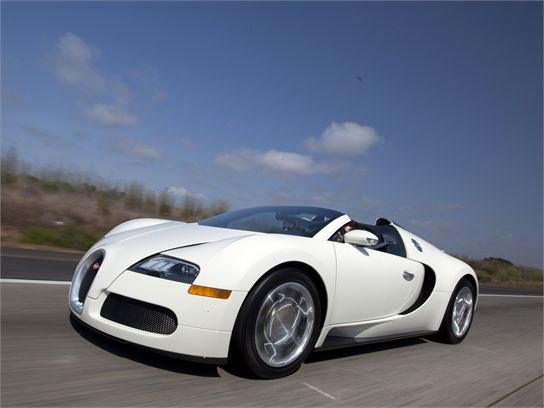
The Bugatti brand dates back to 1909 when Italian eccentric Ettore Bugatti set up shop in the German town of Molsheim, which is actually now part of France. Bugatti proceeded to build some of the world’s fastest, most technologically advanced cars, dominating Grand Prix racing in the 1920s and 1930s. The legendary marque languished under a succession of owners until 1998, when the Volkswagen Group purchased it and developed the Veyron 16.4, a 253-mph engineering marvel that set the new supercar standard when it debuted in 2006.
Page 3The Grand Sport
Now along comes the Grand Sport – essentially a Veyron coupe with a removable transparent polycarbonate roof panel. It’s powered by the same mid-mounted quadruple-turbo 8.0-liter W16 engine (essentially, two twin-turbo V8s sandwiched together). The only significant changes are under the skin: the Grand Sport’s two-piece carbon fiber chassis has been significantly reinforced to make up for the loss of rigidity when the roof panel is removed.
Page 4From the Outside
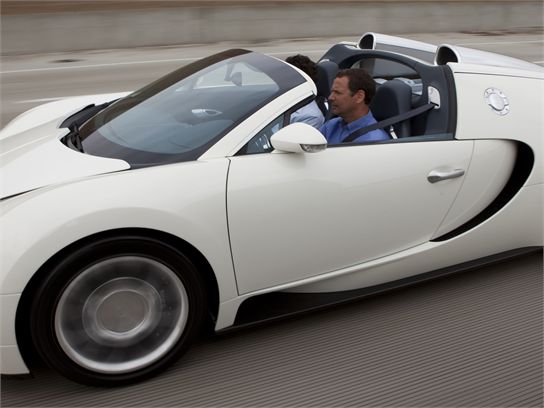
The Grand Sport is surprisingly handsome – “surprisingly” since many superexotics trade good looks for the jagged scoops and ducts needed to defy the laws of physics and provide the downforce to keep these land jets grounded. The Grand Sport’s smooth, pod-shaped profile is free of gaudy aerodynamic accoutrements. And while the Grand Sport retains the typical low-and-wide supercar stance, it’s also surprisingly compact (shorter than your typical midsize sedan). In fact, at first glance, you can’t help but think, “For a 1,001-hp beast, you don’t look so tough. In fact, you’re kind of cute…”
Page 5Get Comfortable
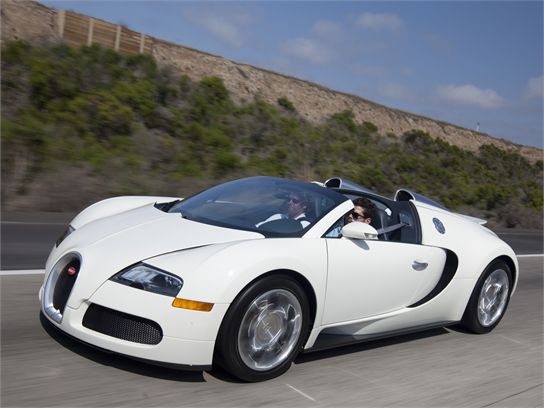
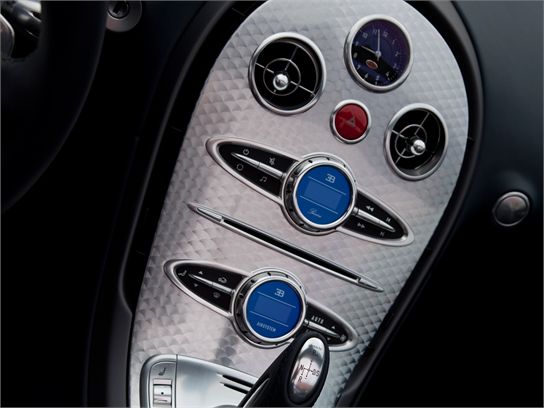
Swing open the carbon fiber door, contort your way into the low-slung cabin and you are greeted by the familiar sights and smells of a luxury performance car: finely stitched hides (reminiscent of those from VW stablemate Bentley) and sport seats fitted around a carbon fiber shell available in seven different shapes. A solid hunk of three-spoke aluminum anchors the center of the thick, leather-wrapped steering wheel. A plate of the same machined metal also covers the cascading center stack, which is stunning in its simplicity: a round clock; two air vents; and symmetrical controls for the audio and AC systems, respectively. And that stereo system? It alone costs $30,000, by the way.
Page 6Unleash the Beast
Starting the Veyron is a four-step process. Step 1) Foot on the brake. Step 2) Insert and twist the key (yes, even a $2 million car comes with the standard switchblade-style fob). Step 3) Press the starter button in the center console. Step 4) Summon the nerves of steel required to get over the fear that comes from knowing you’ve got 1,001 ponies under your right foot and one wrong move could set you back to the tune of the GDP of a small island nation. Ok then? We’re ready.
Page 7Behind the Wheel
The first big surprise of driving the Grand Sport is that the white-knuckle period fades fast. Ease the Grand Sport out into traffic, and the operative word is “ease.” In cars with a fraction of the Bugatti’s potential, a toe twitch can send you lurching forward. Squeeze the Grand Sport’s throttle and the seven-speed dual-clutch automated transmission seamlessly swaps cogs to keep the engine humming at a relatively placid 1,000 rpm. The ride quality is firm, though not punishing, and the steering is perfectly weighted. The brakes – powerful enough to bring this beast to a standstill from 253 mph in a few seconds – exhibit none of the low-speed grabbiness that plagues other carbon-ceramic brakes.
Page 8The Inevitable Crowd
In fact, at around-town speeds, the biggest challenge of driving the Grand Sport is safely navigating around other drivers angling for better looks, cell-phone camera vantage points and the chance to hurl their two cents at the driver. Typical comments range from curiosity (“Hey, what is that?”), to reverence (“Wow, that’s the Bugatti. Awesome!”), to our personal favorite: deification of the driver (“You’re a god, man!”).
Page 9How fast?
Speaking of the supernatural, let’s talk acceleration. Stomp the throttle from a standstill and the 14-inch-wide Michelins (specially designed for the Veyron) grip immediately thanks to all-wheel-drive. Things are normal for about a second, until the massive chrome air intakes above your right shoulder take a deep breath, the four turbos spool up without a hint of lag and that point on the horizon…? Yep – you’re there. Like that. We’d love to tell you how long it took to get to 60, but we honestly don’t remember. The only things we remember are flexing our right calf and the car’s windows rolling up. That happens at 100 mph to improve aerodynamics. And it all happened in about the time it takes to read these four words.
Page 10What $2.1 million Sounds Like
So the Grand Sport is fast. Really fast. So is the Veyron coupe. In fact, the latter might be a bit faster. Why pay the $300,000 premium for the convertible rather than spend it on, say, a perfectly good Ferrari 599 or a trio Porsche 911s? Two words: aural fixation. The Grand Sport’s open top gives you a front row seat to the sound of the 16 cylinders at work – and it’s captivating. At low speeds, it’s an engaging little cacophony of whistles, whines and whirrs of pistons and turbos at play. Pick up the pace, and the soundtrack takes on the tone of a semi truck bearing down on you. Trust us: you will find yourself checking the rearview mirror a massive silver grille and the word “Peterbilt.”
Page 11In case you forgot…
The Grand Sport is so mind-blowing capable that it is easy to forget how little of car’s potential you are using at any given time. Fortunately, it comes with a little reminder: a horsepower gauge in the lower-left corner of the cluster numbered zero to 1,001. At freeway cruising speed, the white needle is dangling limply around the 100 mark. Punch the throttle, say a quick prayer, and congratulate yourself for having the cojones to take a Bugatti Veyron “to the limit” and that needle tickles 500… maybe. This is why Bugatti offers a rigorous training program and a closed track to the customers who want to take their car to the limit. Without both, you can forget about finding out what this car is really made of.
Page 12Gripes about the Grand Sport?
Sure, we can think of a few. It’s built to run on racing fuel (93 octane or higher), which is not easy to find in a pinch. Then again, with a push of a button, the engine can be temporarily detuned to accommodate a lesser grade temporarily. True cost of ownership is truly staggering ($73,000 to replace the wheels every 30,000 miles or so). And the nav system is bananas: info is entered on a PDA device (think: pre-iPhone/Blackberry-era PalmPilot) stowed in a compartment between the front seats and displayed on a tiny screen in the corner of the rearview mirror that is impossible to see. Oh yeah, and price. But $2,100,000 is just a number, right?
Page 13Specs
2009 Bugatti Veyron 16.4 Grand Sport
Layout: Mid-engine, all-wheel-drive, two-seat convertible
Price: $2,100,000 (varies with exchange rates)
Engine: Mid-mounted, quadruple-turbo 8.0-liter W16
Transmission: 7-speed dual-clutch automated manual
Output: 1,001 hp at 6,000 rpm / 922 lb-ft. from 2,200–5,500 rpm
Top speed: 253 mph
0-60: <2.7 seconds
Curb weight: 4,339 lbs.
Wheelbase: 106.7 in.
Dimensions: 175.7 inches x 78.7 inches x 47.4 inches
Fuel Consumption: 8 mpg city / 14 mpg highway
Fast Fact: At its top speed of 253 mph, the Grand Sport’s 26-gallon tank will be empty after about 50 miles
Page 14About the Photography
Robert Kerian is a California-based photographer with an incredible talent for capturing the light-soaked dance between vehicle and road. A former assistant to Pulitzer prize-winning photographers Edie Adams and Nick Ut, Kerian has since established his own portfolio of work that encompasses everything from automotive advertising to portraits of racing legends John Force and Mario Andretti.
You can see more of Robert Kerian's photography at Robertkerian.com, We highly suggest you check it out.