Recent Articles
Popular Makes
Body Types
NASCAR: Track Gods to Showroom Stars
From Camry to Charger, the name's the same...but that's about it
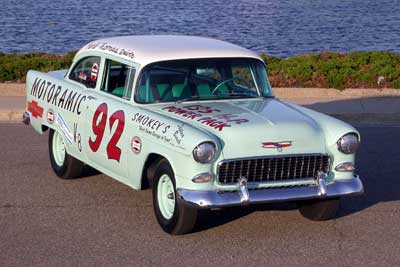
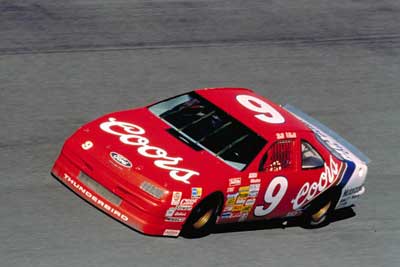
As a kid growing up in Maine, my favorite pastimes involved cars. My affinity for toy cars surely kept Matchbox and Hot Wheels in business, and my ability to identify vehicles based on just a passing glimpse was no doubt an example of unrecognized genius. And when it came to TV, it was racing on the weekends and anything with cars and car chases on the weekdays, like the “Dukes of Hazzard,” “The Fall Guy,” and “TJ Hooker” (in “TJ Hooker’s” case, cars and Heather Locklear). To heck with the Boston Celtics and New England Patriots – I wanted to watch Dale Earnhardt, Geoff Bodine, and Bill Elliott go around in circles 200 times. That was back in the early 1980s, when the sport that had become NASCAR was more than 30 years old, but still offered fans a clear indication of what cars they were watching. Most viewers could decipher that Bill Elliott drove a Ford Thunderbird, not just because they knew that the #9 car was a Ford, but because they could see that it was a Thunderbird. It had the T-bird grille, the actual T-bird shape, and even the indents for the quad headlight setup – you could easily envision the transformation of your ‘Bird in the driveway to Bill’s ride, albeit with slick racing tires and a beefy roll cage. The same went for Earnhardt’s and Bodine’s Chevys, and it was even more the case in the sport’s early years, when the race car looked exactly like a production, or stock car, with taped headlights and a number painted on the doors. Times have changed. Whereas before you could buy something that resembled a car from the track, today’s Nextel Cup racers all pretty much look the same, save for the stickers on the front and rear that are designed to mimic the styling of the production versions. Nowadays, fans know the cars based on the number and the driver or a chance glimpse at the brand badge on the grille. As a last resort for those new to the sport, or simply the brand loyal, NASCAR cars now clearly spell out what you’re looking at – Monte Carlo, Fusion, Charger, or, gulp, Camry – on the front air dam. Hard to see at 180 mph, but I digress. Yeah, that’s right – as every NASCAR fan knows by now, Toyota has entered the heralded hall of stockcar racing with its mass-marketed family sedan. It’s not just from a visual perspective that the chasm between street car and race car has deepened. While engine power varies depending on the type of race and track, NASCAR engines regularly produce up to 800 horsepower, measure about 350 cubic inches, and can run at 9,500 rpms. These gains come from the use of carburetors versus fuel-injection systems, the lack of mufflers and catalytic converters, and unique engine components, though the blocks can usually be bought off of the shelf from your local dealer. The tradeoff for this power is a race engine that’s spent within 800 miles, gets anywhere from three to eight miles-per-gallon, and carries a replacement cost of roughly $60,000. On second thought, maybe it’s just as well that NASCAR drivers have their cars and we have ours. Detailed on the following pages are the rides of a few of the NASCAR champions from 1985 to 2006, as well as each car’s corresponding production version, or in the case of the Ford Taurus, some thoughts on the lack of a production version.
1985
Our overview of the winning cars of NASCAR starts in 1985, when Darrell Waltrip wrapped up his second straight championship in a Chevy Monte Carlo. Back in those days, fans could still see some resemblance between what Waltrip and Earnhardt were driving in Daytona and the Monte Carlo that Tom, Dick and Harry could buy from their local bowtie dealers. NASCAR required that the race cars wear the same sheetmetal as the grocery-getter versions on the street, and it was because of that fact that GM engineers created a new Monte Carlo model in 1983. To be competitive on high-speed tracks, race teams needed a more aerodynamic car, so Chevy dealers welcomed the new Monte Carlo SS with its prominent front air dam and rear spoiler, features that soon found their way to the body shops of NASCAR. With aerodynamics in their favor, Chevy drivers found themselves and their Monte Carlos in the winner’s circle quite a bit during the early 1980s. Terry Labonte brought it home for Chevy in 1984 and Darrell Waltrip did the same in 1985. Fans interested in driving their own Monte Carlo could choose from the V6 or V8 coupes, or the SS model. Prices ranged from about $9,000 to more than $11,000 and horsepower was a meager 130 with the V6 and maxed out at 180 from the SS’s 305 cubic-inch V8.
1986
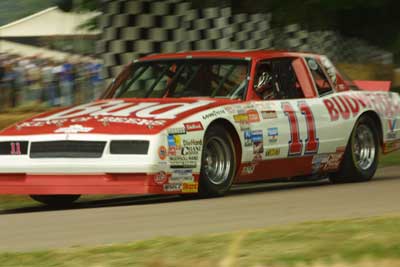
Despite the improvements offered by the 1983-1985 Monte Carlo SS, Chevy found itself again needing to up the aerodynamics factor in 1986 to compete with the fluid lines of the Ford Thunderbird. The solution was called the Monte Carlo SS Aerocoupe, which was basically the same car with a sloped rear window that was designed to reduce drag and, consequently, increase track speed. It was a plan that obviously worked, as evidenced by Dale Earnhardt winning the Winston Cup championship in 1986 and 1987, both times in an Aerocoupe. Though they were abundant on the race track, Aerocoupes were much harder to spot around town. For 1986, Chevy limited the Aerocoupe run to 200 vehicles, and 1987 production reached just over 6,000 units. But that was it for the Aerocoupe, which never saw the 1988 model year, and it wasn’t long after that the Monte Carlo also met its demise, albeit temporarily. While it lasted, the Aerocoupe sold for about $14,000 and delivered 180 horsepower from its 305 cubic-inch V8.
1988
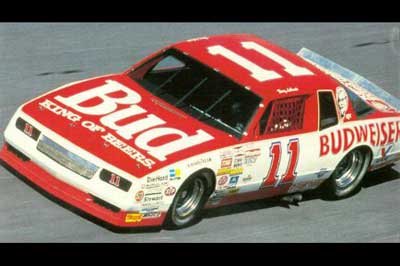
Bill Elliott and his Ford Thunderbird put an end to Chevy’s fantastic run with its Monte Carlo. It was during the 1988 season that Million Dollar Bill Elliott won six races and finished in the top ten an impressive 33 times. Times have changed since then – Bill now straps into a Dodge and the Thunderbird he left behind has been absent from the NASCAR scene for years. But in 1988, the T-Bird was a four-passenger, two-door, rear-wheel-drive coupe offered with one of three engines in four trims: Base and LX models featured a 140-horsepower, 3.8-liter V6 with 215 lb.-ft. of torque; Sport models were powered by a 155-horsepower, 5.0-liter V8 with an impressive-for-the-day 265 lb.-ft. of torque; and the memorable Turbo Coupe came with a turbocharged 2.3-liter four-cylinder engine good for 190 horsepower and 200 lb.-ft. of torque. Ford’s 1988 T-bird looked much like it had since its redesign in 1983, a year that marked the transition from a big, boxy coupe with concealed headlights to a much more aerodynamic, smaller coupe with the option of turbocharged power. Slight changes, including revised front and rear fascias, debuted for the 1987 model year. The price for driving the civilian version of Elliott’s #9 Coors Thunderbird ranged from about $13,000 for the Base model to more than $17,000 for the Turbo Coupe.
1989
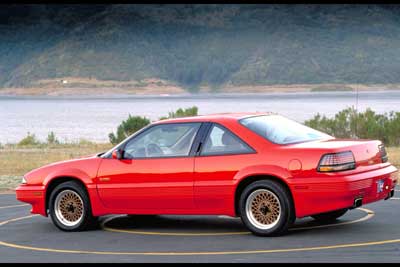
Back in 2005, Rusty Wallace was in The Chase to capture his second NASCAR championship, and what a great way it would have been for this veteran to not only end an impressive season, but also close the door on a remarkable driving career. It didn't happen, and Rusty has since moved on to other pastures. Wallace first took home the Cup in 1989, back when Winston’s tobacco filled the coffers rather than Nextel’s wires. Today, this 49-year old drives a Dodge Charger, but before that it was a Ford, and in 1989 it was a Pontiac Grand Prix. Prices for the 1989 Pontiac Grand Prix started at about $13,000 for the Base sedan, which shared a 130-horsepower, 2.8-liter V6 and five-speed manual transmission with the LE and SE coupe models, NASCAR fan favorites that were priced at $14,000 and $16,000, respectively. In the middle was the Base sedan with an automatic transmission and a 140-horsepower, 3.1-liter V6, which set buyers back $14,000.
1990
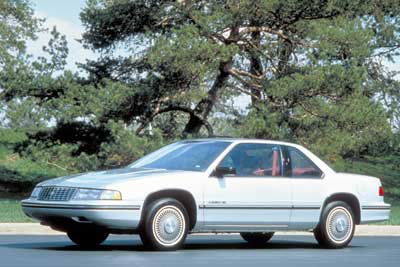
Drivers of the Monte Carlo SS stock car enjoyed a lot of success throughout the early and mid 1980s, but that chapter ended in 1988, the year that Bill Elliott and his Ford Thunderbird raced to the top of the rankings. The nail in the coffin came in 1989, when Chevrolet erased it from the menu. With the demise of the mighty Monte, Chevy filled the void with a new model called the Lumina, available with two or four doors. With a six-cylinder engine powering the front wheels, the bulbous Lumina paled in comparison to the rear-wheel drive, V6- or V8-powered Monte Carlo, but that didn’t keep it from winning more than its share of NASCAR races. After a brief two-year hiatus, Chevy was back on top in 1990 with a Lumina driven by none other than Dale Earnhardt. It was a scenario that was to become familiar with NASCAR fans, as the Intimidator drove a Lumina to the championship again in 1991, 1993, and 1994. It was a great run, not only for Earnhardt and his fans, but also for Chevy and its new Lumina. The version sold to the masses stickered for between $13,000 and $14,500, with all models powered by a 135-horsepower, 3.1-liter V6 that offered 180 lb.-ft. of torque.
1992
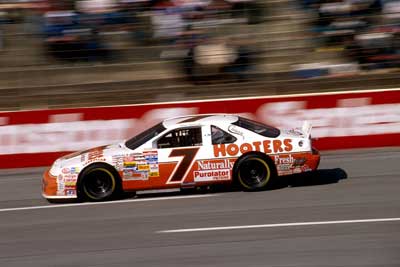
Ford hadn’t found itself with a Winston Cup title since 1988, but the company’s losing streak was broken in 1992 when Alan Kulwicki drove his Thunderbird to victory. Gone was the T-bird driven to success in 1988, having been replaced in 1989 by a bigger ‘Bird with a longer wheelbase. Between the years of 1989 and 1993 the Thunderbird was offered in trims ranging from the Base to the Super Coupe, a sport model that featured a 215-horsepower, supercharged V6 and styling cues including a body kit and dual exhaust tips. A 302 cubic-inch V8 was offered for the 1991 model year, while a full-length taillight was added for 1993. The 1992 season marked not only the first time Alan Kulwicki would take home the Cup, but also the last time a Ford Thunderbird would be driven by a champion. Time will tell if NASCAR and the historic T-bird will cross paths once again, but for now, Ford is represented on paved ovals around the country by a Taurus.
1995
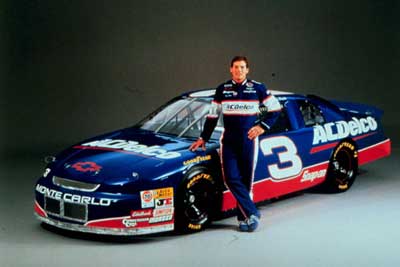
Jeff Gordon made his presence known in 1995 with a championship win in an old driver and fan favorite, the Chevrolet Monte Carlo. With four winning seasons between 1990 and 1994, the Lumina had served NASCAR drivers well, but the production model, the one that you and I could buy, was ready for an update. For 1995, Chevy offered a Lumina with all-new, rounder styling, and only four doors – two-door versions of the same car wore the Monte Carlo badge and were powered by either a 160-horsepower 3.1-liter V6 or a 210-horsepower 3.4-liter V6. With that reintroduction, a NASCAR veteran nameplate found its way back to the track. What Jeff Gordon unwittingly started in 1995 would become a string of Monte Carlo championships spanning four years. Terry Labonte followed through with his Monte Carlo in 1996, with Gordon back to receive the prized cup in the 1997 and 1998 seasons.
1999
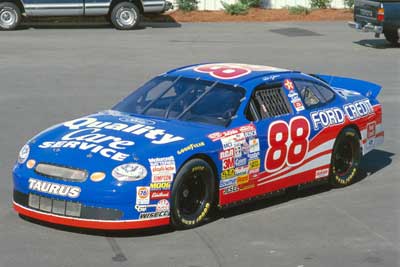
The year 1999 held tremendous significance for three reasons. First, it was a 365-day buildup to the turn of the century, a time when our thoroughly computerized society was supposed to have crashed into chaos, creating a scenario where was ineffective and rebooting was not an option. Second, it was the first time ever that a driver drove a nonexistent car down the road to the Winston Cup championship. We’ll get to the third reason in a moment. The last time a Ford driver claimed the Cup for his own was in 1992, when, at the end of the season, Alan Kulwicki found himself lapping the competition in his Thunderbird. However, the T-bird’s wings were clipped in 1997, leaving a void in the Ford garages behind pit lane. Hence, the two-door Taurus was born, a car raced under the lights on Sundays by the likes of Dale Jarrett, yet was conspicuously absent from your local blue oval dealer. The decision to reserve the two-door Taurus for the track makes sense – the rental car market was already saturated with four-door Tauruses, and two-door versions might not have been considered “hot ticket” items. And that brings us to our third point regarding the importance of 1999 – it was the most obvious sign that the era of “Win on Sunday, sell on Monday” was over. Granted, the divide between race car and street car had expanded exponentially over the years, but never before, so far as we can remember, had a car existed on one side of the track wall but not on the other.
2000
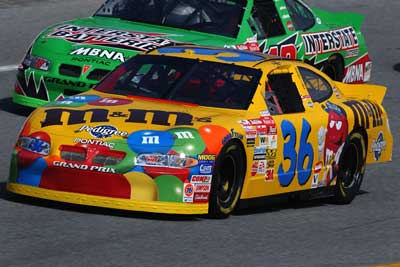
Since last sitting in the winner’s circle with Rusty Wallace in 1989, the Pontiac Grand Prix had gone through more than a few changes. The 1990 model year saw the introduction of a 205-horsepower Turbo coupe and an STE model, ’91 brought us the GT coupe, and 1992 marked the first freshening of the Grand Prix. That particular style lasted until 1996, during which time the lineup was cut to the SE coupe and sedan and up to 215 horsepower became available. The next-generation Grand Prix lasted from 1997 until 2003, accented by more aggressive styling, a new wide-track chassis setup, and up to 240 horsepower. It was this version on which Bobby Labonte’s 2000 NASCAR championship Grand Prix was based, as well as the 2002 model driven to the top of the points ladder by Tony Stewart. A new version of the Pontiac Grand Prix was yet again released for the 2004 model year, at which time much of the production car’s plastic body cladding was removed, the overall design was made even more aggressive, and available power peaked at 260 ponies. Finally, the 2005 model offered a 5.7-liter V8 with 303 horsepower, much to the pleasure of NASCAR fans everywhere. For 2008, the Grand Prix will be replaced by the Australian-bred G8, a rear-drive tire shredder slated to be available with a 362-horsepower Corvette engine.
2001
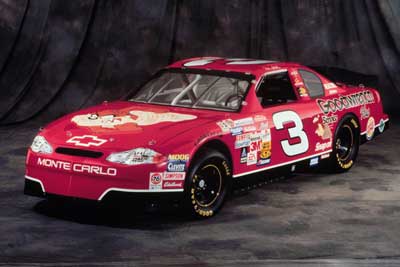
It had been three long years since the Chevrolet badge was at the head of the NASCAR pack, which was, coincidentally, the same period of time that Jeff Gordon had been off the pace. That all changed in 2001 when Gordon, driving a stickered stock car meant to resemble the updated Monte Carlo, found his way to the winner’s circle once again. The Chevrolet Monte Carlo had been transformed for the 2000 model year and race season. Carried over from 1999 was the lower LS trim, but the base 160-horsepower, 3.1-liter six-cylinder engine was replaced by a 3.4-liter six shooter putting out 180 horsepower. The top-tier Z34 model was ditched for the new Monte Carlo SS, though both were powered by the same 3.8-liter V6 with 200 horsepower and 225 lb.-ft. of torque. Unlike Gordon and his #24 Chevy, everyday Monte Carlo drivers were shifting gears through a four-speed automatic. Underneath the new skin were additional body and suspension reinforcements to improve ride and handling characteristics.