Recent Articles
Popular Makes
Body Types
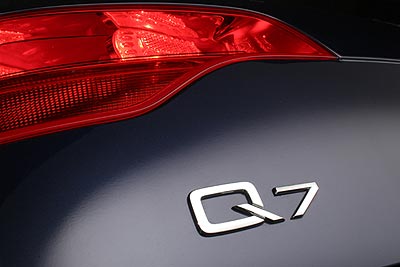
2007 Audi Q7 Review
Good. Very good. But maybe not $70,000 good
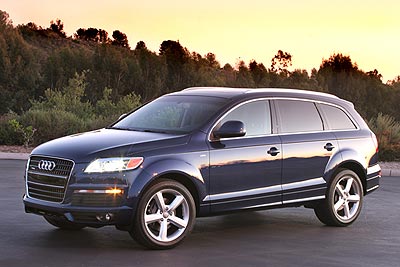
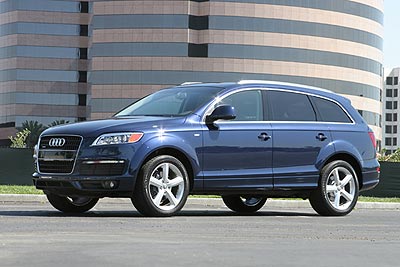
Audi Q7 – Review: Luxury vehicles are sometimes a lesson in diminishing returns. Any car, be it an econobox or a Bugatti Veyron, can get you from A to B. Luxury cars are supposed to do it with an amount of flair, style, performance and sophistication that matches their price. The Audi Q7 has the panache factor, with a 4.2-liter V8 engine, lavish interior loaded with features, and styling with a definite punch, and it certainly has the luxury price: Our loaded test car came out to around $68,500. That’s where the diminishing returns come in. We recently drove an Acura MDX with a sticker price that was about $48,500, and during our time in the Q7 we couldn’t figure out why this Audi was supposed to be $20,000 better than the Acura.
What We Drove
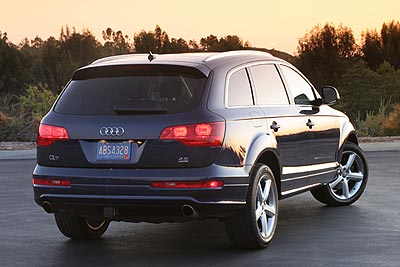
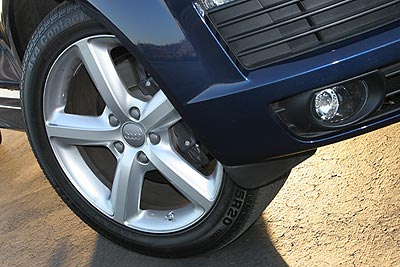
The Q7 shares the Volkswagen Touareg platform, its wheelbase stretched 5.8 inches for a third row of seats. Our Q7 4.2 Premium’s base sticker of $60,710 – with the $720 destination charge – included the 4.2-liter V8 engine and six-speed Tiptronic automatic, a DVD navigation system with Audi’s Multi Media Interface (MMI), and luxury necessities such as eight-way power and heated front seats, a power tailgate, leather upholstery and electric tilt/telescopic steering wheel. The S Line package on our car included 20-inch wheels, a three-spoke steering wheel, S Line-specific grille, aluminum interior trim and S Line badges. The air suspension was $2600, and adaptive cruise control added $2,100. The $550 towing package and the $500 Audi Side Assist – a blind-spot aid – brought the total to $68,520.
Performance
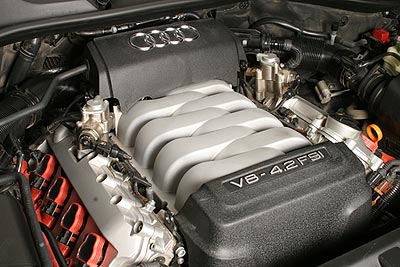
The 4.2-liter V8 engine under the Q7’s hood sings out 350 horsepower and 325 lb.-ft. of torque. It sounds good on paper, but while the engine is willing the flesh is portly: Tony Robbins would have trouble motivating the Q7’s whopping 5,467 pounds. The feeling of gutlessness is exacerbated by the V8’s lack of low-rev torque. It springs to life in the upper 2500 rpm, and that’s where you want to keep it if you’re driving aggressively, but fuel economy goes out the window: we got a lousy 11.6 mpg. The Tiptronic automatic helps, with quick downshifts in automatic mode, but we were disappointed with its manual mode. It upshifted at redline, and it doesn’t match revs on downshifts.
Handling
We may have our complaints with the powertrain, but not the handling. It drives like an Audi should, albeit a very heavy one: You feel the bulk in quick transitions as the steering works to move the mass from one direction to the other. Otherwise there’s easily controllable understeer at the limit, excellent brakes and the surefootedness of quattro. The air suspension’s off-road mode lifts the Q7 9.4 inches above the ground, providing ample ground clearance for light-to-medium duty excursions; if you don’t need a low range, the Q7 can likely handle it. When you’re on the road, the comfort setting smooths out bumps, but Audi’s impeccable road manners squashes any hint of float or wander.
Visibility
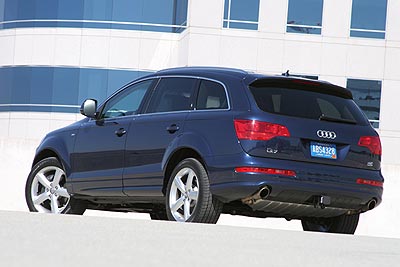
The Q7 boasts a big, airy greenhouse, with thin pillars and oversize outside mirrors that make maneuvering simple. That is, if you’re by yourself and have all the headrests folded. With the headrests up, rearward visibility vanishes, and if you have people or child seats in the third row, you can basically ignore your rear view mirror. Audi’s Side Assist blind spot helper is redundant: Every time it warned us about a vehicle, it was easily visible in the big side mirrors. In front, the hood slopes away quickly for easy parking and off-road maneuvers. When reversing, the MMI screen shows the world behind, along with an on-screen indicator that shows where the car will go as you turn the wheel.
Fun to Drive
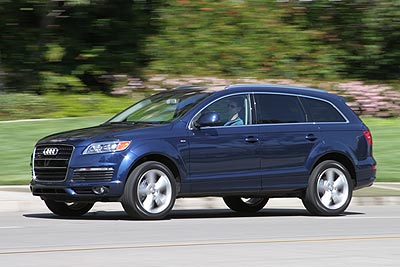
Any enthusiast will enjoy driving the Q7. The handling is very good considering its size and weight, and it’s obvious that Audi has biased the Q7 toward handling, with off-road ability a secondary concern. The engine and transmission are very good, even if they don’t make the Q7 fast. However, you are aware of the vehicle’s mass at every turn. Even the sharp steering and sorted suspension can’t hide the fact that it weighs roughly 1,000 lb. more than the relatively nimble Acura MDX. Take the Q7 down a bumpy trail and it rewards there, too, as long as you don’t tackle more than a rugged fire road, soaking up ruts and rippled dirt roads with aplomb.
Front Comfort
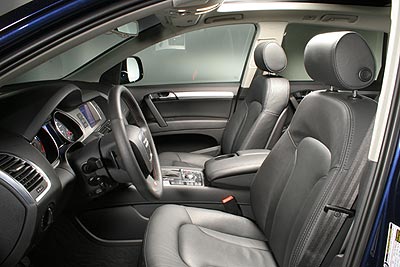
The Q7 feels a lot like an Audi sedan in front, not surprising considering that the gauge panel is taken virtually intact from an A6. This is good in that it’s a great driver’s seat with plenty of support from the bottom, back and to the sides. We drove this car for a solid two hours without a single cheek shift, pretty darn impressive. There’s plenty of head room, and leg room is plentiful, too, but it feels surprisingly intimate. Maybe it’s the closeness of the center console, maybe it’s the closeness of the dash itself, maybe it’s the usual Audi black-on-black-on-black interior décor, but for some reason we felt slightly claustrophobic in the Q7.
Rear Comfort
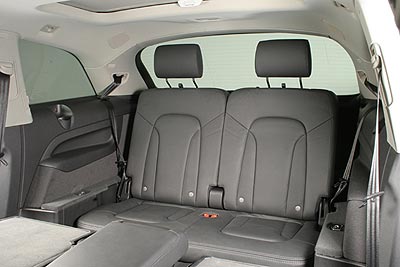
The second row in the Q7 is no penalty box by any means. There’s very good foot, leg and head room for both occupants, and their kneecaps probably will never tell them the front seatbacks are hard plastic. The generous second row console is also handy, and its lid can be raised for an armrest. The third row, however, is a tight, cramped, hard-to reach joke that makes us wonder why Audi even bothered to add it. An average sized adult will beg for mercy after just a few minutes, and even kids will have a tough time, especially if they’re still in booster seats.
Interior Noise
Compromises exist everywhere, even in German luxury cars, and the 20-inch tires on the Q7 are a perfect example. They contribute greatly to the Q7’s excellent handling, but they also contribute to a great deal of the road noise we heard, thumping over every expansion joint, singing loudly on concrete and even asphalt roads. Wind noise is well controlled except around those big outside mirrors, and the rumble of the V8 is clearly audible at any speed save idle. None of the noises are particularly bad, just louder than we expected. If you think the Q7 is strictly a luxury car it’ll get on your nerves, but we think it’s all part of this crossover’s sporty character.
Loading Cargo
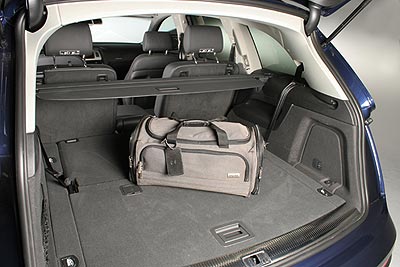
The Q7’s load floor is surprisingly high, and oly a minuscule 10.9 cu. ft. of cargo area if you’re trying to use the third row, not even enough for a standard grocery store haul. Fold the third row down and cargo area expands to 42 cu. ft., with a nice flat floor to boot. The second row also folds down flat for a total of 72.5 cu. ft. of cargo room. The cargo cover can only be used with the third row folded; put the seats up and you have to remove the whole cover, an unexpected oversight in this car’s design. The power liftgate can be opened remotely and closed with a push of a button.
Build Quality
Audi build quality is generally the best we see, and the Q7 is no exception. Despite our finest tooth comb, we couldn’t find one out of place panel or misaligned piece of trim. All the exterior panels feature tight gaps that lend to the car’s all-of-a-piece feel. The interior trim is matched perfectly, with the grain of the leather matching the door panels and dash, even though the latter are molded rubber and not cowhide. The aluminum trim pieces all fit beautifully, too. This is an interior that even obsessive nitpickers like us can live with.